

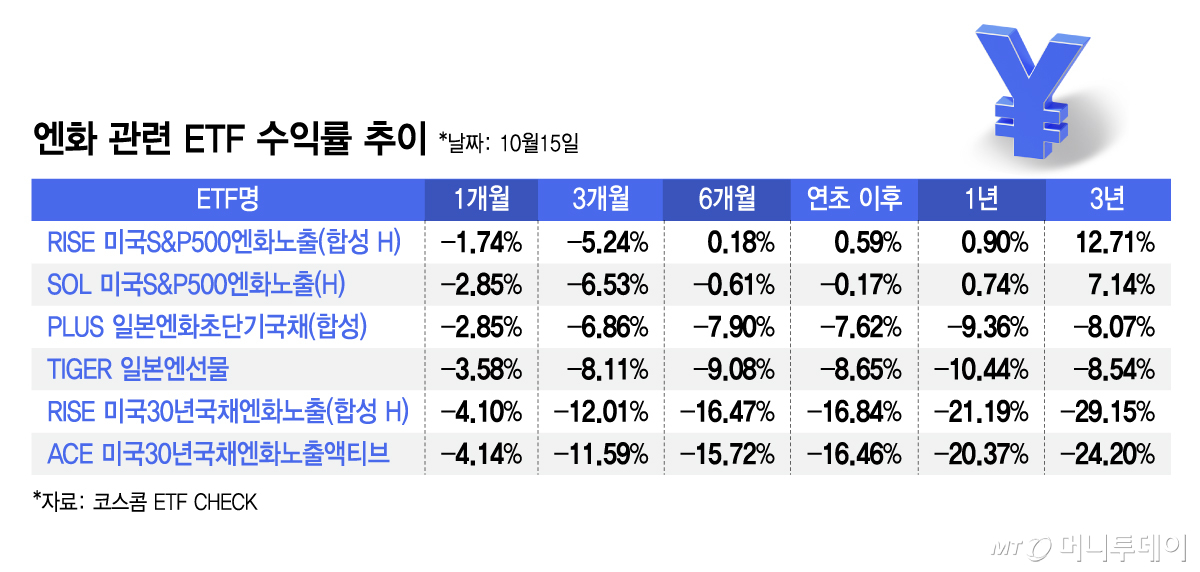
As the yen's weakness deepens, exchange-traded funds (ETFs) that invest in the yen or are exposed to the yen exchange rate are suffering losses one after another. This is because the won/yen exchange rate has fallen to the 830th-won range per 100 yen, marking its lowest level in approximately 18 years. The one-month return of 'TIGER Japan Yen Futures' was -3.58%, recording the largest decline among yen ETFs.
According to Investing.com on the 15th, the won/yen exchange rate fell as low as 839 won per 100 yen intraday on the 12th. This is the lowest level since January 2008, just before the global financial crisis fully unfolded. Since early August, the won/yen exchange rate has consistently remained below the 900th-won mark, plunging by approximately 6.3% in about two months.
The securities industry cites the strength of the U.S. dollar as a factor behind the yen's weakness. Rising international oil prices and solid employment indicators have combined to intensify inflationary pressure. Consequently, the likelihood that the Federal Reserve System (Fed) will raise its base rate in October, following its September hike, is increasing. In particular, the consumer price index (CPI) for September, released on the 14th (local time) by the Bureau of Labor Statistics under the U.S. Department of Labor, rose 3.7% year-on-year, slightly exceeding market expectations of 3.6%.
In contrast, the pace of monetary tightening by the Bank of Japan (BOJ) has fallen short of market expectations. Although the BOJ raised its base rate by 25 basis points (1bp = 0.01 percentage point) in September, it was revealed that two out of nine committee members opposed the hike. With no clear signal regarding further increases, views have gained traction that the interest rate gap between the U.S. and Japan will widen. As the investment appeal of dollar assets, which offer higher interest income than the low-yielding yen, grows, pressure on the yen to weaken has intensified. Additionally, the won strengthened due to factors such as strong September export indicators, causing the won/yen exchange rate to fall.
Amid the yen's weakness, returns for ETFs investing in the yen have also been sluggish. According to KOSCOM ETF CHECK, the one-month return of 'TIGER Japan Yen Futures' was -3.58% as of that day. Even among products tracking the same U.S. index, those invested in yen rather than dollars showed lower returns. While 'RISE US S&P 500' recorded a return of 0.22%, 'RISE US S&P 500 Yen Exposure (Synthetic H)' showed -1.74%, creating a gap in returns.
In ETFs holding U.S. ultra-long-term government bonds denominated in yen, losses have increased as rising bond yields are compounded by the weak yen. Bond yields and bond prices move in opposite directions; when yields rise, prices fall accordingly. 'RISE US 30-Year Treasury Active' showed -1.57%, while the yen-exposed product 'RISE US 30-Year Treasury Yen Exposure (Synthetic H)' recorded -4.10%, widening the difference.
However, opinions are emerging that a rebound is possible given that recent yen weakness has reached excessive levels. Analysts suggest that the value of the yen could gradually recover by the first half of next year, as the Bank of Japan is highly likely to signal further interest rate hikes at this month's monetary policy meeting in an effort to normalize its monetary policy. Woo Hye-young, a researcher at LS Securities, stated, "Recent yen weakness is largely due to changes in the external financial environment, such as U.S. interest rate hikes and dollar strength, rather than issues with Japanese economic indicators," adding, "Factors supporting a stronger yen could take effect until the first or second quarter of next year, as long as the Bank of Japan continues its gradual interest rate hikes."

 in STOCK
