

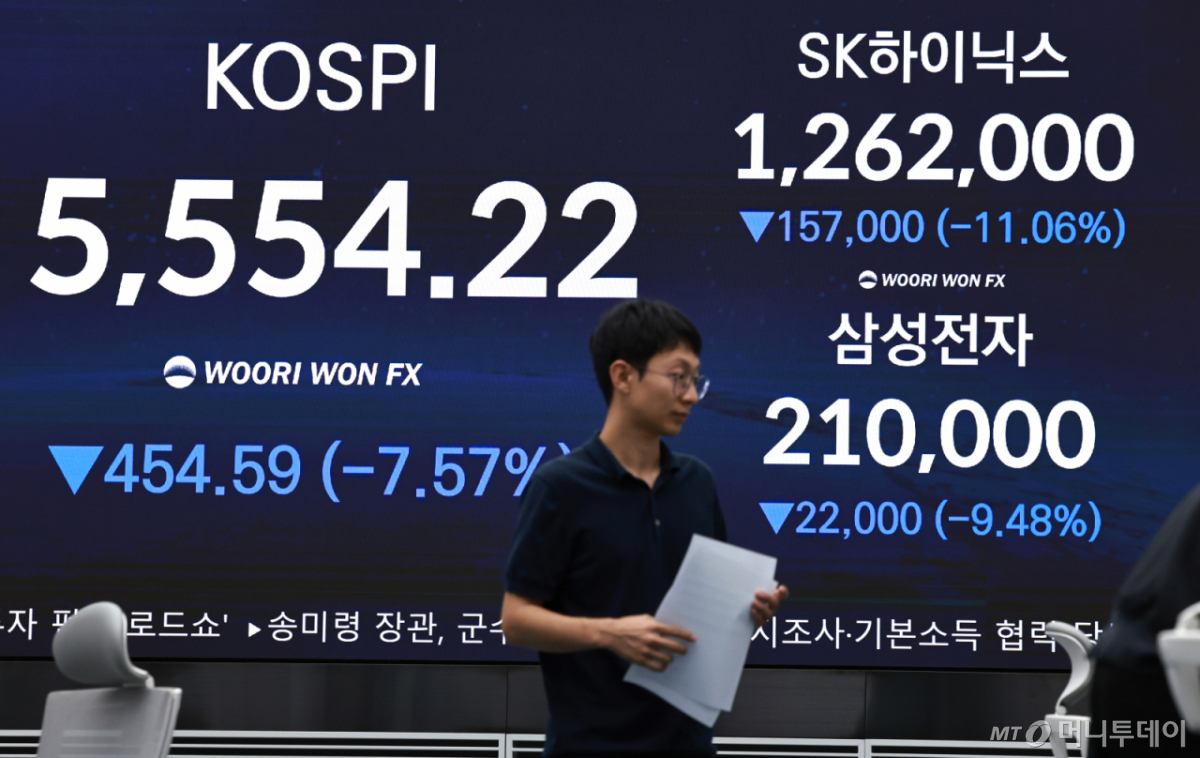
The securities industry has identified 5,000 as the first support line for the KOSPI. Although the KOSPI fell by more than 7% in a single day due to a shock from U.S. price indicators and arguments regarding the limits of investment in AI companies, analysts judge that there is little room for further decline given that the market has entered an unprecedented oversold zone.
However, they unanimously advised that rather than hastily declaring a bottom amid continued outflow by foreign investors, one should respond while confirming signals of a rebound.
The KOSPI plunged to the 5,500 range for the first time since July 30, but analysts said there was limited room for further declines on technical grounds.
Yoo Jong-woo, head of research at Korea Investment & Securities, said the index's short-term support level was 5,000, where its 12-month forward price-to-book ratio (PBR) stands at 1, adding that it would be difficult for the index to fall below book value in a high-return-on-equity (ROE) environment.
Yoon Seok-mo, head of research at Samsung Securities, also said the KOSPI 5,000 level was expected to serve as its first line of support, provided corporate earnings estimates did not begin to be revised downward in earnest.
At that level, the index's 12-month forward price-to-earnings ratio (PER) would be 4.1 and its price-to-book ratio (PBR) 1.1, both lower than during periods of market volatility in late March and late July, placing the index in deeply undervalued territory, he said.
Lee Jong-hyung, head of the Research Center at Kiwoom Securities, diagnosed that "because this is an unprecedented oversold zone, the probability of a rebound is higher than the probability of further decline, making it a phase to hold firm."
Analysts identified several key signals for a market rebound, including easing foreign net selling, the profitability and funding conditions of AI companies, renewed confidence in semiconductor earnings, interest rate trends following the U.S. Federal Open Market Committee (FOMC) meeting, and reduced political uncertainty after the U.S. midterm elections in early November.
Park Yeon-ju, head of the Research Center at Mirae Asset Securities, emphasized that "the most important condition for a rebound is the semiconductor industry outlook, specifically the reconfirmation of the sustainability of AI investment and semiconductor earnings resilience."
Park stated, "In the short term, it is important to see whether the utility of AI can be confirmed in the Big Tech earnings reports scheduled for late October, and in the medium term, whether revenue growth at AI companies such as Anthropic can strengthen again," adding, "Ultimately, since AI is a foundational technological revolution, the corporate valuation of beneficiary companies is expected to rise in the medium to long term, and diversified investment from a medium- to long-term perspective centered on global key players is recommended."
Kim Jung-soo, head of Research Division 1 at Mirae Asset Management, presented the following indicators to watch closely: △quarterly CAPEX (capital expenditure) guidance from AI hyperscalers △CDS (credit default swap) premiums for AI companies such as NVIDIA △trends in memory semiconductor prices △and 2027 guidance from major semiconductor companies.
The common advice from the securities industry is to avoid hasty trading until rebound signals are confirmed. This means that vigilance regarding volatility must not be relaxed. In a situation with significant macro uncertainty, such as high U.S. interest rates and inflation, as well as Middle East geopolitical risks, risk should be reduced through diversified investment.
Lee urged, "Even if a technical rebound appears after the sharp drop, it is advisable to respond with methods such as split buying while confirming trading volume, foreign supply and demand, and the stability of stock prices for large semiconductor stocks, rather than immediately interpreting it as a trend reversal," adding, "It is necessary to refrain from leveraged investments, keeping in mind the possibility of further expansion of volatility."
Yoon stated that "a risk-management-first strategy of maintaining cash positions and responding gradually after confirming the results of major events scheduled for late October to early November is desirable," adding, "Hasty bargain hunting or aggressive position increases should be avoided until foreign selling calms down and external uncertainties are resolved."
Yoo advised, "If holding cash, one can split-buy large blue-chip stocks such as semiconductors; if cash has been depleted, one should hold existing leading stocks and wait it out," adding, "However, averaging down through credit is prohibited."
Kim advised that "in a phase where delays in the interest rate cut path, dollar exchange rate volatility, and geopolitical risks overlap, an investment strategy focusing on earnings visibility and capital efficiency (ROE·shareholder return) is effective," adding, "It is effective to respond by focusing on sectors with relatively high earnings growth rates and visibility compared to the market, as well as sectors with high room for shareholder returns."

 in STOCK
