

Samsung Electronics has ushered in an era of 10 trillion won in quarterly operating profit, and the International Monetary Fund (IMF) raised its growth forecast for Korea to 3.3%, but the KOSPI remains sluggish. As earnings and share prices move in opposite directions, the KOSPI price-to-earnings ratio (PER) has fallen to historic lows. External uncertainties and selling by foreign investors are weighing on stock prices. The securities industry believes that a rebound in share prices will only be possible after confirming the long-term stability of semiconductor industry performance and easing global risks.
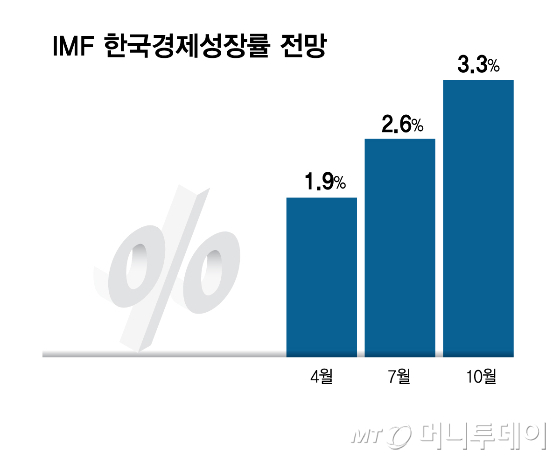
According to the financial investment industry on the 15th, the International Monetary Fund (IMF) raised its forecast for Korea's economic growth rate this year from 2.6% to 3.3%, an increase of 0.7 percentage points, in its World Economic Outlook released on the 12th. This significantly exceeds the upward revision of 0.1 percentage points for the global average and 0.4 percentage points for the advanced economy average.
Strong semiconductor performance and robust exports underpin the upward revision of the growth rate. The IMF analyzed that strong external demand for semiconductors is offsetting the negative impact of the Middle East war, driving Korea's economic growth.
In fact, Samsung Electronics recorded a record-high quarterly operating profit of 107.4 trillion won in its preliminary third-quarter earnings released on the 8th. This exceeded market expectations. Expectations for improved corporate performance, centered on semiconductors, have thus been reflected in the overall growth outlook for the Korean economy.
Despite simultaneous improvements in corporate earnings and economic growth forecasts, stock prices are moving in the opposite direction. In particular, as profit forecasts rise while share prices fall, valuations in the domestic stock market are rapidly declining. According to Kiwoom Securities, the forward price-to-earnings ratios (PER) for the KOSPI and the semiconductor sector have fallen to historic low levels of 4.6 times and 3.2 times, respectively.
The securities industry views whether the earnings growth trend will continue as a key variable for a stock price rebound. Analysts note that since investors are skeptical about future profits even in an undervalued phase, confidence must be secured regarding performance forecasts beyond 2028 to generate upward momentum.
Park Yeon-ju, head of the research center at Mirae Asset Securities, stated, "The most important condition for a rebound is reconfirming the sustainability of AI (artificial intelligence) investment and the resilience of semiconductor profits." He added, "In the short term, it is important to confirm the utility of AI in big tech earnings releases at the end of October, and in the medium term, whether revenue growth among AI companies such as Anthropic strengthens."
He further noted, "AI is a foundational technological revolution and a matter of survival for big tech companies, so the likelihood of continued investment is high." He added, "While the semiconductor industry outlook will remain solid over the next two to three years, it is also important from a share price perspective whether large-scale AI investments translate into actual profits."
Yoo Jong-woo, head of the research division at Korea Investment & Securities, also emphasized, "It appears we have entered a bottom zone," adding that "it is necessary to monitor the U.S. Federal Open Market Committee (FOMC) meeting scheduled for the 27th and 28th, and SK Hynix's earnings release on the 27th."
Easing global uncertainty is also cited as a condition for a rebound. Yoon Seok-mo, head of the research center at Samsung Securities, stated, "As U.S. 10-year Treasury yields surged to around 5.3%, the relative investment appeal of the Korean stock market has significantly declined." He added, "It is necessary to see a calming of net selling by foreign investors, easing of external macroeconomic uncertainty, and resolution of political uncertainty through the U.S. midterm elections in early November."

 in STOCK
