

KOSPI plunged over 7% as a shock from U.S. inflation indicators and debt issues at AI (artificial intelligence) companies came to the forefront. The decline was particularly steep compared with major U.S. indices, which fell only about 1%, and other key Asian markets such as Japan, Taiwan, and China, which dropped between 2% and 4%. Analysts diagnose that the domestic market is structurally sensitive to AI and semiconductor investment sentiment due to its high weighting of large-cap semiconductor stocks, and has become vulnerable to negative news as supply-demand gaps have widened in the second half. However, it is pointed out that current stock price levels represent an extremely undervalued zone.
On the 15th, the KOSPI index closed at 5,554.22, down 7.57% from the previous trading day. A direct blow was dealt when the U.S. September CPI (consumer price index) rose 3.7% year-on-year, exceeding expectations, causing the yield on 10-year U.S. Treasury bonds to briefly break through 5.3%. Additionally, doubts about the profitability of AI investments spread as the corporate bond yield of U.S. AI company CoreWeave exceeded 15%, leading to a sharp contraction in AI and semiconductor investment sentiment.
The structure concentrated in semiconductors and supply-demand imbalances are cited as reasons why the domestic market fell into panic alone. In fact, while the U.S. S&P 500 index and NASDAQ Composite Index fell by only 1.1% and 1.9%, respectively, on the previous day (local time, the 14th), the KOSPI index dropped by more than 7%.
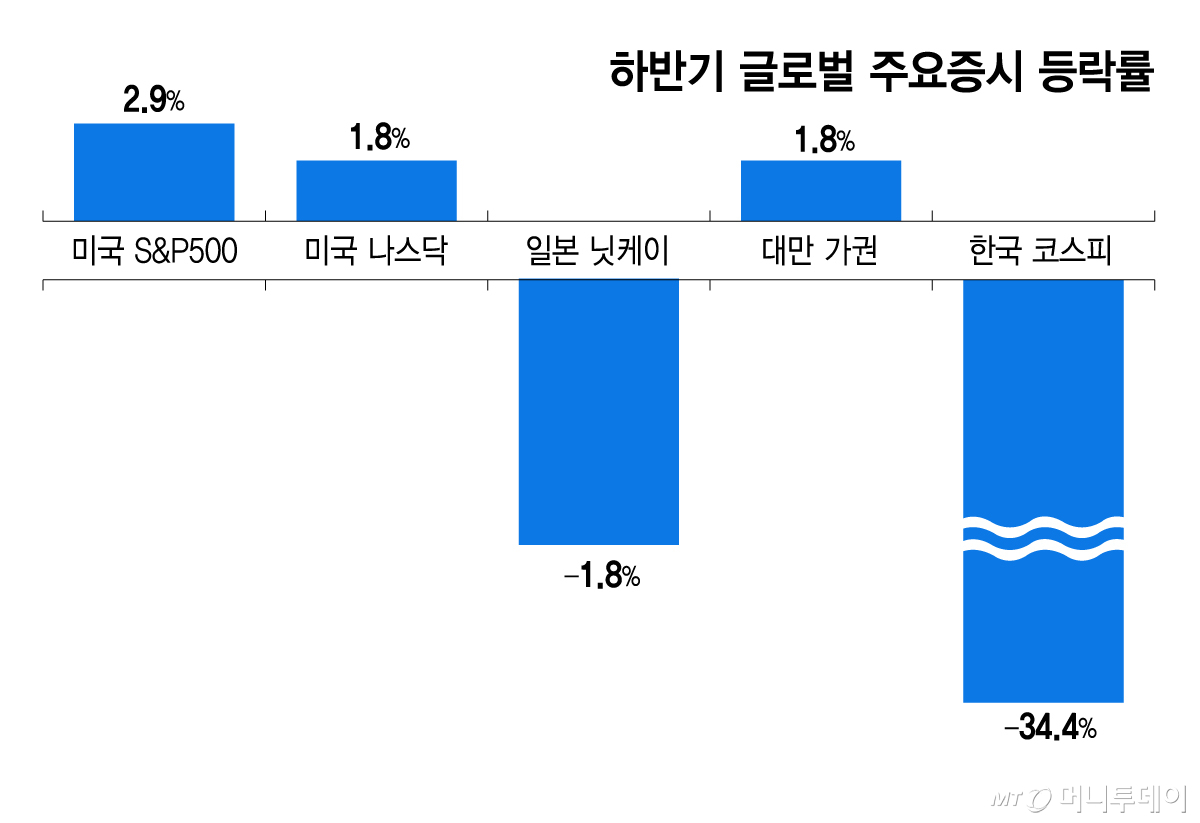
This trend has continued throughout the second half. The KOSPI index has fallen 34.5% since the start of the second half. Over the same period, the S&P 500 index and NASDAQ Composite Index rose by 2.9% and 1.8%, respectively, while the Taiwan Weighted Index increased by 1.8% and Japan's Nikkei index fell by 8%. This makes it the weakest performing among major national stock markets.
Yoon Seok-mo, head of the Research Center at Samsung Securities, explained, "The proportion of semiconductor companies such as Samsung Electronics and SK Hynix in the Korean stock market is very high," adding, "We received the shock from global doubts about the sustainability of AI investments more directly than other markets." Lee Jong-hyung, head of the Research Center at Kiwoom Securities, stated, "Recent adjustments in U.S. semiconductor stocks, controversies over AI investment profitability, and concerns about strengthening technological competitiveness among Chinese companies have been concentratedly reflected in domestic representative semiconductor stocks," adding, "Combined with outflows of foreign funds, the decline has expanded compared to major national markets."
From a supply-demand perspective, it is pointed out that the lack of entities to support the market makes it difficult to find clues for a rebound. Park Yeon-ju, head of the Research Center at Mirae Asset Securities, said, "While foreigners are taking profits in the memory semiconductor sector, which has high earnings volatility, there is no clear buying entity to support them." Since the start of the second half, foreign investors have made net sales of 56.4 trillion won in the KOSPI market. Over the same period, retail investors made net purchases of 19 trillion won, and institutional investors made net sales of 15 trillion won. Profit-taking demand following the sharp rise in the first half, coupled with increased preference for safe assets due to rising interest rates, led to concentrated selling in the Korean stock market, which had a high weighting within the MSCI (Morgan Stanley Capital International) Emerging Markets Index.
However, many opinions hold that current stock price levels are undervalued relative to fundamentals. Center Head Yoon Seok-mo said, "The KOSPI 5,000 line corresponds to a 12-month forward PER (price-to-earnings ratio) of 4.1x and a PBR (price-to-book ratio) of 1.1x, which is a lower undervaluation area than the volatility phases in March and July." It is judged that a rebound is possible if foreign net sales subside and external macroeconomic uncertainty eases. To gauge the timing of a rebound, key schedules and indicators to watch include the October FOMC (Federal Open Market Committee) meeting to check interest rate trends, U.S. midterm elections, Q3 earnings releases from U.S. big tech and semiconductor companies, memory semiconductor price trends, and 2027-2028 earnings guidance from major semiconductor companies such as Samsung Electronics and SK Hynix.
It is pointed out that while the semiconductor industry outlook will see steady growth in memory demand alongside AI expansion, there are also risk factors. Center Head Lee Jong-hyung stated, "Memory demand driven by AI infrastructure expansion is valid as a medium-to-long-term growth driver for the semiconductor industry," but added, "However, it is a phase where we must simultaneously check the sustainability of AI investments, profitability relative to investment, and the possibility of technological catch-up by Chinese companies."

 in STOCK
