

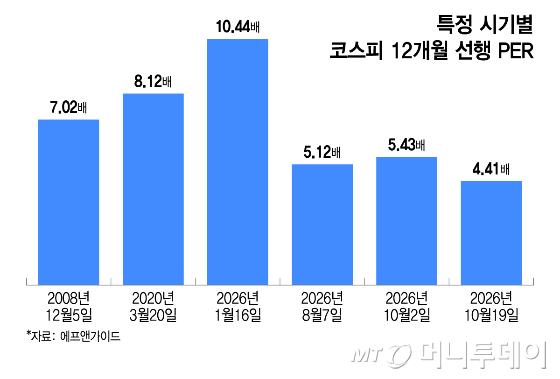
The KOSPI’s 12-month forward price-to-earnings (P/E) ratio has fallen to the 4th-fold range. This is lower than the 7th- to 8-fold levels seen during the global financial crisis and the COVID-19 pandemic. Some point out that the undervaluation is excessive, as external uncertainties and foreign investor outflows are weighing on stock prices more than earnings-generating capacity. Analysts argue that market confidence must be boosted and the government should respond appropriately.
According to financial information provider FnGuide and the financial investment industry on the 20th, the KOSPI’s recent 12-month forward P/E ratio stood at 4.41 times, a drop of more than one point from 5.43 times in early this month.
The forward P/E is an indicator calculated by dividing the current stock price by the expected earnings per share (EPS) over the next 12 months. A lower figure indicates that the stock price is valued low relative to the company’s projected earnings.
The current KOSPI forward P/E is at a historically low level. Even during the 2008 global financial crisis and the 2020 COVID-19 pandemic, the forward P/E was in the range of 7 to 8 times.
A key factor behind the decline in the forward P/E is cited as improved earnings forecasts for semiconductor companies. With growing expectations for AI (artificial intelligence)-related semiconductor demand and performance growth centered on Samsung Electronics and SK Hynix, the forward P/E for the semiconductor sector has fallen below 3 times. As stock prices have failed to keep pace with the rate of earnings growth, the overall KOSPI forward P/E has also declined.
It is not just semiconductors. The undervaluation in the domestic stock market is also evident in stocks outside the semiconductor sector. In fact, the KOSPI forward P/E excluding semiconductors was calculated at 10.3 times. Han Ji-young, a researcher at Kiwoom Securities, said, “The recent forward P/E excluding semiconductors represents a significant drop from this year’s high of 14.5 times and is also below the past 20-year average of 10.4 times.”
Ultimately, this suggests that the undervaluation of the domestic stock market is not merely a temporary optical illusion caused by the surge in semiconductor sector earnings, but is occurring across the entire market. The market analyzes that global interest rate spikes, geopolitical uncertainties, and foreign selling pressure are weighing on stock prices, even as expectations for earnings growth at major companies remain intact.
President Lee Jae-myung’s remark on the 19th at a press conference held in the Chun Chu Gwan of Cheong Wa Dae that “it is true that South Korea’s stock market is significantly undervalued” is also not unrelated to this domestic stock market situation.
However, a low P/E does not immediately lead to a rebound in stock prices. Opinions suggest that confidence in companies’ future earnings and improved investor sentiment must be supported. Kim Jae-seung, a researcher at Hyundai Motor Securities, said, “Doubts about the market’s future earnings are not resolved by 12-month forward forecasts,” adding, “There is a need for upward revisions to 2027 earnings forecasts and confidence in 2028 earnings.”
Calls for policy support are also emerging. Researcher Han Ji-young added, “To turn around weakened investor sentiment, it is now necessary for the government to put forward plans to stabilize stock market supply and demand, as they have mentioned.”

 in STOCK
