

"Once the VIX (Volatility Index) rises above 30, you should invest aggressively."
Choi Go-min-su (real name Park Min-soo), a stock investment expert and author, said this in an interview with Money Today’s securities-specialized YouTube channel, "Bukkumi – Ants Dreaming of Becoming Rich." He emphasized that one must step into the market when fear reaches its peak.
※You can watch the full interview video on the YouTube channel "Bukkumi – Ants Dreaming of Becoming Rich."
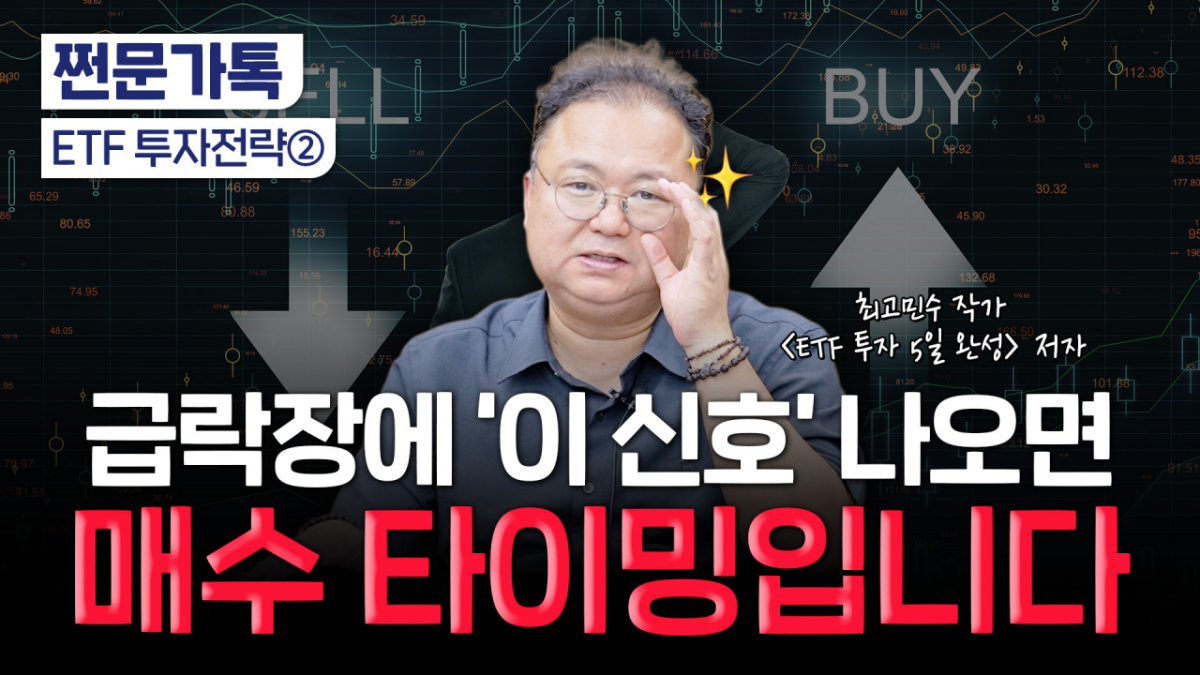
Q. What signals should investors pay attention to when investing?
▶Pay attention to the VIX index. This is a derivative product based on the expected stock price volatility of the S&P 500 over the next 30 days. Under normal circumstances, this index fluctuates between 15 and 20. Occasionally, it exceeds 30. I tell people that this is "the opportunity to turn your life around." It is a situation where fear is maximized. Once the VIX index rises above 30, it would be good to invest aggressively. In that sense, if you make trading profits, do not reinvest them; instead, convert them into cash and hold onto them. This can be done in various ways, such as through savings accounts that allow immediate withdrawal or foreign currency deposits. Therefore, when the VIX index exceeds 30, it is good to invest in attractive targets with cash. Also, if you invest aggressively when the VIX exceeds 30 and a circuit breaker is triggered, you can achieve significant profits. When the VIXX exceeds 30, that fear does not last even a month. The records over the past 20 to 30 years show this. If you really do not know what to buy, you can simply buy an active ETF that tracks the NASDAQ100.
Q. What strategy should be formulated for ETF investment?
▶I recommend the "4-4-2 strategy." Invest 40% in a representative index, another 40% in individual sectors, and the remaining 20% in covered call ETFs or other monthly dividend ETFs. You might ask what to buy for the representative index portion. I prioritize ETFs that track the NASDAQ100 first, followed by the S&P 500. I also consider the Philadelphia Semiconductor Index a representative index that competes with the NASDAQ100. Over the past 20 years, the S&P 500 has risen by nearly 500%. The NASDAQ100 has risen by about 1,800%. John Bogle, known as the father of funds, said this: "Do not try to beat the market; buy as many stocks as possible." This means you should aim to earn returns comparable to the market rate. However, it is very difficult to achieve returns higher than the market rate. Therefore, to earn returns close to the market rate, you should include as many good stocks as possible. That is exactly what an ETF is. I believe that most of the stocks that will become future game changers are included in the NASDAQ100. One more thing to mention: I recommend active funds over passive ones because active funds have achieved much higher returns in bull markets.
Q. Which individual sectors should be watched?
▶The AI (artificial intelligence) ecosystem is a hot topic, isn't it? Recently, with the release of Meta's "Muse," we are now in the era of AGI (general artificial intelligence). When a user asks a question, an AI similar to a human will apply its own judgment and continue running even if the computer power is turned off. It manages my schedule, does shopping, and handles Excel work for me. And AI still has a long way to go. It is reported that only about 2% of the total population subscribes to ChatGPT or Gemini. A market penetration rate of 2% means that about 98% of the market remains. The question is also which part of AI to invest in. I think the situation where supply falls short of demand in the memory industry will continue. It seems necessary to pay attention to areas such as robotics as well. We should pay attention to CPUs (central processing units).
Q. How do you view the domestic stock market?
▶The KOSPI has been doing well since last year, but excluding Samsung Electronics and SK Hynix, it does not seem that other sectors can compete with the global NASDAQ100. Therefore, from a long-term investment perspective, I think ETFs tracking the NASDAQ100 would be the best option. Since Samsung Electronics and SK Hynix themselves are in the memory industry, they have shown cycles of 2 to 3 years. There is currently great concern in the market about when the memory cycle will end. Also, challenges from Chinese memory companies continue. I believe that the NASDAQ100, which includes a diverse range of technology stocks, offers more stability for long-term investment than volatility centered on memory.

 in STOCK
