

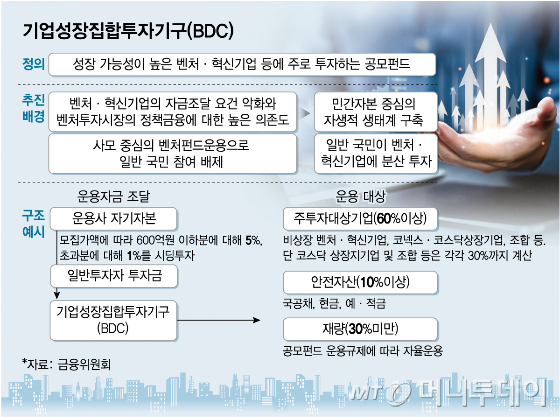
The move to allow securities firms to operate Business Development Companies (BDCs), which was initiated as government legislation four years ago but failed in the National Assembly, is being revived. The Korea Financial Investment Association has stepped up efforts to inform financial regulators and other stakeholders of the need for regulatory improvements. This follows the assessment that leveraging the investment banking (IB) capabilities of securities firms could expand the supply of venture capital to venture and innovative companies.
According to the financial investment industry on the 20th, the Korea Financial Investment Association has recently been in contact with financial regulators, the National Assembly, and others, explaining that securities firms should be included among the entities eligible for BDC operating licenses. Since amending the law also requires a decision from the Financial Services Commission, the initial aim is to broaden consensus on the participation of securities firms. A BDC is a listed public offering fund designed to enable retail investors to easily invest in unlisted venture and innovative companies.
The Financial Services Commission included securities firms as BDC operators in its 2022 government-proposed amendment to the Capital Markets Act. However, during deliberations in the National Assembly, concerns over conflicts of interest arising from the concurrent operation and sale of funds were raised, leading to the exclusion of securities firms. Consequently, when the BDC system was implemented last March, operating entities were limited to 42 comprehensive asset management companies with public offering fund management qualifications, venture capital companies (VCs), new technology business finance providers (new tech finance providers), and others.
The BDC market remains in its infancy. To date, the only BDC launched is Shinhan Asset Management's "Shinhan Innovative Business Growth Investment Trust No. 1," which targets professional investors. Even if a BDC operator raises funds at the minimum target amount of 30 billion won, it must invest at least 1.5 billion won of its own capital (proprietary assets). Furthermore, it is required to hold the investments for a period longer than either "five years" or "half of the maturity (up to 10 years)," whichever is longer. Asset management companies have relatively small amounts of proprietary capital, and VCs and new tech finance providers are subject to additional requirements such as track record and assets under custody, resulting in a significant burden for participation.
The industry forecasts that securities firms equipped with IB capabilities can open up a path for the BDC market. Unlike typical listed stock investments, BDCs require IB capabilities, such as negotiating investment terms with unlisted companies, purchasing securities, or providing loans. For securities firms, BDCs also represent a new source of revenue. While major securities firms are increasing venture capital supply through issued notes and Integrated Investment Accounts (IMA), small and mid-sized securities firms can also enter the venture capital sector by using BDCs to combine public offering funds with their proprietary capital.
A financial investment industry official evaluated, "Securities firms possess expertise across the entire IB spectrum, including fund raising, management, disclosure, and initial public offerings (IPO), and have large amounts of proprietary capital, enabling them to raise substantial funds." The official added, "Venture company investments carry high risk, making investor protection crucial. Among financial institutions, securities firms have the highest level of investor protection systems in place."
Increased BDC operators through the participation of securities firms could also serve as a "timely rain" for the VC industry. In a situation where the IPO and M&A (mergers and acquisitions) markets are sluggish, VCs can sell their stakes in unlisted companies to BDCs operated by securities firms to recover their investments. A VC industry official explained, "Through BDCs, we can create a 'win-win' structure where VCs recover their investments, growth companies secure liquidity, and investors earn returns."
However, concerns over conflicts of interest must be resolved before allowing securities firms to operate BDCs. The issue is that interests may conflict between the proprietary accounts in which securities firms invest their own capital and the BDCs managing client funds. For this reason, voices are emerging within the industry stating that systems for operational transparency and preventing conflicts of interest with existing financial businesses must be established simultaneously.
Tax incentives to attract general investors are also a key issue. Some asset management companies are known to have suspended or postponed discussions on product launches after a bill providing tax benefits for BDCs failed to pass the National Assembly in April. In response, the government included a plan in its "2026 Tax Reform Proposal" announced last August to apply a 9% separate taxation rate to dividend income received from investments made through dedicated BDC accounts, up to a contribution limit of 100 million won. It also included BDCs among the investment targets for Productive Finance ISAs (Individual Comprehensive Asset Management Accounts). Attention is now turning to whether the bill will pass the review of the Tax Subcommittee in November following the National Audit and ultimately be approved by the plenary session.

 in STOCK
