

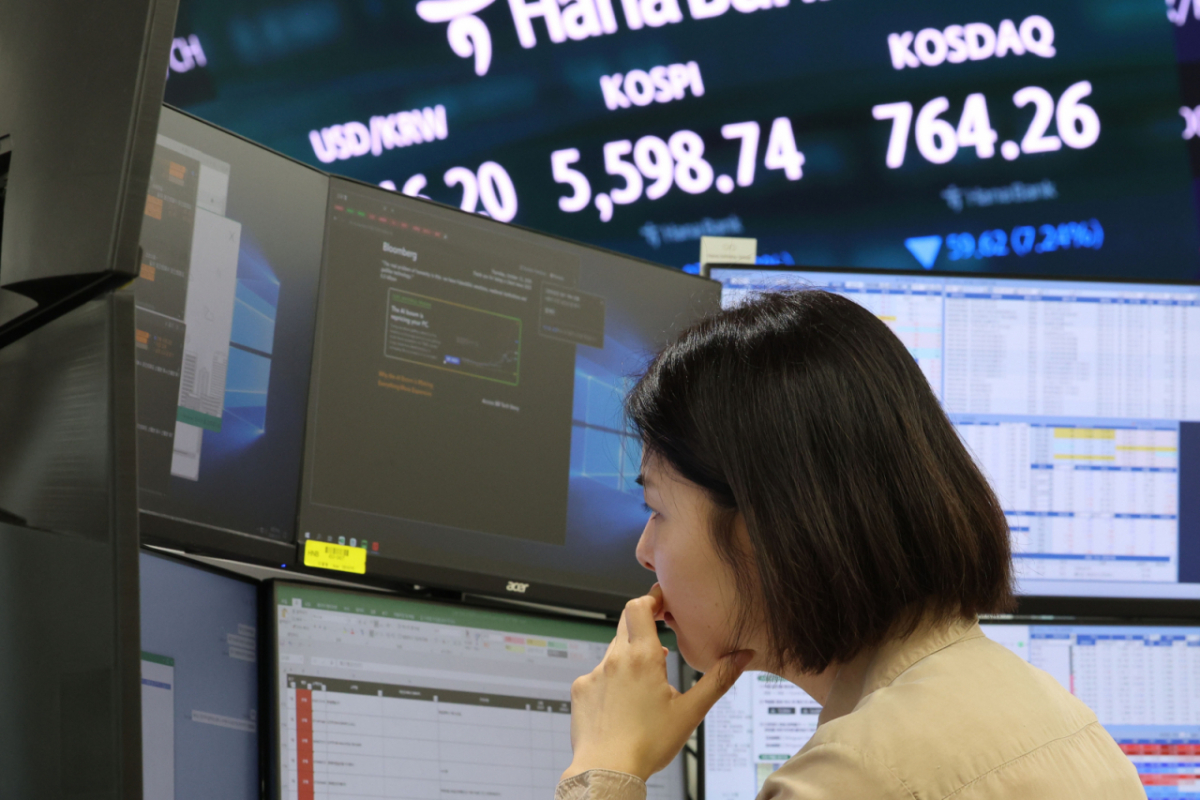
Major semiconductor stocks, including Samsung Electronics and SK Hynix, collapsed en masse due to macroeconomic factors such as the possibility of a U.S. interest rate hike, despite solid operating results. Semiconductor substrate stocks were also weak, with Samsung Electro-Mechanics falling by more than 200,000 won in a single day.
As of 1:58 p.m. on the 15th, Samsung Electronics was trading at 212,000 won, down 20,000 won (8.62%). SK Hynix was trading at 1,277,000 won, down 142,000 won (10.01%).
Semiconductor substrate stocks plunged sharply. Samsung Electro-Mechanics was trading at 1,174,000 won, down 200,000 won (14.56%), and SK Square was trading at 780,000 won, down 72,000 won (8.45%).
In the KOSDAQ market as well, semiconductor substrate stocks and materials, components and equipment (Sobubang) stocks took a direct hit. Simmtech, the leading KOSDAQ substrate stock, fell in the 13th% range, while Jusung Engineering and Wonik IPS, the leaders in the Sobubang sector, plunged by more than 12% and 13%, respectively.
The securities industry had predicted a rebound in semiconductor stocks following Samsung Electronics' preliminary third-quarter earnings announcement. However, stock prices fell sharply as doubts about AI semiconductor profitability and macroeconomic factors were added. After falling for five consecutive trading days, Samsung Electronics had slightly rebounded the previous day before plunging again. The drop of Samsung Electronics' stock price to the 210,000 won range is the first time in two and a half months since late July.
Samsung Electronics reported preliminary third-quarter operating results of 107.4 trillion won, an unprecedented performance that even global big tech companies have not achieved, yet its stock price actually retreated. SK Hynix also fell by more than 10% in a single day, with stock prices trending downward contrary to the strong earnings.
The sharp drop in major semiconductor stocks caused both major markets to collapse relentlessly. The KOSPI index showed 5,600.65, down 408.16 points (6.79%). After losing the 6,000 line, it fell nearly 8% in a single day, dropping to the 5,600 range.
KOSDAQ also failed to hold onto the 800th line, which it had barely managed to defend. At the same time, KOSDAQ showed 766.91, down 56.97 points (6.91%).
In this unusual crash, market volatility mitigation devices were triggered in unison early in trading. As futures indices fell simultaneously at the start of trading, the sell-side sidecar (futures market circuit breaker) was triggered for the first time in about two and a half months since July 29. The sidecar (futures market circuit breaker) was triggered at 9:07 a.m. on KOSPI and 9:12 a.m. on KOSDAQ, respectively, halting program trading for five minutes.
In the afternoon, the first-stage circuit breaker was triggered. The circuit breaker was activated at 12:23 p.m. on KOSDAQ and 12:38 p.m. on the KOSPI market, respectively, suspending all trading for 20 minutes. This is also the first time in 51 trading days since July 29 that circuit breakers have sounded simultaneously in both major markets.
In particular, foreign investors' "sell" streak is fierce in the KOSPI market. Foreign investors sold more than 33 trillion won, and despite net purchases by retail investors and institutional investors, the index decline continues.
This is interpreted as being influenced by U.S. price indicators and the weakness of AI and semiconductor stocks on the New York Stock Exchange overnight. The U.S. September CPI (consumer price index) rose 3.7% year-on-year, slightly exceeding market expectations (3.6%). Core CPI rose 2.6% year-on-year and 0.3% month-on-month, both surpassing market expectations.
As U.S. price indicators exceeded expectations, raising the outlook for a base rate hike, and as AI and semiconductor stocks showed weakness on the New York Stock Exchange due to concerns over AI investment debt, our country's large-cap stocks also came under pressure.
Hwang Su-uk, a researcher at Meritz Securities, noted, "The U.S. market reaction appears to stem from doubts about the sustainability of leveraged investments in AI infrastructure centered on CoreWeave, rather than the CPI (consumer price index). While the market may have reacted somewhat excessively, it is time to focus on concerns that are beginning to surface."
Researcher Hwang added, "It is necessary to consider that Korea has already fallen significantly, while the U.S. has only just begun its decline," and advised, "The market should respond conservatively until a trigger confirming the alleviation of capital circulation concerns is identified."
Han Ji-young, a researcher at Kiwoom Securities, noted, "The market's evaluation criteria for the AI investment cycle are shifting from the scale of CAPEX (capital expenditure) expansion to the profitability of invested capital and the stability of funding," adding, "The third-quarter big tech earnings season will be a test proving how much more profit and cash flow AI investments can generate compared to the previous quarter."

 in STOCK
