

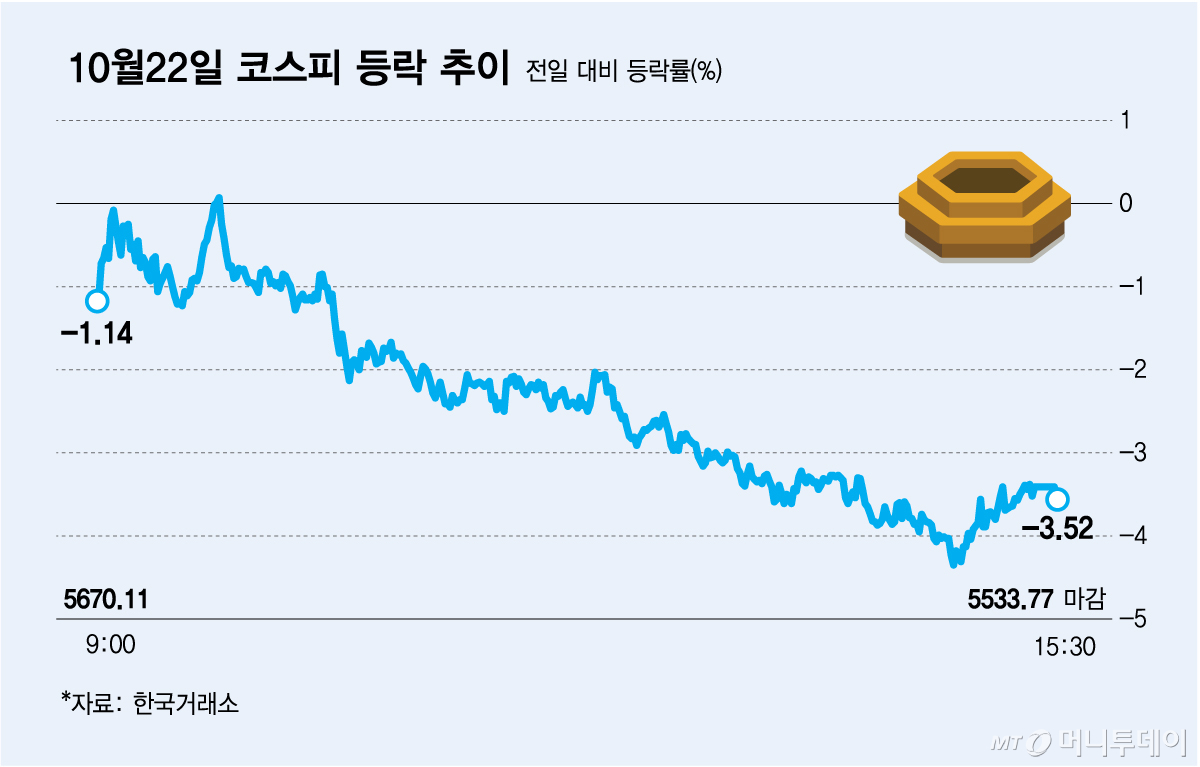
The KOSPI index barely held the 5,500 mark after a sharp drop on the 22nd. Anxiety over artificial intelligence investment and tightening concerns from the Middle East and Europe dampened the tailwind for U.S. tech stocks. Experts cited semiconductor earnings, shareholder returns, and the direction of inflation as key variables for the stock market going forward.
The KOSPI index closed at 5,533.77, down 201.89 points (3.52%) from the previous trading session. Based on the combined regular trading hours of Korea Exchange and NextTrade, retail investors made net purchases worth 1.363 trillion won, while institutional investors sold a net 683.3 billion won and foreign investors sold a net 399.1 billion won.
Selling pressure was intense in semiconductor stocks. Samsung Electronics closed the regular session at 214,500 won, down 9,000 won (4.03%), while SK Hynix ended at 1,223,000 won, down 71,000 won (5.49%). LG Energy Solution fell in the 5th% range, SK Square and Samsung Biologics dropped in the 3rd% range, Hyundai Motor declined in the 2nd% range, and Samsung Electric, KB Financial Group, and Samsung Life Insurance weakened in the 1st% range, adding to downward pressure on the market.
By sector, KOSPI medical precision, chemicals, electrical electronics, and manufacturing fell in the 4th% range; machinery equipment and metals dropped in the 3rd% range; pharmaceuticals, transportation and warehousing, securities, transportation equipment, parts, and telecommunications declined in the 2nd% range; and finance, entertainment and culture, and textiles and apparel weakened in the 1st% range. This contrasted with the New York stock market on the 21st (local time), which closed higher as the three major indices (Dow Jones 30, S&P 500, NASDAQ) rose, driven by strong earnings from SpaceX and Supermicro coupled with expectations for Russia-Ukraine war negotiations.
Meta's quarterly earnings, released before the domestic market opened on this day, highlighted a shift to negative free cash flow (FCF), fueling concerns about AI capital constraints. Additionally, the Bank of Korea Monetary Policy Board meeting held during the morning session heightened expectations for a further base rate hike in November. From a supply and demand perspective, it is also noted that selling pressure intensified as SK Hynix completed its on-market share buyback. Net purchases by other corporations totaled just 40.6 billion won across both exchanges on this day.
Kang Jin-hyuk, a researcher at Shinhan Investment Corp, stated, "The current KOSPI market is in a phase where attempts at a technical rebound and the possibility of further correction coexist, resulting in an ongoing tug-of-war." He added, "Multiple attractiveness does not guarantee a short-term bottom, and supply-demand grounds are still not clear."
Researcher Kang said, "The direction could become clearer as additional corrections stem from disappointment selling, while downside support comes from the inflow of relief buying." He noted, "As next week continues to serve as a verification stage for big tech earnings, we must see how the market reacts to the earnings and specific shareholder return plans of Korea's two major semiconductor stocks."
Lee Eun-taek, a researcher at KB Securities, stated, "One of the key factors recently weighing on the market—concerns over memory semiconductors and inflation—must ease for the market to find clues for a rebound." He added, "A decline in the price index within the U.S. Institute for Supply Management (ISM) Manufacturing Purchasing Managers' Index (PMI), or a slowdown in wage growth as seen in employment indicators, could serve as positive factors."
Researcher Lee said, "Even when the KOSPI index fell to the 3rd% range intraday on the 19th before closing with a gain in the 1st% range, expectations for expanded oil supply due to U.S. President Donald Trump's suspension of sanctions and tariffs against Russia became the catalyst for the rebound."
The KOSDAQ market could not escape a simultaneous sharp drop. The index closed at 764.10, down 28.66 points (3.62%) from the previous day. Retail investors made net purchases worth 257.6 billion won, while foreign investors sold a net 156.5 billion won and institutional investors sold a net 104.6 billion won.
All top 10 stocks by market capitalization declined. In particular, Ecopro BM fell in the 9th% range, Jusung Engineering dropped in the 8th% range, Wonik IPS and Ecopro declined in the 7th% range, and Samchundang Pharm fell in the 5th% range. Lino Co. and Iotech dropped in the 4th% range, Alteogen weakened in the 3rd% range, and HLB and RAINBOW Robotics declined in the 2nd% range.
By sector, KOSDAQ finance and machinery equipment fell in the 5th% range; non-metals, electrical electronics, and manufacturing dropped in the 4th% range; publishing, chemicals, general services, and pharmaceuticals declined in the 3rd% range; medical precision, textiles and apparel, distribution, and metals weakened in the 2nd% range; and paper and wood, transportation equipment, telecommunications, and food and tobacco fell in the 1st% range. Construction was strong in the 1st% range.
On this day, the won/dollar exchange rate closed at 1,324.2 won for Seoul foreign exchange market daily trading, down 1.0 won from the previous day.

 in STOCK
