

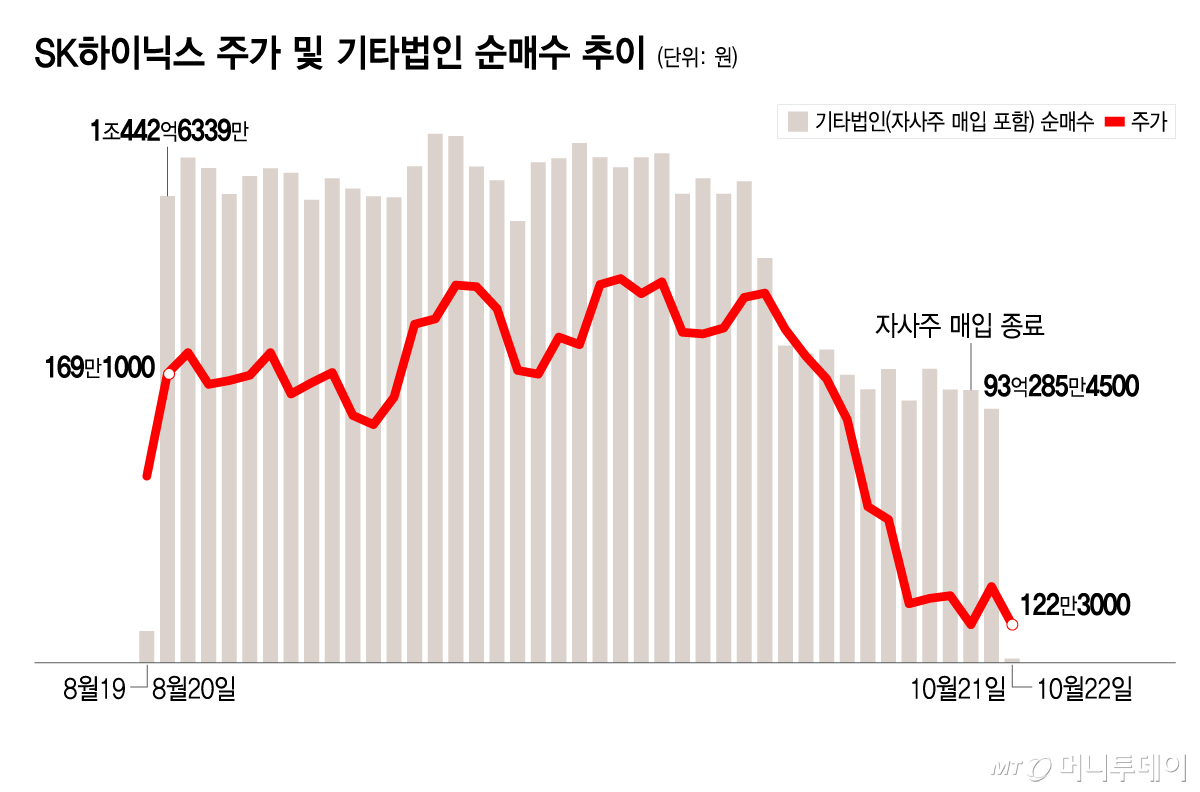
As SK Hynix completed its 4 trillion won share buyback program approximately one month ahead of schedule, concerns over a supply-demand gap in large-cap semiconductor stocks have intensified.
This is because concerns regarding the profitability of AI (artificial intelligence) have not fully subsided, and foreign investors continue to sell net. The industry is placing its hopes on additional shareholder return measures that SK Hynix is expected to announce by the end of this month.
On the 22nd, in the KOSPI market, SK Hynix closed regular trading at 1,223,000 won, down 71,000 won (5.49%) from the previous trading day. SK Hynix remained near flat levels early in the session but gave up all of its previous day's gains under pressure from strong selling by institutional investors and the share buyback gap. On the 21st, SK Hynix closed at 1,294,000 won, up 71,000 won (5.81%) from the previous trading day.
The industry believes that the supply-demand gap likely influenced SK Hynix's decline. Lee Kyung-min, head of the FICC Research Department at Daishin Securities, explained, "In a situation where supply-demand buffering capacity has weakened, net selling by institutional investors has led to weakness across the entire KOSPI." He added, "In particular, the semiconductor sector declined as profit-taking sell orders emerged following the previous day's rebound."
Over the past two months, SK Hynix's supply and demand have been supported by a 4 trillion won share buyback. SK Hynix had announced on August 19 that it would acquire and subsequently cancel all of its 24.07 million treasury shares, valued at 4 trillion 43 million 4,000 won. This represents approximately 3.3% of issued shares and is the largest scale of treasury share cancellation among domestic listed companies.
According to the Korea Exchange's corporate disclosure channel, SK Hynix purchased between 400,000 and 650,000 shares (approximately 600 billion won to 1.2 trillion won) per trading day from August 20 through the 21st. By the 21st, it had purchased 98.43% of the planned 24.07 million shares, effectively ending the share buyback. The original share buyback period was disclosed as running from August 20 to November 19, but it ended one month earlier than expected.
During the share buyback period, SK Hynix absorbed net selling volumes from institutional investors, foreign investors, and retail investors. According to the Korea Exchange, from August 20 through the 21st, institutional investors and foreign investors made net sales of SK Hynix shares worth 2 trillion 681.2 billion won and 25 trillion 662.8 billion won, respectively. Retail investors also sold 11 trillion 262.1 billion won. In contrast, "other corporations," including the share buyback entity, made net purchases of 39 trillion 668.7 billion won.
In fact, SK Hynix's stock price moved in line with the scale of net purchases by other corporations. From August 20 through the 1st, while other corporations maintained net purchases in the range of 1 trillion won, SK Hynix's stock price remained sideways. It began to trace a downward curve from the 6th of last month, when net purchases by other corporations fell below 700 billion won. Of the 41st trading days during which the share buyback was conducted, foreign investors made net purchases on only nine trading days.
The securities industry is paying attention to the recovery of foreign investor supply and demand and the announcement of additional shareholder return measures by SK Hynix. It is believed that if foreign supply recovers and additional share buybacks occur, the stock price could rebound.
Foreign investors have been making net purchases of SK Hynix for two consecutive trading days since the 21st. The scale of net purchases was 190.9 billion won on the 21st and 45.4 billion won on this day. Prior to this, they had engaged in net selling for 18 consecutive trading days starting from the 17th of last month.
The cumulative net sales during that period amounted to 16 trillion 200 billion won. While it is difficult to interpret this as a trend-based improvement in supply and demand, the strong selling pressure appears to have eased somewhat.
Han Ji-young, a researcher at Kiwoom Securities, explained, "Foreign investors, who had cumulatively net sold Samsung Electronics shares worth 7 trillion 800 billion won over 12 consecutive trading days from the 28th of last month through the 15th, made net purchases for four consecutive trading days from the 16th to the 21st.
This indicates that changes have begun in the concentrated semiconductor selling by foreign investors, who were a key supply-demand player in the domestic stock market." She added, "It may be premature to definitively call this an improvement in supply and demand, but it is worth noting that changes have begun in the concentrated semiconductor selling by foreign investors, who were the primary driver of the sharp decline in the domestic stock market."
The most anticipated event is SK Hynix's third-quarter earnings announcement scheduled for the 28th. The industry expects SK Hynix to announce a new shareholder return policy on that day.
Kim Un-ho, a researcher at IBK Investment & Securities, stated, "In the shareholder return policy announced on August 19, the company said it would use more than 50% of FCF (free cash flow) excluding CAPEX (capital expenditure) for shareholder returns. We estimate this to be at least 9 trillion won as of 2026." He added, "In addition to the 4th trillion won already executed, we expect additional share buybacks to proceed during the fourth quarter."

 in STOCK
