

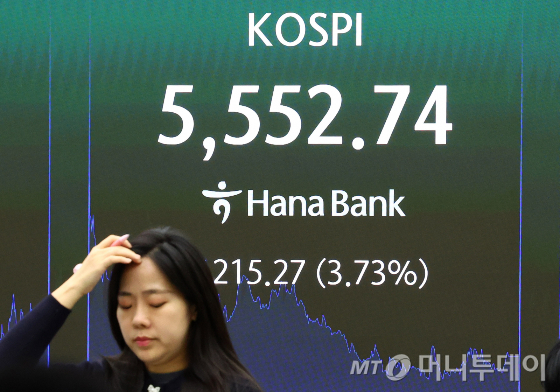
For young people who have relatively few opportunities to accumulate assets, the stock market is seen as a breakthrough for increasing wealth with a small initial capital. However, recent sharp declines in stock prices are also shaking young people's expectations. In particular, many young people with limited accumulated assets use leverage to expand their investment scale. Concerns are being raised that investments chosen to narrow the asset gap may instead become a factor delaying economic independence among the youth.
Margin investing (investing with debt) indicator: Credit financing balance still in the 30th trillion won range... Investment losses among young people also growing
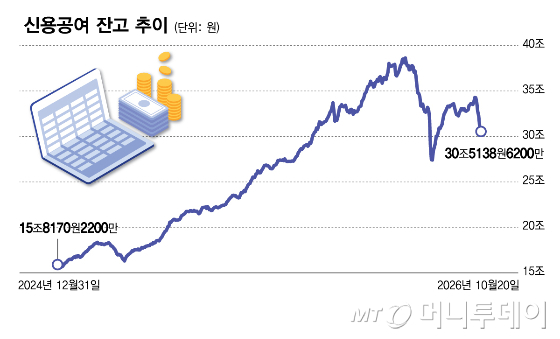
According to the Korea Financial Investment Association on the 24th, the credit trading financing balance as of the 20th was 30.5139 trillion won, still exceeding 30 trillion won despite recent sharp stock price declines and credit trading restrictions by the financial investment industry.
The credit trading financing balance is the amount of funds borrowed from securities firms to purchase stocks that have not yet been repaid, serving as a key indicator of so-called "margin investing (investing with debt)" (investing with borrowed money). The credit trading financing balance was at around 16 trillion won until the end of 2024, but it swelled to 38 trillion won at one point by the end of last June. This represents an increase of approximately 2.3 times in a period of less than two years.
A notable aspect is the rate of increase in margin investing (investing with debt) among young people. As of the end of last June, approximately 4.2 trillion won of the total credit trading financing balance was recorded as borrowings by investors in their 20s and 30s. This is a 2.5-fold increase compared to approximately 1.7 trillion won at the end of 2024. It exceeds the 2.1-fold increase in credit financing balances for those in their 40s and 50s, who are core economically active age groups, over the same period.
The reason the expansion of margin investing (investing with debt) among young people is concerning is that actual investment losses are also appearing more significantly among credit financing users. When financial authorities analyzed individual investor accounts at some major domestic securities firms in early March last year, the loss rate for credit financing users in their 20s and 30s was approximately 18%, significantly higher than the approximately 7% loss rate for investors of the same age who did not use credit financing.
At that time, the domestic stock market experienced extreme volatility due to geopolitical shocks from the Middle East. The KOSPI, which had risen to the 6,300 level due to the outbreak of war between the United States and Iran, plunged by about 17% over two trading days before rebounding by approximately 10% in a single day, showing a volatile market trend. Recently, as the KOSPI has fallen for seven consecutive trading days, showing an unstable flow, analysts say the risk of losses for young investors using credit trading is growing again.
Investment losses "fatal" for young people with few financial assets... Risk of forced liquidation also expanding
Such margin investing (investing with debt) risks place a greater burden on the youth, who have relatively weak asset bases. Those in their 20s and 30s, who have not been working for long, have less accumulated financial assets than middle-aged and older generations, so they are relatively lacking in the capacity to recover from investment losses. Furthermore, if the burden of repaying borrowings is added, it may hinder long-term asset formation plans.
In fact, forced liquidations have surged as KOSPI volatility has expanded recently. On the 14th, the proportion of actual forced liquidation amounts relative to unsettled brokerage funds was 7.2%, recording the third-highest level since the second half of this year. The forced liquidation amount on that day was 122 billion won, the second highest for the same period. Since the 13th, the proportion of forced liquidations has exceeded 4% for five consecutive trading days, with cases of investors' held stocks being forcibly disposed of occurring one after another.
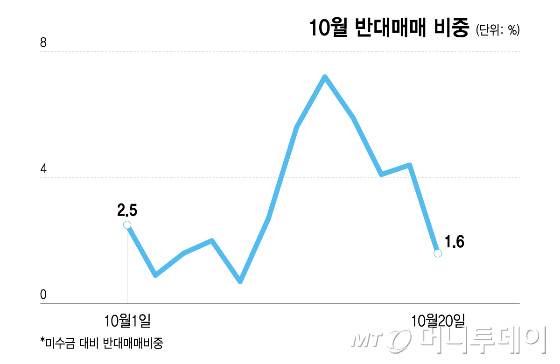
Forced liquidation is also concerning because it can expand volatility across the entire stock market, not just individual investor losses. If collateral value drops due to falling stock prices, securities firms forcibly sell stocks, and the flood of selling volume during this process can trigger a vicious cycle that further drives down stock prices.
A source in the financial investment industry said, "In a situation where stock prices are plunging, the impact of forced liquidation may act more strongly on young people," adding, "Early-career workers have relatively limited financial capacity to secure additional funds or reduce losses, so they may bear the investment risks as-is."
Debt burden for housing acquisition among youth also expanding... Concerns over delayed economic independence
The debt burden of young people is not limited to stock investments. As the scale of loans for securing housing grows, the financial burden that young people must bear has reached a considerable level.
According to household debt statistics by borrower released by the Bank of Korea for the second quarter of this year, the average new household loan amount per borrower across all age groups was 34.13 million won, a decrease of 1.28 million won from the previous quarter. In contrast, those in their 20s were recorded as having an increase of 203.94 million won from the previous quarter. Even as the overall scale of new loans decreased, the new borrowing scale for borrowers in their 20s actually expanded.
The expansion of debt burden among young people was also prominent in mortgage loans. As of the end of the second quarter this year, the average loan balance for mortgage borrowers in their 20s was 203.94 million won, an increase of 5.75 million won from the previous quarter. This marked the first time it exceeded 200 million won since the compilation of related statistics, and the amount of increase was also the largest among all age groups.
The average balance for mortgage borrowers in their 30s also increased by 4.09 million won from the previous quarter to 234.19 million won. In contrast, the increases for those in their 40s and 50s were only 1.86 million won and 440,000 won, respectively. This means that the borrowing burden of young people for housing acquisition is expanding faster than other age groups.
Loans for securing housing and borrowings for stock investments differ in nature, but they need to be examined together as the overall financial burden that young people must bear. In particular, if credit financing-based investments are expanded while holding existing debts such as mortgage loans, shocks from market volatility can spread to the entire household financial situation.
The problem is that if young people who already hold considerable debt take on additional borrowing and losses in the process of stock investment, they may face greater difficulties in future asset formation. If investment losses are added to the burden of repaying loans for housing and living expenses, savings capacity will decrease, and asset accumulation for economic independence may be delayed. This means that risks taken to narrow the asset gap could instead lead to results that widen the gap.
Lee Hyo-seop, Head of the Financial Industry Division at the Capital Markets Institute, emphasized the need for institutional improvements to foster a long-term investment culture among individual investors. Director Lee said, "It is necessary to design a structure where tax benefits increase with longer stock holding periods to reduce incentives for short-term trading and encourage long-term holding," adding, "Financial education must be strengthened throughout the entire life cycle from adolescence to old age."

 in STOCK


