

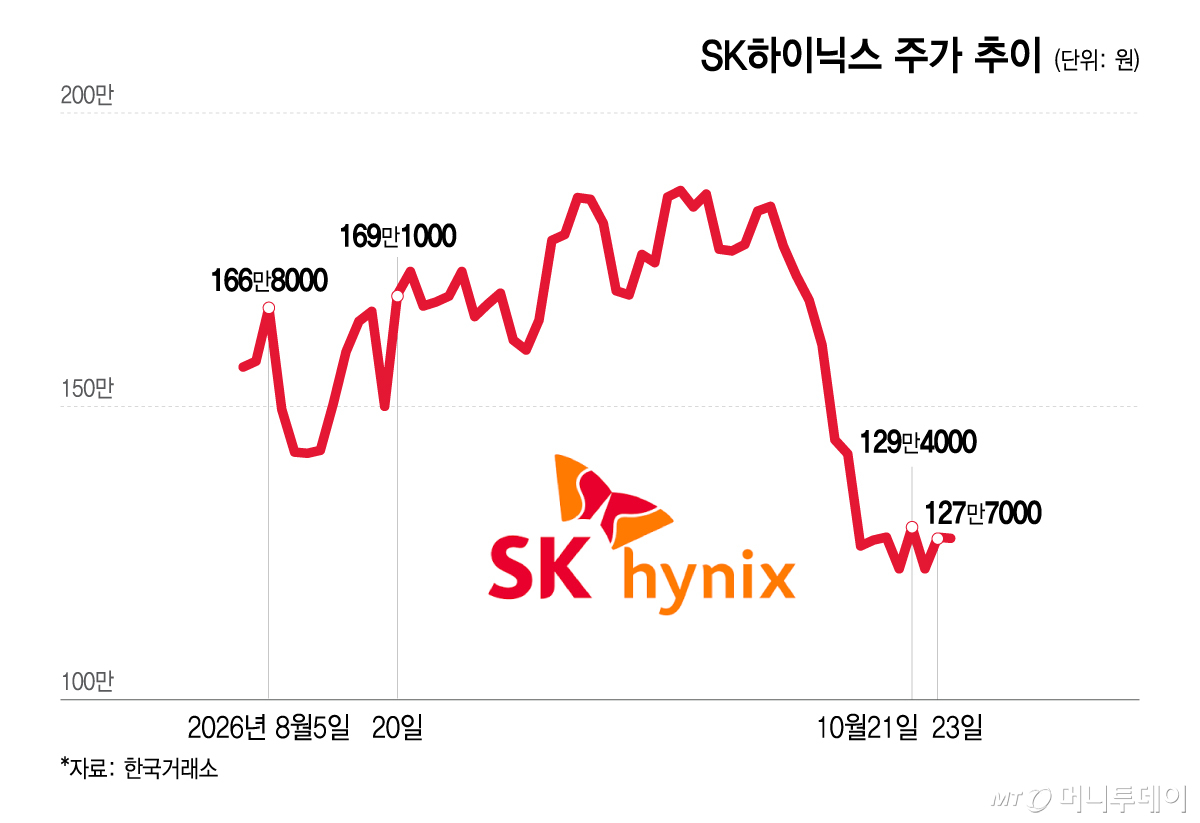
Concerns have been raised over how to secure investment funds for expanding production facilities after SK Hynix halted its review of an initial public offering (IPO) for its U.S. grand-subsidiary, Solidigm. However, securities firms are in agreement that "there is no need for concern." They view the profits SK Hynix will earn through next year as sufficient amid a phase where long-term supply agreements (LTVs) are expanding due to semiconductor shortages. It is projected that the company will be able to secure enough cash to simultaneously proceed with shareholder returns and capital expenditures (CAPEX).
On the 26th, the securities industry forecasted that SK Hynix would be able to secure investment funds for expanding Solidigm's production capacity using its own funds. Mirae Asset Securities projected that SK Hynix's free cash flow (FCF) this year would reach 180 trillion won. SK Securities analyzed that SK Hynix's FCF next year would exceed 260 trillion won.
Lee Chang-min, a researcher at KB Securities, predicted, "In a situation where they are not without their own cash, they will not seek other external financing methods," adding, "Given the suspension of the (Solidigm) listing, it is appropriate to view the investment plan as having shifted to utilizing internal funds."
This outlook is due to positive performance forecasts driven by the semiconductor supercycle. According to KB Securities, SK Hynix's combined operating profit for 2026 and 2027 is projected at 648 trillion won. Next year's operating profit is expected to be 389 trillion won, an increase of approximately 50% from this year.
Kim Dong-won and Lee Chang-in, researchers at KB Securities, explained, "Approximately 70 to 80 percent of SK Hynix's planned memory production volume for 2027 has been effectively secured through five-year LTVs signed with global big tech customers." They added, "With only 20 to 30 percent of remaining production capacity not yet under contract, competition among major hyperscalers to secure supply for that volume continues."
Recently, NVIDIA CEO Jensen Huang stated at GTC 2026 in Berlin, Germany, that the possibility of a memory oversupply by 2029 is low. Consequently, positive forecasts regarding the semiconductor industry are expected to be maintained for the time being.
Securities firms explained that Solidigm investment utilizing internal funds would not be disadvantageous from the perspective of existing investors. A semiconductor specialist analyst who requested anonymity stated, "Since Solidigm is a NAND company, investing in it means concentrating investments on memory semiconductors, which will enhance the core business value of SK Hynix."
It was pointed out that considering an IPO despite having sufficient internal funds was intended to take advantage of reduced external financing costs in a positive semiconductor market environment. For SK Hynix, which has many long-term investment opportunities beyond Solidigm, this judgment likely meant it was advantageous to minimize cost burdens as much as possible.
Lee Min-hee, a researcher at BNK Investment & Securities, stated, "While internal funds can be used, SK Hynix must upgrade existing Solidigm facilities and build a second factory, while also needing to invest in new domestic plants such as Yongin." She added, "If they receive valuation recognition in the U.S. and conduct an IPO, they can raise funds at a lower cost than borrowing for investment, so there is no downside for the company."
The researcher added, "However, from the perspective of existing shareholders, if Solidigm lists on NASDAQ, foreign investors may shift their focus there. Therefore, the withdrawal of the listing is positive for existing shareholders."

 in STOCK
