

The Financial Supervisory Service (FSS) has determined that the securities industry's response to so-called margin investing remains inadequate, hinting at the possibility of reviewing additional regulations.
On Tuesday, the FSS held a "Roundtable on Strengthening Self-Management of Credit Loans in the Securities Industry" with the Korea Financial Investment Association and risk management executives (CROs) from 10 comprehensive financial investment businesses, including Mirae Asset Securities and Korea Investment & Securities, announcing this.
FSS deputy director Seo Jae-wan urged the securities industry to strengthen risk management and investor protection through proactive credit loan management.
While it is encouraging that the securities industry has recently formulated a "Plan to Strengthen Self-Management of Credit Loans," he emphasized the importance of responding promptly to market conditions. Seo stated, "Even before the completion of computer system construction and the reflection of internal regulations, proactive management must be prioritized with investor protection as the top priority."
The plan to strengthen self-management of credit loans proposed by the securities industry centers on limiting the scale of credit lending operations from 100% to 90% of a brokerage's own capital and managing the proportion of credit loans for specific stocks within 15%.
It was pointed out that there are still shortcomings in credit loan management even after the CRO roundtable held by the securities industry last June. It was explained that mechanical and uniform risk management, which was criticized at the time, persists. Therefore, he re-emphasized the need to actively manage credit loans.
As best practices for credit loan management, it introduced a brokerage that reduced credit loan limits for all domestic stocks or lowered the basic limit for stocks with high credit loan concentration from 300 million won to 200 million won and restricted increases in extensions. It also cited cases where RPA (Robotic Process Automation) was used to monitor credit loan status and stocks with sharp intraday fluctuations in real time, implementing measures such as downgrading stock ratings and restricting credit loans, and cases where a three-stage monitoring system of "before market open, during trading, twice a day" was established.

Additional regulations were also foreshadowed. Seo stated, "If self-management is insufficient, additional regulatory measures may be activated," and urged, "Please faithfully implement the self-management plan."
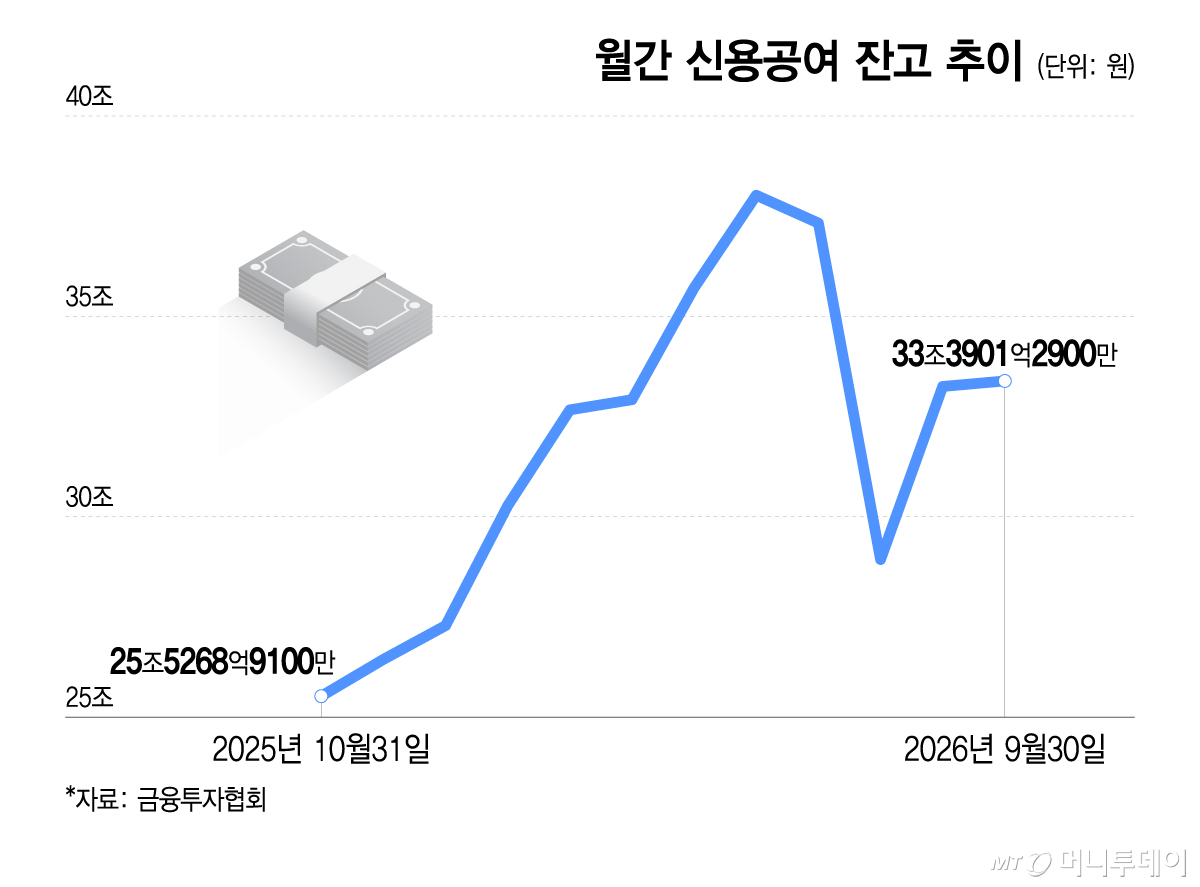
The reason the FSS is urging strengthened credit loan management is that the scale of credit loans still reaches the 30th trillion won range. According to the Korea Financial Investment Association, the monthly credit loan scale peaked at 38 trillion won at the end of last May and recorded over 33 trillion won at the end of last month. As of the 23rd, it stands at 30.1521 trillion won, still maintaining the 30th trillion won range.
If credit loan balances expand excessively, a sharp drop in stock prices can lead to large-scale forced liquidations, spreading market shocks and raising concerns about declining market confidence. Credit loans are transactions where investors provide stocks purchased with borrowed money as collateral. If stock prices fall and the collateral value drops below a certain level, brokerages initiate forced liquidation by forcibly selling the collateral stocks to recover the loan amount. In a sharp decline, forced liquidation volumes can flood the market all at once, pushing stock prices down further and leading to additional forced liquidations in a vicious cycle.
The securities industry expressed its recognition of the need for strengthened credit loan management and its intention to actively cooperate.
An FSS official stated, "We will support the effective implementation of the securities industry's plan to strengthen self-management of credit loans and continuously communicate to ensure that a healthy investment culture is established early."

 in STOCK

