

The government has opened an exit route to KONEX for KOSDAQ companies facing delisting due to insufficient market capitalization, but fewer than half are eligible to transfer.
This is because the special provision for transfer listing, established as a relief measure while the government pushes for the swift removal of underperforming firms, requires a history of positive operating profit. Companies that have posted operating losses for three consecutive years cannot use the provision, even if they have sufficient capital.
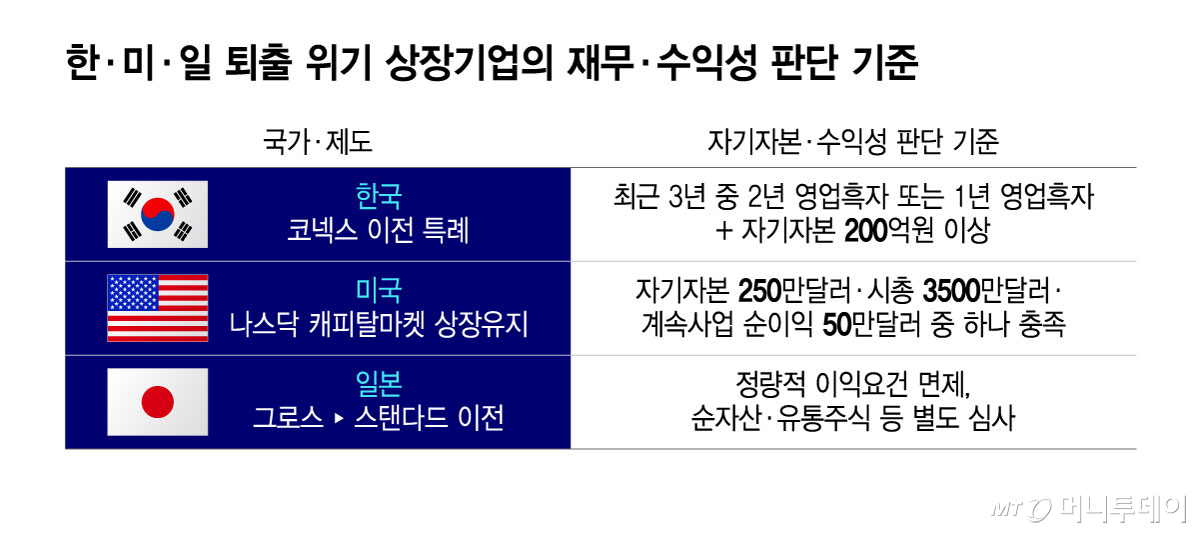
This differs from the U.S. and Japan, which recognize opportunities to maintain listing or transfer markets based on various criteria such as equity, prompting calls for more refined design of relief standards.
The Financial Services Commission maintains its policy direction of swift and strict removal of underperforming firms while stating that delisting procedures can be partially supplemented in accordance with court rulings.
However, the issue of ensuring opportunities to present arguments during the delisting process and which companies among those below the market cap threshold should be given a chance to maintain listing or transfer markets are separate matters. There are calls to review not only procedural improvements but also the adequacy of criteria for determining relief targets.
Currently, KOSDAQ companies become subject to delisting through certain procedures if their market capitalization falls below 20 billion won. Starting next July, this threshold will rise to 30 billion won. In September last year, the government established a special provision allowing KOSDAQ companies designated as monitored stocks solely due to insufficient market capitalization to transfer to KONEX without a closing auction.
However, to use this provision, a company must have recorded positive operating profit for at least two of the past three years, or have been profitable for more than one year while maintaining equity of 20 billion won or more. Companies with capital impairment are excluded from the provision.
Under these requirements, companies that have posted operating losses for three consecutive years cannot use the KONEX transfer listing special provision, even if they have sufficient equity and no capital impairment. According to an analysis by financial authorities of 97 KOSDAQ companies with a market cap below 20 billion won as of August 26, only 43 companies (44.3%) met the transfer requirements.
The U.S. NASDAQ Capital Market recognizes not only market capitalization but also a company's capital strength and profitability as alternatives for maintaining listing. Meeting any one of equity of $2.5 million, listed securities market cap of $35 million, or net income from continuing operations of $50 million satisfies the financial and market cap maintenance criteria.
This means that even loss-making companies can meet the criteria if they possess a certain level of equity. However, the stock price must be at least $1, and other requirements such as the number of shareholders and the scale of tradable shares in the market must also be met.
Japan's Tokyo Stock Exchange also does not apply the condition that companies must have generated profits above a certain scale in the past when transferring from the growth-focused Growth Market to the general-company-focused Standard Market. Instead, it reviews transfer eligibility based on other criteria such as net assets and the scale of circulating shares.
U.S. listing maintenance criteria, Japanese market transfers, and South Korea's KONEX transfers are systems with different targets and requirements. However, the U.S. and Japanese cases offer insights in that a company's listing suitability can be judged by various indicators such as equity and financial condition, in addition to whether operating profit is positive.
There are voices calling for consideration of whether separate relief opportunities should be granted to companies that have demonstrated financial soundness through equity and cash flow, while maintaining the policy goal of swift removal of underperforming firms.
An official in the financial investment industry said, "Rather than judging KONEKS transfer solely based on profitability, it is necessary to consider indicators showing a company's ability to continue its business, such as equity or cash flow," adding, "Relief criteria should be supplemented to allow for the swift removal of underperforming firms while providing reasonable opportunities to companies with potential for recovery."

 in STOCK
