

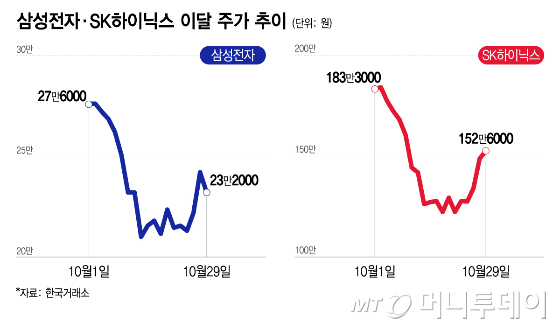
As Samsung Electronics and SK hynix embark on shareholder returns totaling up to 210 trillion won this year, attention is turning to whether the weakened supply-demand dynamics in the domestic stock market, caused by foreign investor outflows, will recover.
However, not all of the 210th trillion won will flow directly into the stock market. Unlike share buybacks, which translate into actual buying demand, cancellations and cash dividends do not constitute new buying funds, or their reinvestment remains uncertain.
Nevertheless, it is worth watching whether the record-high shareholder returns from leading domestic stocks will serve as a turning point to reverse the weakened supply-demand situation driven by foreign outflows.
According to financial investment industry sources on the 29th, Samsung Electronics reaffirmed during its third-quarter earnings release that it plans to pursue shareholder returns totaling 90 trillion to 110 trillion won this year.
The amount already executed or confirmed is 35 trillion won, while the remaining 55 trillion to 75 trillion won is planned to be returned through cash dividends and share buybacks and cancellations.
SK hynix also disclosed its shareholder return plan of approximately 100 trillion won on the previous day, including cash dividends of over 30 trillion won and share buybacks and cancellations of over 60 trillion won. Combined, the shareholder returns from these two companies, which rank first and second in KOSPI market capitalization, reach up to 210 trillion won.
The securities industry expects that large-scale shareholder returns will serve as a catalyst for improved supply-demand dynamics and a revaluation of corporate valuations.
Kim Dong-won, head of the Research Division at KB Securities, said, “Despite the expanded earnings generation capacity of both companies, their stock prices have fallen from their peaks, entering an unusual phase of undervaluation with price-to-earnings (PER) ratios around 3 times.”
He added, “At a time when record-high earnings and historical undervaluation coexist, the expansion of shareholder returns to a record scale is expected to be a decisive factor in resolving the undervalued corporate valuations.”
However, capital market experts advise that investors should also consider that the total amount of shareholder returns does not directly equate to new funds flowing into the domestic stock market.
Analysts suggest that rather than rushing to buy based solely on expectations regarding the scale of shareholder returns, it is necessary to evaluate the actual supply-demand improvement effects.
Specifically, shareholder returns are broadly divided into cash dividends and share buybacks and cancellations. Among these, share buybacks involve companies directly purchasing their own shares in the stock market, thereby generating actual buying demand.
Samsung Electronics completed a share buyback of approximately 15 trillion won on the 6th, while SK hynix finished a share buyback of approximately 40 trillion won on the 21st.
The securities industry assesses that during this period, even as selling pressure from foreign investors continued, the share buybacks by both companies absorbed the selling volume and played a role in reducing downward pressure on stock prices.
In contrast, the cancellation of treasury shares involves eliminating already purchased shares, meaning no additional buying funds are injected during the cancellation process.
While this has the effect of increasing existing shareholders’ ownership ratios and improving per-share value, it means that the amount spent on cancelling previously purchased treasury shares cannot be counted as new inflows to the stock market.
Cash dividends also do not directly connect to supply-demand dynamics. This is because investors who receive dividends are not necessarily required to repurchase domestic stocks. If the funds are used for consumption, deposits, or overseas investments, they will not return to the domestic stock market.
In particular, the destination of dividends returned to foreign investors is a variable. The foreign ownership ratios of Samsung Electronics and SK hynix are approximately 46% and 48%, respectively. If Samsung Electronics’ cash dividend of 30 trillion won and SK hynix’s dividend plan of 30 trillion won are applied simply, the amount returning to foreign investors is estimated at approximately 28 trillion won.
The foreign ownership ratios of Samsung Electronics and SK hynix are approximately 46% and 48%, respectively. If these figures are simply applied to Samsung Electronics’ cash dividend of 30 trillion won and SK hynix’s dividend plan of 30 trillion won, the portion for foreigners is estimated at approximately 28 trillion won.
If foreigners reinvest this money in domestic stocks, it will strengthen supply-demand dynamics; however, if they exchange it into dollars or other currencies and remit it overseas, the effect on liquidity expansion will be limited. There is also no guarantee that dividends paid to affiliates holding shares in Samsung Electronics, such as Samsung Life Insurance, Samsung Fire & Marine Insurance, and Samsung C&T Corporation, will be reinvested in the domestic stock market.
Ultimately, analysts point out that not only the scale of shareholder returns but also the specific execution methods and capital flows of foreign investors are important. On this day, despite announcing record-high third-quarter earnings, Samsung Electronics’ stock price fell by approximately 6% during trading hours.
This trend contrasts with SK hynix’s sharp rise on the previous day. It is noted that ambiguous announcements regarding shareholder returns, such as Samsung Electronics’ plan to finalize specific execution methods for its remaining shareholder return funds by the end of January next year, failed to fully meet market expectations.
An official from the securities industry said, “Large-scale shareholder returns are positive in defending against stock price declines and improving investor sentiment, but not all announced amounts translate into new buying funds.”
He added, “For a sustained rebound in the domestic stock market, it is crucial to determine how much of the expanded scale of shareholder returns can lead to actual inflows of new investment funds.”

 in STOCK
