

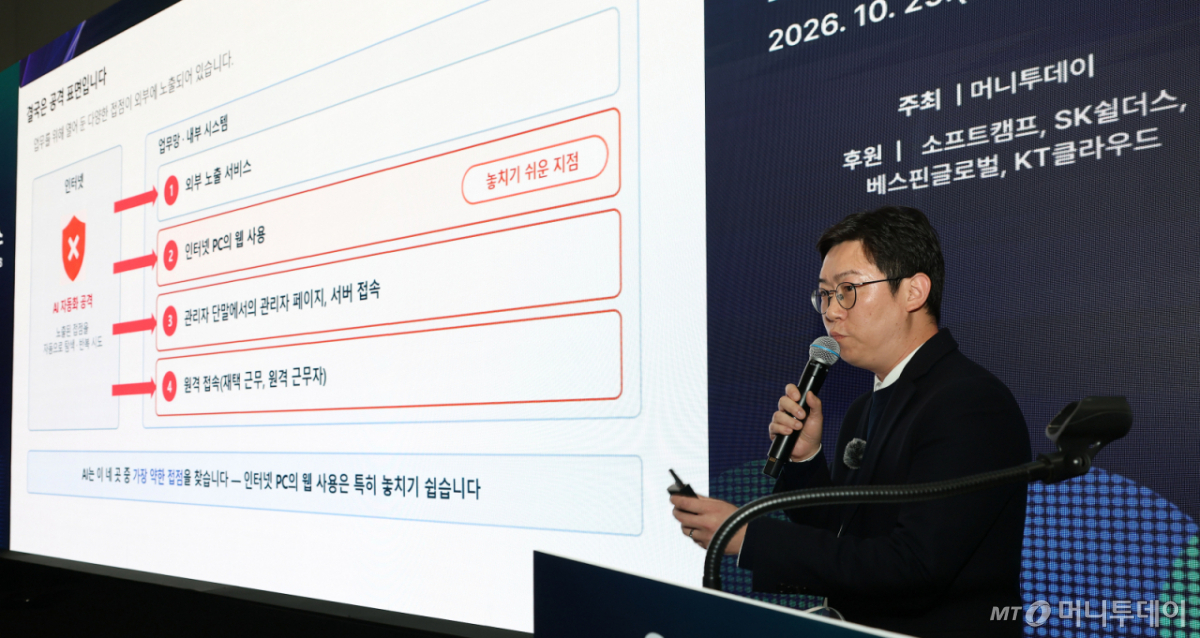
"Hacking in the AI era is structured to disadvantage defenders. This is because even if you block an attack 1,000 times, you cannot afford to be breached by the 1st,001st attack. For this reason, there is something more important than using AI to stop AI."
Kim Dong-hoon, deputy director of the Consulting Division at SoftCamp, made these remarks at the "2026 AI Infrastructure Frontier Conference" held on the 29th in Hall B of COEX in Seoul Samsung-dong. Kim presented three response principles: reducing the attack surface, controlling AI, and maintaining records and traceability.
First, Kim said that the surface vulnerable to external attacks must be reduced. Companies must protect not only core business systems but also supplementary services used by employees and partners. As the number of services increases, so do the publicly exposed access addresses and authentication paths. "Isolation of externally exposed services" using RBI (Remote Browser Isolation) technology was proposed as a solution.
This method involves terminals not connecting directly to web pages, but only receiving rendered images (the process of converting data, code, etc., into human-viewable images) from a remote server.
Kim explained, "It is a method where a container equipped with a browser is launched in an isolated server space between the terminal and the website for connection." He added, "If it receives an attack from malicious code, you simply terminate the connection and discard the container."
SoftCamp operates SHIELD Gate, which combines Identity-Aware Proxy (IAP) and RBI. When a connection request is received, IAP verifies identity and permissions, while web content is executed via a remote browser.
It enables a service that displays only the services available according to user-specific permissions on the portal. Kim said, "The time taken to apply patches is a security weakness, but SHIELD Gate can completely block threats by isolating internal resources."
Second, he proposed controlling the permissions of AI agents used internally. It is necessary to determine who delegated permissions to an AI agent and what tools it invoked for which tasks.
Granting all access permissions solely because a task has been assigned to AI leads to permission abuse, while blocking all permissions reduces work efficiency.
SoftCamp's "SHIELD AI Gateway" verifies not only the agent but also the identity of the user who delegated permissions to the agent, and limits the list of available tools accordingly. It records which tool an agent invoked under whose permissions, enabling traceability.
Kim noted, "AI agents work like humans, making them difficult to distinguish." He added, "Procedures are needed, such as registering AI agent owners, issuing identities for AI agents, organizing the principle of least privilege, and revoking licenses after employees leave."
Finally, he emphasized the importance of records and control. This is necessary for auditing and response after an incident occurs. It also helps determine whether a company's control rules are excessive or insufficient.
Kim said, "Everything that is isolated must be recorded from authentication to usage history." He added, "It also facilitates verification in cases where false positives or over-detection occur."

 in TECH
