

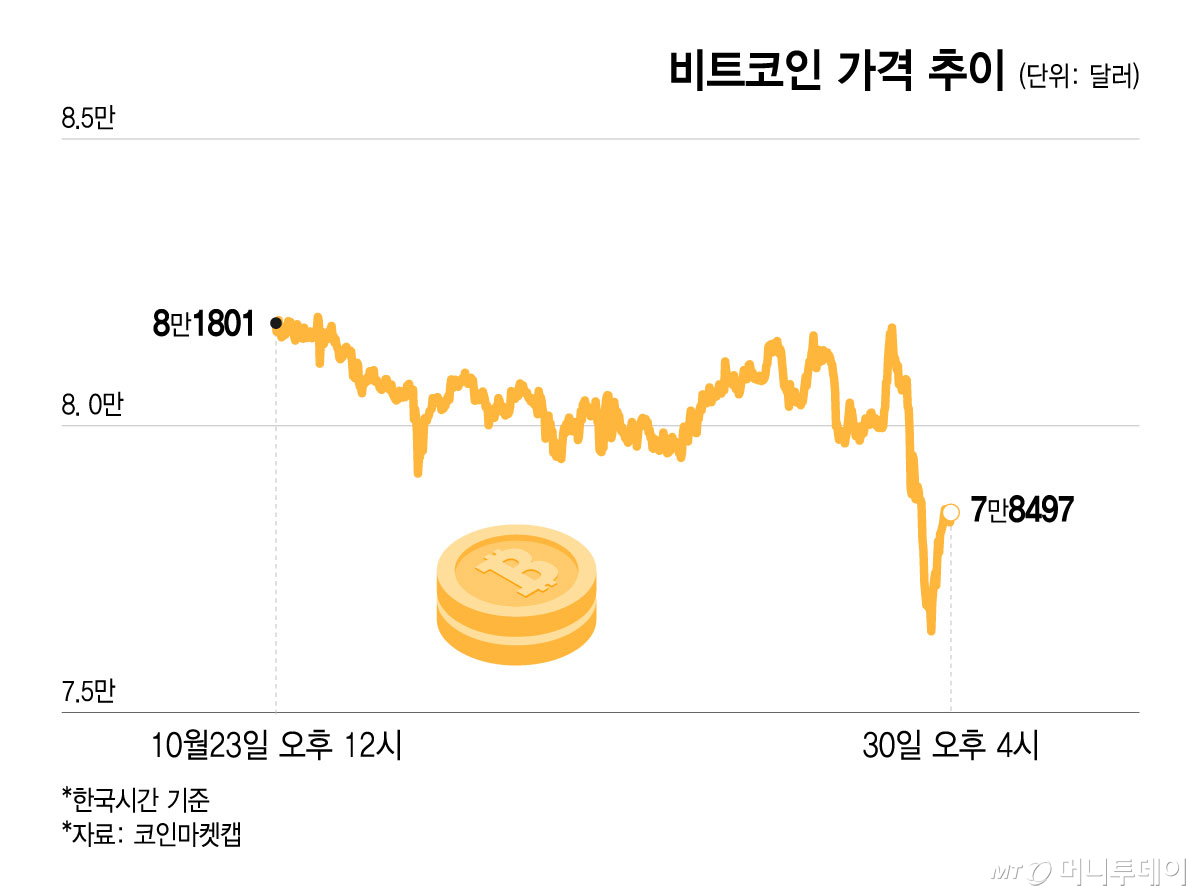
Bitcoin has fallen below the $80,000 mark as it enters the final weekend of October. The “Uptober” (October bullish theory) appears to be in tatters. Amidst a cooling effect on investor sentiment caused by signs of a hack that emerged at Binance, the world’s largest cryptocurrency exchange, market attention is shifting to the U.S. midterm elections, which will determine the fate of the Trump administration.
As of 4 p.m. on the 30th (all times Korea Standard Time), Bitcoin was priced at $78,497 on CoinMarketCap, a global cryptocurrency market data platform, down 4.01% from a week earlier. The domestic price stood at 156.5 million won on Upbit, 0.71% higher than the Binance price.
Ethereum recorded a 6.51% drop over the same period to $2,250. CoinMarketCap’s “Fear and Greed Index,” which approaches zero as investor sentiment weakens, fell by 10 points in a week to 38 out of 100, moving down from the “Neutral” stage to the “Fear” stage.
The cryptocurrency market saw Bitcoin fluctuate between $79,000 and $80,000 during the week before experiencing a sudden plunge starting at 1 a.m. on the 30th. By 11 a.m., Bitcoin had dropped to the $76,000 range.
Experts explained that the selling pressure was triggered by signs of the Binance hack. They noted that anxiety in the market was stirred when an on-chain analysis firm detected and reported large-scale withdrawals from electronic wallets classified as being owned by Binance the previous evening.
Binance halted all cryptocurrency deposits and withdrawals on the 30th and began security checks. The company released preliminary investigation results that morning, estimating the damage at approximately $6.3 billion (8.4344 trillion won).
Lee Hwan-wook, a researcher at Yuanta Securities, stated, “$5.7 billion outflow from Binance spread risk-averse sentiment, and cascading sales from the liquidation of $380 million in long positions widened the decline.” He added, “It is merely a security incident at a specific exchange, not damage to Bitcoin’s own fundamentals.”
The researcher noted, “Until just before the hack, Bitcoin exchange-traded fund (ETF) funds saw net inflows for three consecutive days, shifting the monthly trend to net inflows, and outflows from exchange balances continued.” He added, “This sharp drop has deepened undervaluation, with the MVRV (Market Value to Realized Value ratio) falling to 0.82.”
Park Sung-je, a researcher at Shinhan Investment Corp, stated, “The Federal Reserve System (Fed) held its base rate steady at the October Federal Open Market Committee (FOMC) meeting, but caution regarding additional tightening remained.” He added, “With the U.S. midterm elections scheduled for the 3rd (local time), the direction of cryptocurrency legislation following changes in the composition of Congress is expected to emerge as a key variable.”
He further stated, “Bitcoin is in a phase where it is testing whether it can hold support at $80,000, and improvements in ETF supply and demand and the recovery of $82,000 are important.”
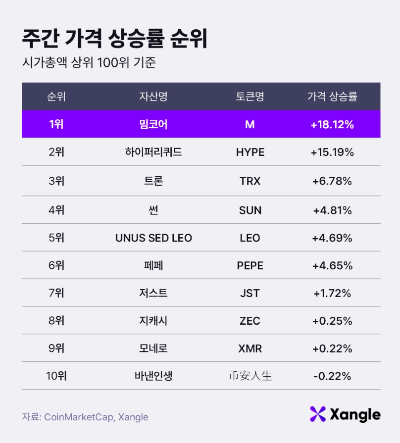
The altcoin market continued to face a sharp cooling phase where it was virtually impossible to avoid losses. Among the top 100 cryptocurrencies by market capitalization tracked by Zangle as of 9 a.m. on the 30th, only two tokens (MemeCore and Hyperliquid) posted weekly returns exceeding 10%.
Kim Jun-seong, a researcher at Zangle, stated, “Despite the interest rate hold, the rebound has not continued, and investor sentiment in cryptocurrencies has been dampened by the Binance hack.” He added, “The resolution of the incident and the easing of caution regarding additional tightening will be key variables determining the recovery of major assets.”

 in STOCK

