

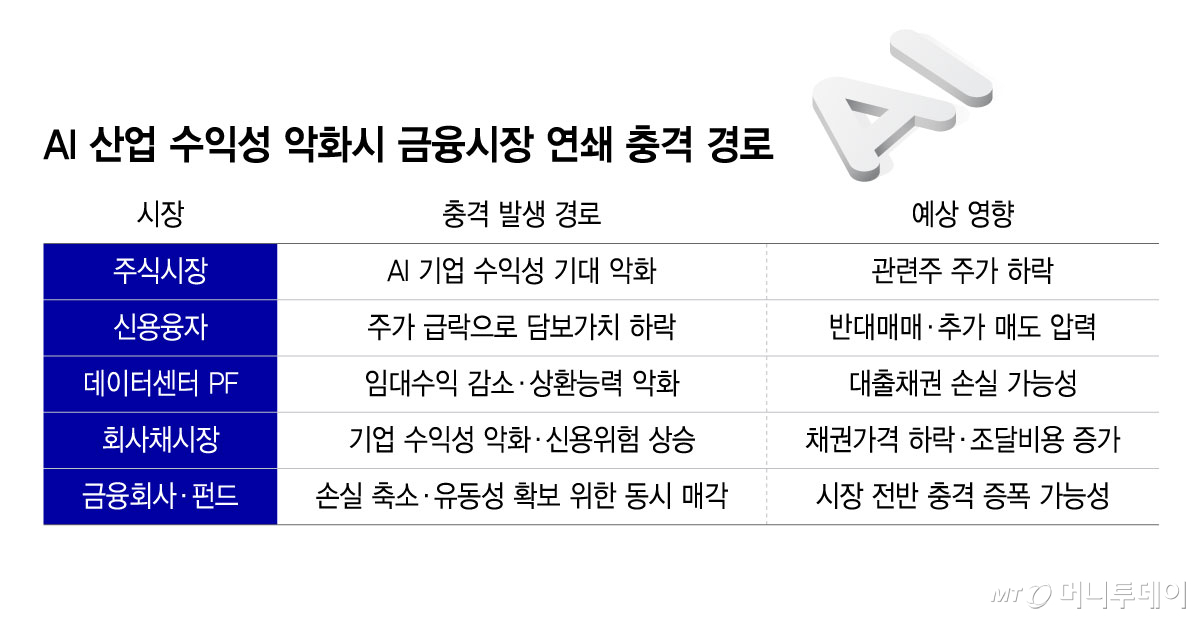
Concerns are emerging that the shock to the domestic financial market from the US stock market plunge, driven by the burden of profitability in the artificial intelligence (AI) industry, may not be limited to the equity market. If expectations for expanded AI investment wane, semiconductor demand could slow, which in turn could affect loans and corporate bonds of related companies. Experts point out that it is necessary to examine not only short-term losses from the stock price plunge but also the possibility of defaults in corporate finance.
Domestically, margin investing concentrated in semiconductor stocks is cited as an immediate risk factor. In the medium to long term, if AI investment shrinks, the profitability of data centers and the debt repayment capacity of related companies could decline. There is also a possibility that financial institutions and funds simultaneously selling held assets to reduce losses could deliver additional shocks to the stock and bond markets.
US stocks plunge on AI profitability concerns… Burden of Korean semiconductor margin investing
According to the financial investment industry on the 1st, the NASDAQ index plunged 2.86% in the US New York stock market on the 30th of last month (local time). This was influenced by growing doubts about whether massive AI investment costs could be recovered, triggered by the earnings and investment plans of Intel and Amazon. The Philadelphia Semiconductor Index also fell 7.2%. Whether the AI industry can generate actual profits, rather than growth expectations, has emerged as a variable determining the stock market.
Overseas financial regulators are wary of the possibility that an AI investment slowdown could spread to other financial markets. The Bank of Japan analyzed in its Financial System Report on the 23rd of last month a situation where shocks amplify as expectations for AI investment profitability decline and overseas funds reduce their holdings. The Federal Reserve System (Fed) introduced market participants' concerns about overvaluation of AI-related stocks and increased borrowing in its Financial Stability Report in May. The Bank for International Settlements (BIS) also analyzed on the 27th of last month a structure where risks are linked across financial markets, as bank funds are supplied not only to AI data center operators but also to financial institutions and funds that have invested in related loans.
The impact of deteriorating profitability in the AI industry on domestic semiconductor companies is also noteworthy. If major US tech companies scale back investment plans, the growth in demand for high-performance semiconductors used in data centers could slow. This acts as a factor lowering earnings forecasts for domestic semiconductor firms. In particular, if stock prices have risen reflecting expectations of future earnings improvement, stock prices could fluctuate significantly due to changes in investor outlooks even before actual demand declines materialize.
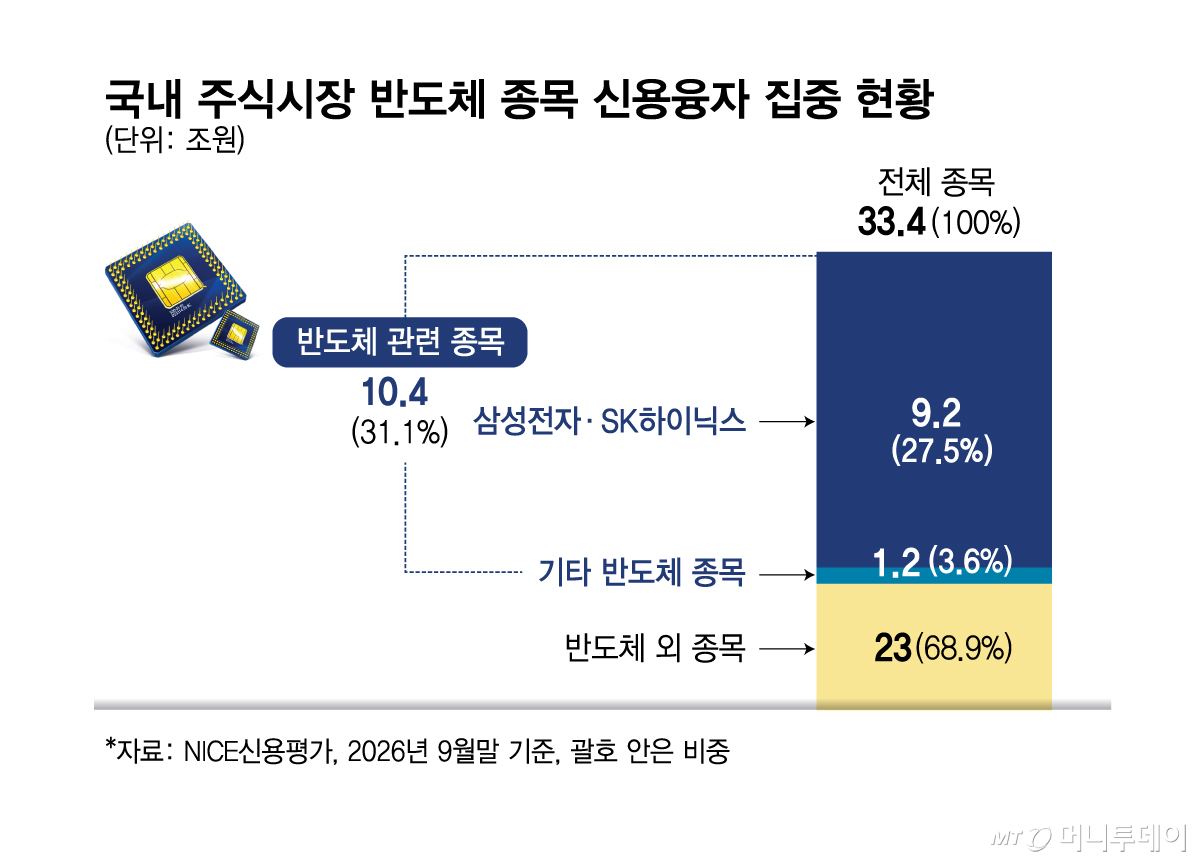
The most direct risk domestically is margin investing (borrowing to invest) concentrated in semiconductor stocks. According to NICE Credit Rating, out of the 33.4 trillion won balance of credit trading loans at domestic securities firms as of the end of September last month, 10.4 trillion won was in semiconductor-related stocks, accounting for 31.1% of the total. As much as 9.2 trillion won was concentrated in Samsung Electronics and SK hynix alone.
If stock prices fall further, forced liquidations could occur due to insufficient collateral. If sell orders flood in at once, it could exacerbate the decline. However, NICE Credit Rating judges that the risk of securities firms failing to recover loan amounts is relatively limited, given that these are large-cap stocks with active trading.
The risks from forced liquidations are not limited to investors who borrowed money. If falling stock prices trigger additional selling, which in turn drives prices down further, investors who did not use margin investing will also be affected. If market anxiety grows and overlaps with moves by investors to reduce risky assets, selling pressure could expand. However, the entire balance of margin investing is not simultaneously subject to forced liquidation; the actual scale of sales varies depending on collateral ratios and the magnitude of stock price declines.
Corporate finance also faces shock if AI investment shrinks… Guard against loan and corporate bond defaults
Outside the stock market, data center financing is cited as a major risk pathway. Data centers launched on expectations of expanding AI demand repay loans based on rental income and other revenues. However, if AI investment slows and actual demand or rental income falls short of expectations, operators' repayment capacity could deteriorate. Financial institutions holding related loan receivables may also face losses.
The corporate bond market could also be affected. If AI-related companies fail to generate sufficient returns compared to the funds borrowed for large-scale capital investment, credit risk could increase and bond prices could fall. Rising costs for new corporate financing could also act as a burden, further worsening investment and profitability. If financial institutions and funds simultaneously sell held assets to reduce losses or secure cash, shocks could spread to other markets.
In particular, data center finance may not end with transactions between operators and lenders. A method is also used where separate investment companies construct data centers, raise funds based on long-term lease agreements, and then transfer loan receivables to funds or institutional investors. In this process, if banks supply funds to both the investment company and the fund, the impact of business underperformance could appear simultaneously in multiple financial institutions. However, whether actual losses occur varies depending on the stability of lease agreements, loan terms, and the investment scale of each financial institution.
A financial investment industry official said, "It is necessary to check the scale of investments and loans by financial institutions in AI-related companies and data centers, as well as the concentration of risk in specific industries," adding, "It is important to comprehensively evaluate whether financial institutions can absorb losses even in a situation where shocks occur simultaneously in the stock, bond, and loan markets."

 in STOCK

