

As the impact of the plunge in major U.S. stock markets is expected to affect domestic markets, cautious responses from retail investors are required. In volatile market conditions, situations where losses expand due to hasty selling, the temptation to buy at low prices, or excessive leveraged investments can arise, making it important to thoroughly understand market trends before investing, experts point out. In particular, given that recent volatility is heavily influenced by supply-demand gaps, advice suggests confirming a shift in foreign investors' trends and executing trades by price range.
According to the financial investment industry on the 1st, domestic stock market volatility is expected to increase further due to the impact of the U.S. stock market plunge. On the 30th of last month (local time), concerns over the profitability of AI (artificial intelligence) investments spread, leading to concentrated selling of tech stocks, with the U.S. NASDAQ falling by 2.86% and the S&P 500 dropping by 1.82%.
The domestic stock market is in a situation where volatility risk has heightened further amid a supply-demand gap caused by foreign investors' net selling of 12.237 trillion won over the month of October. VKOSPI (KOSPI 200 Index Volatility) had fallen to the 30s on the 30th, but rose in mid-October before exceeding 50 again, returning to levels seen in August. Typically, a VKOSPI above 40 is considered an overheated zone.
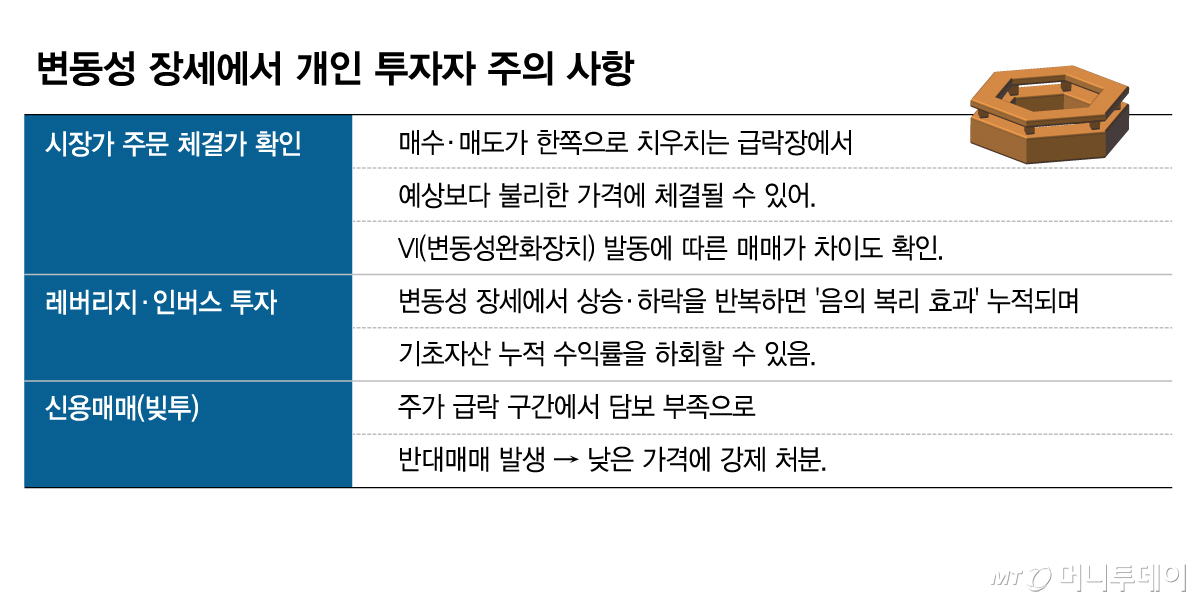
Investment experts point out that caution is needed with "market orders" in highly volatile situations. A market order is a trading method where investors buy or sell stocks at prices currently available in the market without specifying a desired price. While quick execution is an advantage, trades may occur at prices less favorable than expected as buy and sell orders skew sharply to one side. The risk is particularly high when sell orders flood in during the early trading hours and bid offers are insufficient. This is why it is necessary to continuously check the expected execution price and bid/ask offers.
Understanding the VI (Volatility Inducer), which activates during stock price fluctuations, is also essential. The VI is a measure that switches to single-price trading for two minutes if an individual stock's price moves sharply over a short period. It is a mechanism designed to slow down trading speed and provide time to judge an appropriate price. When orders come in, trades are not executed immediately; instead, buys and sells are collected over a set period and executed at a single price. During this process, the actual execution price may differ significantly from the price investors expected.
The most critical area for caution is investing in leveraged ETFs (Exchange-Traded Funds) expecting a rebound after a plunge. In volatile market conditions where a trend reversal cannot be confirmed, jumping into leveraged investments prematurely can lead to significant losses due to the "negative compounding effect." Caution is also required for inverse products based on the same principle.
Leveraged ETFs are products designed to track the daily return of an underlying index at a specific multiple. For example, a 2x leveraged ETF product can generate a 10% return (twice the rate) if the tracked index rises by 5%. Conversely, it is structured to incur losses of approximately 10% if the index falls by 5%. Because this multiple return rate is applied on a daily basis, even if the underlying asset recovers its previous price, leveraged products may not return to their original level.
Credit trading, referred to as "margin investing (investing with debt)," is also an investment method that should be avoided in volatile market conditions. This is because sharp stock price drops can trigger forced liquidation due to insufficient collateral. If investors fail to meet the collateral maintenance ratio set by the securities firm, they must provide additional cash or stocks as collateral; if this is not fulfilled within the specified period, the securities firm forcibly disposes of the held stocks in a process known as forced liquidation.
When forced liquidation occurs, stocks are disposed of at low prices regardless of the investor's will, locking in losses. Even if stock prices rebound later, it is difficult to recover losses because the stocks have already been sold. If large volumes of forced liquidation occur, they can also increase downward pressure on overall stock prices, posing a negative factor for both investors and the market.
Foreign media have also pointed out the risks of margin investing phenomena and leveraged investments in the highly volatile Korean stock market. Manish Raychoudhury, founder and CEO (Chief Executive Officer) of Emmer Capital Partners, warned Reuters last September that a chain reaction of negative stock price cycles continued as credit financing (margin investing scale) rapidly expanded for ETF products targeting sharp fluctuations. This resulted in a phenomenon where the overall market decline widened regardless of companies' fundamental strength.
Experts advise avoiding hasty trend reversals or position increases in volatile markets and instead employing split buying. Kim Yong-gu, Head of the Investment Strategy Team at Yuanta Securities, stated, "The situation is at an extreme of overreaction psychologically and in terms of supply and demand, even though performance or fundamentals growth itself has not changed, so a battle of time is needed with price as collateral." He added, "While enduring volatility until the first half of next year when the macro environment of high inflation and high interest rates improves, if the sustainability of AI CAPEX (capital expenditure) is confirmed and anxiety eases, supply and demand will recover."

 in STOCK
