

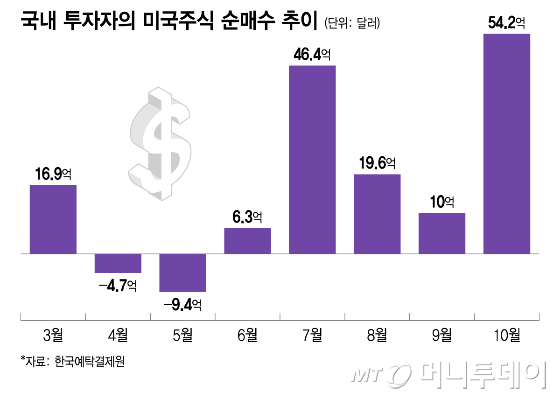
The scale of net purchases of U.S. stocks by retail investors investing in the U.S. stock market hit its highest level this year in October, reaching a level similar to that at the end of last year.
Although the government introduced tax incentives at the end of last year to curb the outflow of overseas investment funds and encourage a return to the domestic stock market, buying pressure has intensified again in just over a year, leading to assessments that the policy's effectiveness has been limited.
October net purchases of U.S. stocks by retail investors in overseas stocks hit annual high... Amid U.S. market turbulence, an opportunity for bargain hunting?
According to the Korea Securities Depository on Tuesday, domestic investors' net purchases of U.S. stocks last month totaled $5.423 billion (approximately 7.3 trillion won), marking the largest monthly figure this year. This is the highest level in just over a year, following net purchases of $6.855 billion (approximately 9.2 trillion won) in October last year and $5.934 billion (approximately 8 trillion won) in November.
It is noteworthy that buying by retail investors in overseas stocks expanded amid increased volatility in both domestic and global stock markets. Last month, the domestic market showed weakness due to large-scale selling by foreign investors, while the U.S. market also underwent a correction amid doubts about the growth potential of the AI (artificial intelligence) industry and external uncertainties.
Despite this, domestic investors actively bought U.S. stocks last month, increasing their overseas investment allocation. Prior to that, net purchases in August and September were limited to $1.962 billion (approximately 2.6 trillion won) and $1.002 billion (approximately 1.3 trillion won), respectively.
Even in July, when domestic market volatility was extreme due to the impact of single-stock leverage ETFs (exchange-traded funds), the scale of net purchases of U.S. stocks by retail investors in overseas stocks stood at approximately $4.6 billion (approximately 6.1 trillion won).
This is interpreted as retail investors in overseas stocks viewing the expansion of volatility in the U.S. stock market as an opportunity to buy key stocks and products at low prices. In particular, it is known that buying pressure for ETFs betting on a rebound in the U.S. semiconductor sector has been steep.
Additionally, analysts suggest that the burden of buying U.S. stocks has eased somewhat as the won/dollar exchange rate, which had risen to the mid-1,500 won range in June, recently fell to the 1,300 won range.
Inducing a domestic U-turn through tax incentives... but it became a "wasted effort" after just over a year
This result also runs counter to the government's policy of encouraging the return of overseas investment funds to the domestic market. At the end of last year, the government announced the introduction of the Return Investment Account (RIA) to reduce the outflow of individual investor funds abroad and encourage a return to the domestic stock market.
The RIA is a system that provides tax relief on capital gains from overseas stocks if the proceeds from selling those stocks are invested in domestic stocks or other assets for a certain period, which took effect this March. The relief rate is 100% for sales of overseas stocks through May, 80% for June to July, and 50% for August to December.
In April and May, when the tax relief benefits were greatest, domestic investors made net sales of U.S. stocks, seemingly showing policy effectiveness. However, from June, when the relief rate decreased, buying shifted back to net purchases, and last month saw buying pressure expand to its largest scale in just over a year.
The securities industry views that it is limited to sustain the return of overseas investment funds to the domestic market solely through temporary tax benefits.
Ultimately, opinions suggest that the flow of funds heading abroad can only be changed by enhancing the investment appeal of the domestic stock market through expanded shareholder returns, a rebound in the share prices of growth companies, and the restoration of market confidence.
An official at a securities firm said, "There are points noting that RIA enrollment conditions are not simple and that funds must be maintained for more than one year after returning to the domestic market, which acts as a burden on the domestic U-turn by retail investors in overseas stocks."

 in STOCK
