

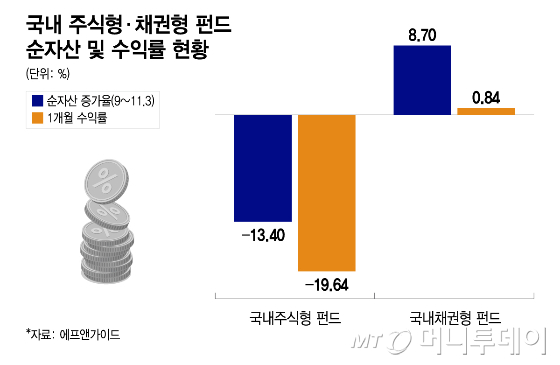
The fortunes in the fund market have diverged as the domestic stock market plunged. Since early September, while the net assets of domestic equity funds decreased by 34 trillion won, domestic bond funds increased by 8 trillion won, surpassing the 100th trillion won mark. While equity funds posted double-digit losses, bond funds maintained positive returns, drawing attention as a stable alternative.
According to financial information platform FnGuide on Wednesday, the net assets of domestic equity funds, which stood at 254 trillion won in early September, decreased by 13.4% to 220 trillion won as of the 3rd. In contrast, during the same period, the net assets of domestic bond funds increased by 8.7%, from 92 trillion won to 100 trillion won.
The net assets of overseas equity and overseas bond funds also saw slight declines or remained flat during the same period. Amid a general decrease in the net assets of most major fund types both domestically and abroad, only domestic bond funds showed a notable increase.
A similar trend was observed in the ETF (Exchange-Traded Fund) market as well. The net assets of domestic equity ETFs decreased by 12.5%, from 200 trillion won to 175 trillion won during the same period, while domestic bond ETFs increased by 11.9%, from 67 trillion won to 75 trillion won.
Analysts suggest that this difference in net asset flows is not unrelated to the gap in returns. The recent one-month return for domestic equity funds was -19.64%, with three-month and six-month returns at -10.77% and -27.73%, respectively, all recording double-digit losses. In contrast, domestic bond funds showed positive returns of 0.84%, 1.34%, and 1.02% over the same periods, respectively.
The situation is similar for ETFs. The recent one-month, three-month, and six-month returns for domestic equity ETFs were -19.87%, -10.60%, and -23.77%, respectively. During the same period, domestic bond ETFs maintained positive returns of 0.37%, 0.98%, and 0.68%, respectively.
However, compared to the beginning of the year, the change is distinct. At the start of the year, the net assets of domestic equity funds were around 138 trillion won, while those of domestic bond funds were about 106 trillion won. Despite recent declines, the net assets of domestic equity funds have increased by 82 trillion won compared to the beginning of the year, whereas bond funds have decreased by 6 trillion won.
Until the first half of this year, equity products attracted investor interest thanks to the rise in the domestic stock market. However, with recent sharp drops in stock prices increasing loss risks, the appeal of bond products, which deliver relatively stable performance, is being highlighted. Market attention, which had been concentrated on equity funds since the beginning of the year, appears to be shifting toward bond funds recently.
The high-interest-rate environment is also cited as a factor enhancing the investment appeal of bond funds. It is explained that the ability to secure relatively high interest income in a situation where returns are difficult to expect from the stock market is stimulating investor sentiment. However, it should be noted that if market interest rates rise further, bond prices may fall, potentially resulting in valuation losses.
"As volatility in the stock market has increased due to various domestic and international variables, the preference for safe assets is becoming prominent," a securities industry official said. "While some funds have flowed into bonds, considering inflation levels, the possibility of additional interest rate hikes cannot be ruled out, making an investment strategy centered on short-term bonds rather than long-term bonds appear advantageous at this point."

 in STOCK
