

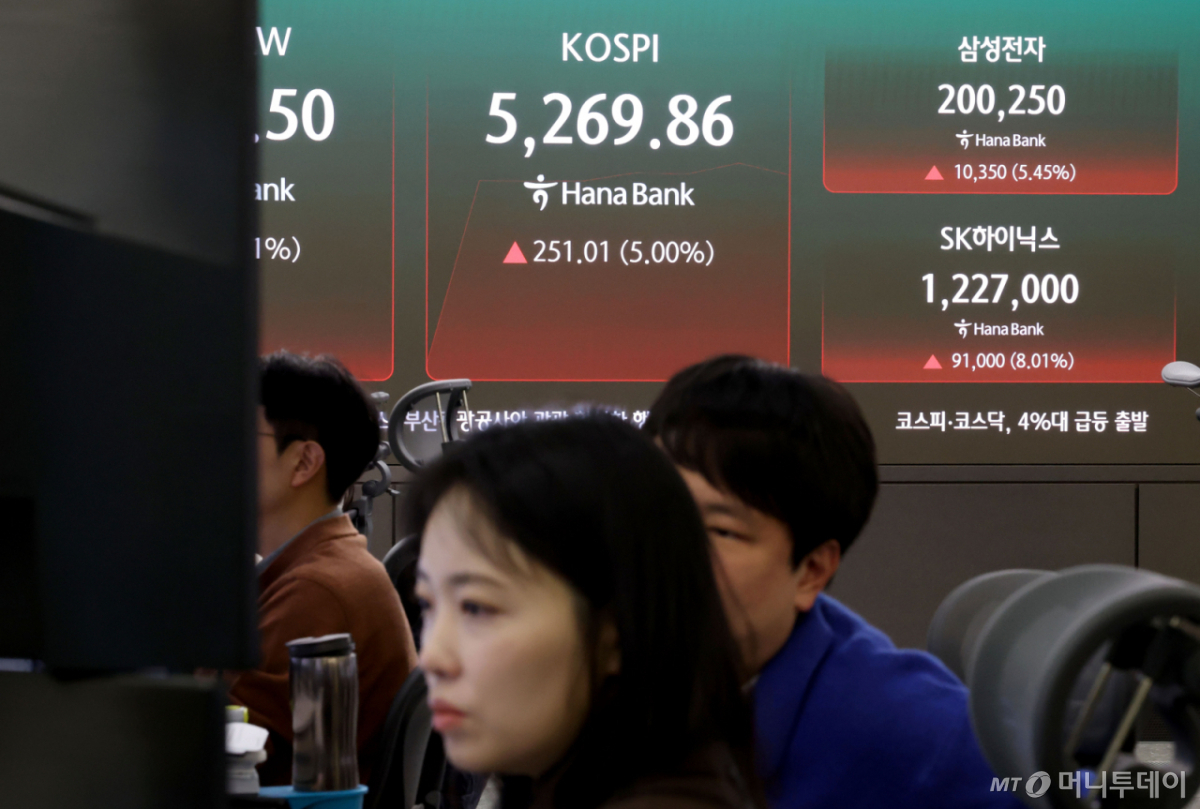
Global investment banks Goldman Sachs and Morgan Stanley issued diametrically opposite diagnoses on Korean semiconductor stocks on the same day.
Goldman Sachs viewed Samsung Electronics and SK hynix, which plunged after the U.S. midterm elections, as being in an "oversold" phase approaching historic lows.
In contrast, Morgan Stanley cut its target price for SK hynix by 38%, citing potential profit margin compression due to increased memory supply in 2028. Both IBs viewed the current industry conditions as solid, but their judgments diverged on the outlook for 2028.
According to financial investment industry sources on Tuesday, Goldman Sachs stated in a report on Monday (local time) that semiconductor stocks had entered an oversold zone. This diagnosis followed the sharp drop in stock prices driven by concerns that regulations on AI (artificial intelligence) data center construction could be tightened after the U.S. midterm elections. The Philadelphia Semiconductor Index fell 13% over the past week and 31% since the 1st.
The basis for Goldman Sachs' optimism lies in expanded AI investment and valuation. Goldman Sachs forecast that "AI infrastructure investment will increase from approximately $1.3 trillion (approximately 1,751 trillion won) next year to about $2 trillion (approximately 2,694 trillion won) by 2028."
Stock price levels have also approached historic lows. According to estimates from the securities industry, the 12th-month forward PBR (price-to-book ratio) for Samsung Electronics and SK hynix is 1.21x and 1.23x, respectively. The all-time low PBRs for the two companies were 0.83x and 0.8x, respectively. Goldman Sachs noted that "while there may be a lack of catalysts for stock price increases by year-end, selective investment appeal has increased."
David Solomon, CEO (Chief Executive Officer) of Goldman Sachs, also emphasized in an interview with CNBC on the same day that while acknowledging the possibility of market adjustments due to changes in the political environment, "I still firmly believe in the long-term outlook that AI will contribute to improving the productivity of our economy."
In contrast, Morgan Stanley significantly lowered its target prices for major Korean semiconductor stocks on the same day. Sean Kim, a researcher at Morgan Stanley, cut Samsung Electronics' target price by 19% from 381,000 won to 309,000 won, and SK hynix's target price by 38% from 2.6 million won to 1.6 million won. The firm maintained its overweight recommendation for both companies but lowered its long-term profitability assumptions.
Morgan Stanley viewed 2028 as a turning point for the industry cycle. This is precisely the year Goldman Sachs expects continued growth in AI investment. Kim and other researchers stated, "Short-term memory fundamentals appear solid, but increased supply in 2028 due to new production capacity coming online is the issue," adding, "If memory supply increases from late 2027, it may become difficult to maintain high profitability, so we lowered our long-term profit margin assumptions and the valuation multiples applied to target prices."
Researcher Kim previously drew market attention by warning of a semiconductor industry downturn in his August 2021 report titled "Memory, Winter is coming."

 in STOCK
