

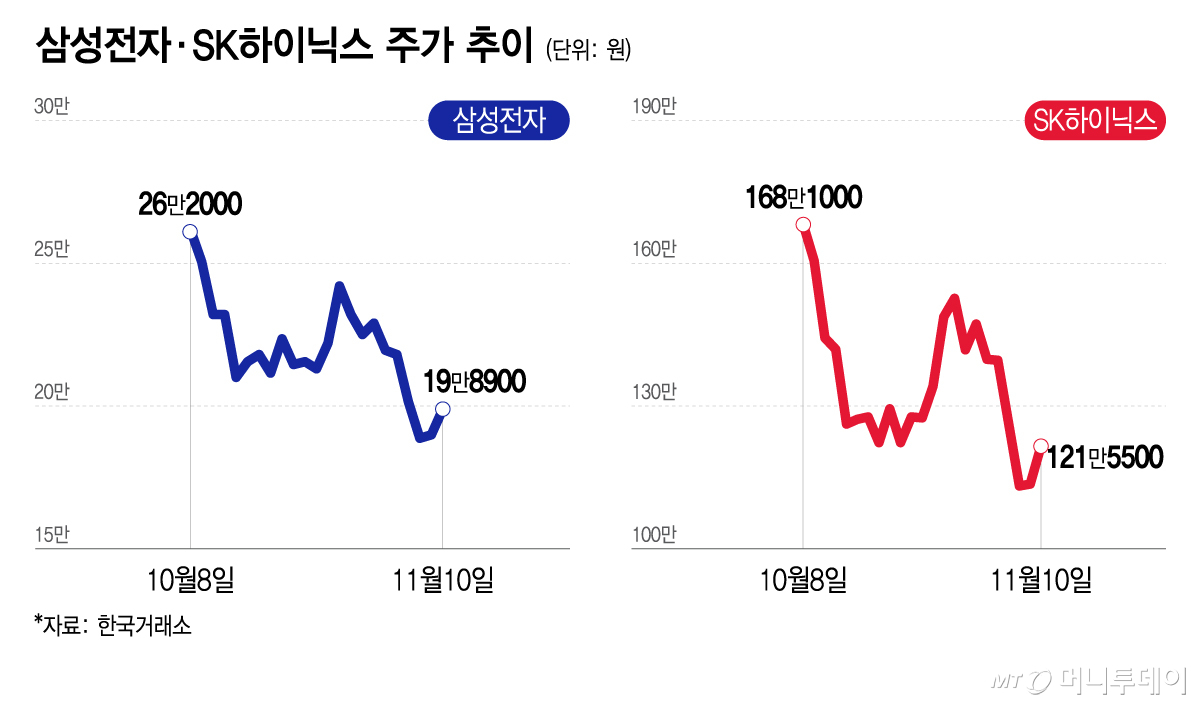
Samsung Electronics, SK hynix and other semiconductor stocks rose for the second consecutive day. This followed a rally in the U.S. New York stock market overnight, driven primarily by AI (artificial intelligence) semiconductors and technology stocks, as well as falling oil prices and inflows of bargain-hunting buying following recent declines.
Analysts at securities firms noted that while concerns over stricter regulations on AI data centers had caused a pause in the market, perceptions are spreading that the total volume of investment will be maintained.
On Tuesday, SK hynix, one of the top two semiconductor stocks, closed regular trading at 1,242,000 won, up 76,000 won (6.69%) from the previous close. Although SK hynix rose for the second day in a row, it failed to recover the losses incurred over the preceding four trading days. Samsung Electronics, the leading stock on the KOSPI, also closed at 198,900 won, up 900 won (4.74%) from the previous close. The daily price movement for Samsung Electronics mirrored that of SK hynix.
So-called “S7” stocks, linked to these companies through business ties and shareholdings, also showed broad strength. Samsung Electronics Preferred (5.37%), SK Square (5.26%), Samsung Electro-Mechanics (4.63%), Samsung C&T (3.53%), and Samsung Life Insurance (3.16%) all closed higher.
Demand for semiconductor investment spread to related small- and mid-cap stocks as well. In the KOSDAQ semiconductor equipment sector, Coase closed at 28,650 won, up 4,050 won (16.46%) from the previous close. Following this, LTI BCL (15.13%), Iotech (14.48%), SFA Semiconductor (13.17%), Exicon (13.14%), and Jestem (10.50%) all posted double-digit gains.
The two major domestic stock exchanges benefited from this situation. Early in trading, a buy-side sidecar (futures market circuit breaker) was triggered on both the KOSPI and KOSDAQ. This marks the ninth time this year that buy-side sidecars have been activated simultaneously on both exchanges.
The strength in the semiconductor sector appears to have been influenced by overnight developments in the New York stock market. On the 9th (local time), AMD surged 13.26%. Additionally, Marvell Technology (9.49%), Broadcom (8.78%), Micron Technology (6.25%), and SK hynix’s U.S. American Depositary Receipts (ADRs) (5.53%) all closed higher.
On the same day, NVIDIA fell more than 8.7% intraday, but overall investor sentiment toward AI semiconductors remained positive. The market did not interpret the fact that Jensen Huang, CEO of NVIDIA, admitted to an affair with a female businessperson suspected of being a Chinese spy, and that the board of directors subsequently launched an investigation into related allegations, as a risk for the entire sector. Consequently, the U.S. S&P 500 rose 2.35%, the Dow Jones Industrial Average gained 2.15%, and the NASDAQ Composite Index, centered on technology stocks, climbed 2.74%.
The market viewed falling international oil prices and bargain-hunting buying in technology stocks as factors boosting investor sentiment. Remarks by U.S. President Donald Trump downplaying the possibility of a military attack on Iran also appear to have had an impact.
Securities firms said that the prevailing outlook that the total volume of AI investment will be maintained could lead to a rebound in the stock market. Lee Kyung-min, a research analyst at Daishin Securities, stated, “Recently, concerns over stricter regulations on AI data centers caused a sharp drop across the entire AI value chain,” while adding, “However, perceptions are spreading that delays in new data center permits may slow the pace of investment execution but will not directly lead to a reduction in the total volume of AI investment.”
Lee Su-rim, a research analyst at DS Securities, noted, “The investment appeal of Samsung Electronics can be found not only in its earnings growth next year but also in the scale of profits it can maintain even after price adjustments,” adding, “Similarly for SK hynix, the scale of profits that can be maintained after price adjustments supports its medium-term investment appeal.”

 in STOCK
