

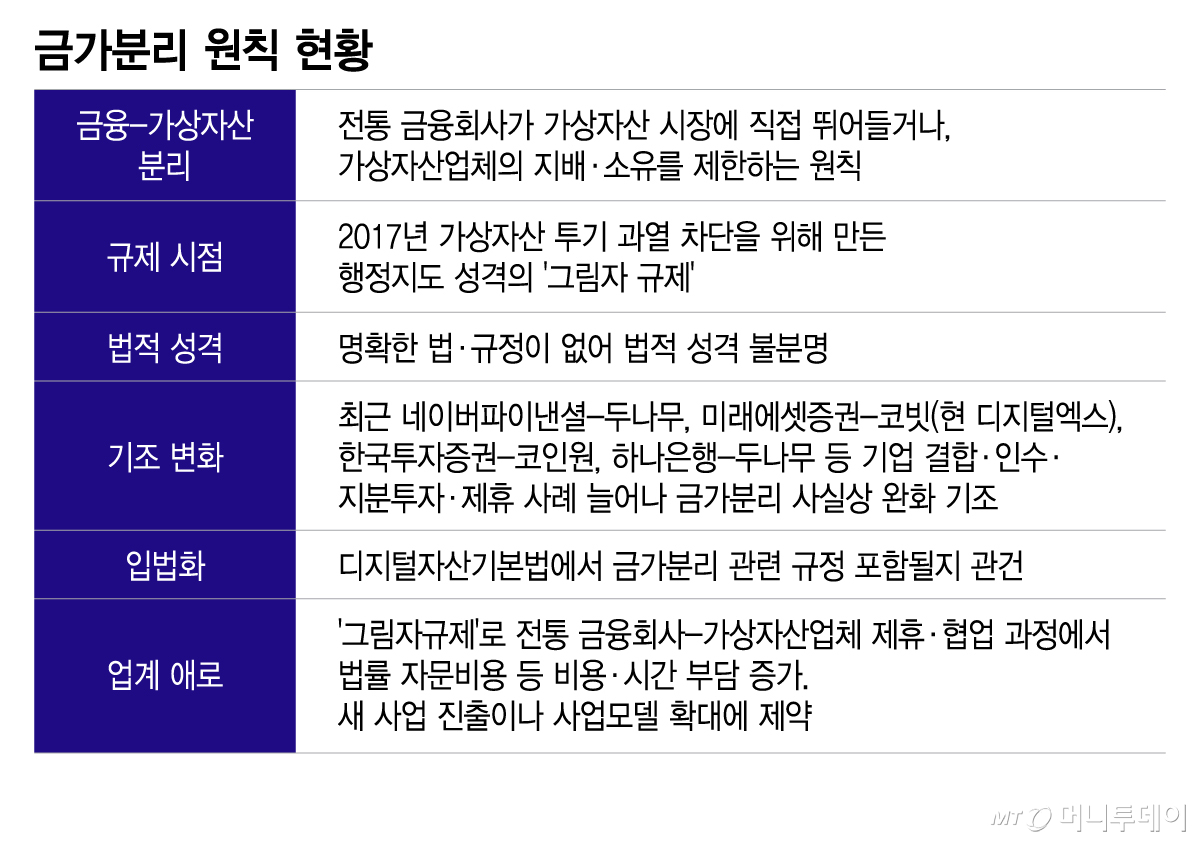
Collaboration between financial companies and virtual asset operators has been slow to gain momentum. Critics point out that the so-called principle of separating finance and virtual assets, which restricts ownership, control, and collaboration between the two sectors, is increasing the burden on both the industry and regulators. The principle itself is ambiguous, and its legal status is unclear, resulting in significant burdens such as legal costs for the financial investment industry and heavy management and supervision responsibilities for financial authorities. The industry is watching to see whether the Digital Asset Basic Act that financial authorities are expected to submit to the National Assembly this month will remove this ambiguity.
According to the financial investment industry and financial authorities on the 16th, the Financial Services Commission is expected to submit the Digital Asset Basic Act to the National Assembly within this month. The act is set to include definitions of the digital asset industry, scope of business, obligations that operators must adhere to, and sanctions for violations. It is predicted that the principle of separating finance and virtual assets, which had unclear legal status and content, will also be clarified through this law. A financial official familiar with the matter stated, "Until now, there were no codified regulations regarding the principle of separating finance and virtual assets," adding, "Once the bill is released, regulations on many areas, including the separation principle, will become clearer."
The principle of separating finance and virtual assets is a type of policy direction introduced by the Financial Services Commission in 2017 to prevent a speculative boom in virtual assets. Because there are no codified laws or regulations, it has been interpreted as a comprehensive prohibition, leading to restrictions on new business expansion for financial investment companies and virtual asset operators. An industry official said, "The regulation that concerns us most when traditional financial institutions and virtual asset exchanges collaborate is the separation principle, but we cannot tell what is allowed and what is not," adding, "That is why they are trying to avoid controversy by simply creating a single company through mergers and acquisitions."
Financial authorities have also had no choice but to manage and supervise the industry by urging sufficient legal review. According to a business letter from the Korea Financial Investment Association obtained by Kang Jun-hyun, a Democratic Party of Korea lawmaker on the National Assembly's Political Affairs Committee, the association, at the request of the Financial Supervisory Service, notified the planning, compliance monitoring, and digital asset-related departments of each securities firm that "business partnerships through virtual asset exchanges may violate the principle of separating finance and virtual assets depending on their content."
The business letter stated, "Before pursuing business partnerships with virtual asset operators, such as linking Mobile Trading Systems (MTS) and Home Trading Systems (HTS), please conduct sufficient internal legal reviews at your securities firm and discuss thoroughly in advance with the Financial Supervisory Service." This meant that the Financial Supervisory Service, through the association, requested each company to conduct its own legal review and hold preliminary discussions with the supervisory authority.
Authorities are equally struggling. Although they have recently shown a trend toward easing the separation of finance and virtual assets, because standards are not codified, they must make judgments on a case-by-case basis. An industry official stated, "When new partnership services emerge between financial institutions and virtual asset exchanges, other companies frequently inquire with financial authorities to check if there are any issues with those services," adding, "Ultimately, the authorities have no choice but to judge and interpret each individual case one by one, resulting in a heavy burden of time and cost."
In particular, this year has seen an increase in mergers and partnerships between securities firms and virtual asset exchanges, leading to a flood of inquiries from various companies. In the financial investment industry this year, leaders such as Mirae Asset Consulting's acquisition of Coinbit (now Digital X) and Korea Investment & Securities' equity investment in CoinOne have entered the digital asset business by expanding touchpoints with partners. An industry official lamented, "Looking at the combination of Naver Financial and Dunamu, and Hana Bank's equity investment in Dunamu, the industry views it as a relaxation of the separation regulation," adding, "However, because there is no industry-specific law yet, there are limits to collaboration even if we want to do it."
Calls have also emerged from the National Assembly for rapid legislation to resolve shadow regulations. Lawmaker Kang Jun-hyun emphasized, "With the addition of digital assets, means of transaction are diversifying and transaction patterns are becoming varied, making the structure of the financial market increasingly complex," adding, "In this rapidly changing situation, if we fail to establish clear principles for market definition through industry classification, confusion and uncertainty may grow. Financial authorities must quickly establish standards."
Based on a summary of financial authorities' policy directions so far, it appears that the authorities will apply strict criteria to digital asset issuers. It is likely that they will impose major shareholder eligibility requirements similar to those for existing financial institutions on stablecoin issuers, while applying relatively weaker entry regulations to distribution operators. Anti-money laundering and customer identification obligations are expected to be applied strictly with reference to overseas cases, and supervision is also expected to be strengthened.

 in STOCK
