

South Korea's record $1 trillion in annual exports has fueled expectations of further gains in the stock market. Rising exports typically boost corporate sales and profits, providing a key driver for share prices.
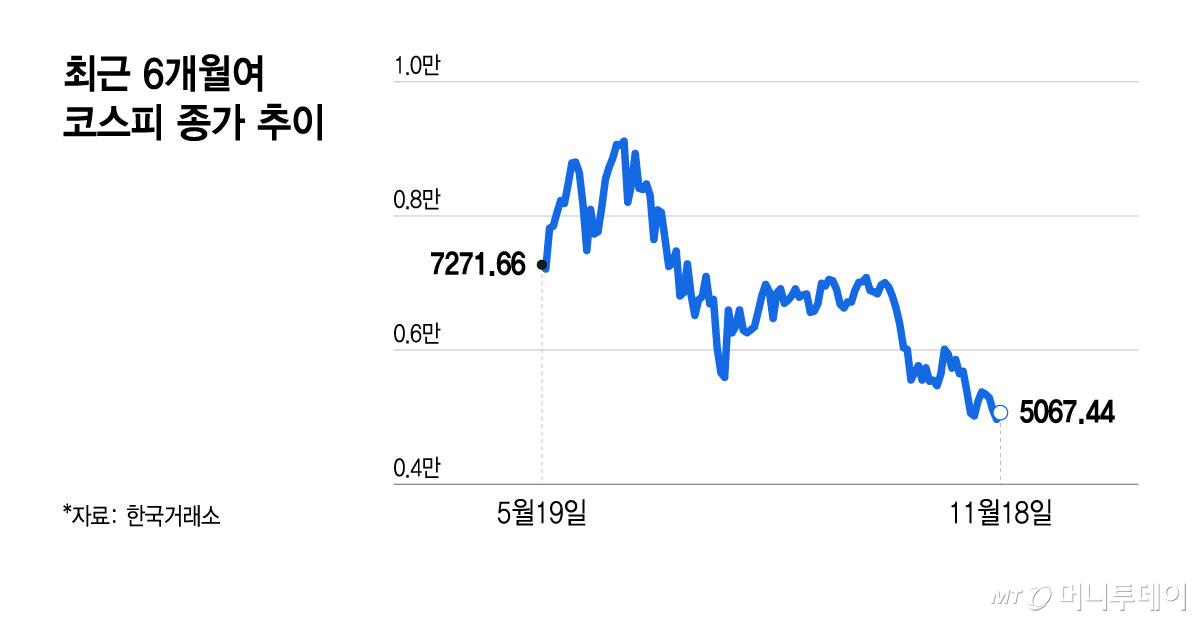
But the domestic market has recently swung amid concentrated capital flows and domestic and global uncertainties. Analysts say export strength must spread beyond semiconductors to other industries to sustain a broader Kospi rally.
Korea enters $1 trillion export era… Profits and stock prices skewed toward semiconductors
According to the Ministry of Trade, Industry and Energy and the Korea Customs Service on Thursday, Korea has joined the "$1 Trillion Export Club" as the fourth country in the world, following the United States, Germany, and China. This is evaluated as a remarkable achievement in Korea's roughly 80-year export history.
Semiconductors are at the center of the export boom. Semiconductor exports from January to October this year surged 193.1% year-on-year to $396.8 billion, accounting for 42.7% of total exports. Computer exports also exceeded three times their previous peak at $45.1 billion, driven by server demand. Electrical equipment ($15.6 billion) and non-ferrous metals ($16.1 billion) also recorded all-time high results.
However, a temperature gap is also felt between semiconductors and other major export items. According to Korea Customs Service data, semiconductor exports from the 1st to the 10th of this month were $16.632 billion (approximately 22.21 trillion won), up 331.2% year-on-year. In contrast, passenger car exports decreased by 4.3%. Since semiconductors account for a significant portion of export growth, the burden from industry cycle fluctuations remains.
This structure is also confirmed in the earnings outlooks of domestic listed companies. While profit forecasts for semiconductor companies are being revised upward significantly, performance forecasts for other sectors are actually deteriorating.
A report released by Kiwoom Securities on the 12th also highlights that upward revisions to profit forecasts are concentrated in semiconductors.
The operating profit forecast for the semiconductor sector for 2027 increased by 118 trillion won, while the operating profit forecasts for the 25th sectors excluding semiconductors decreased by approximately 8 trillion won.
In particular, the automotive sector, burdened by raw material and promotional costs combined with a strong won, saw its profit forecast for next year revised downward by about 13%, showing the largest decline.
Choi Jae-won, a researcher at Kiwoom Securities, expressed concern, stating, "The momentum for upward revisions in annual performance forecasts is concentrated in the single sector of semiconductors," and "In other sectors, performance deterioration is actually spreading."
"The profit base needs to broaden evenly, and results must sufficiently return to shareholders"
The issue is that the semiconductor-centric growth structure is acting as a factor increasing domestic stock market volatility. As the market's upward momentum concentrates on some large-cap stocks such as Samsung Electronics and SK hynix, the likelihood that price changes in these stocks will determine the overall market's ups and downs is growing.
In fact, despite improved performance from semiconductor companies, the domestic stock market showed extreme volatility entering the second half of the year. This was because expectations for the growth potential of the AI (artificial intelligence) industry and concerns about overinvestment intersected, shaking investor sentiment centered on large-cap semiconductor stocks.
Capital market experts advise that it should be considered that increased exports and corporate performance do not only have a positive impact on stock prices. They explain that the stock market comprehensively reflects not only current performance but also the sustainability of future profit growth, interest rates, exchange rates, and global supply and demand.
Roh Doong-gil, a researcher at Shinhan Investment Corp, analyzed, "Stock prices often move ahead of published consensus estimates," and "The fact that stock prices fell despite high upward revisions to semiconductor companies' profit forecasts is the result of the market shortening the period it takes to recognize high profits."
While the securities industry attributes significance to achieving $1 trillion in exports as a result strengthening the fundamental strength of the domestic stock market, it points out that for the KOSPI to rise continuously, the base of profit growth must broaden.
There is an opinion that upward momentum can spread across the entire stock market only if performance improvements are accompanied by major export companies in sectors such as automobiles, shipbuilding, steel, and chemicals, alongside semiconductors.
Expanding shareholder returns and improving corporate governance are also cited as key tasks. An official from a securities firm said, "Even if corporate valuation rises due to increased exports and performance, there will inevitably be limits to stock price increases if those results do not sufficiently return to shareholders," adding, "Restoring foreign investors' trust in the domestic market is also a condition for stable stock market growth."

 in STOCK
