

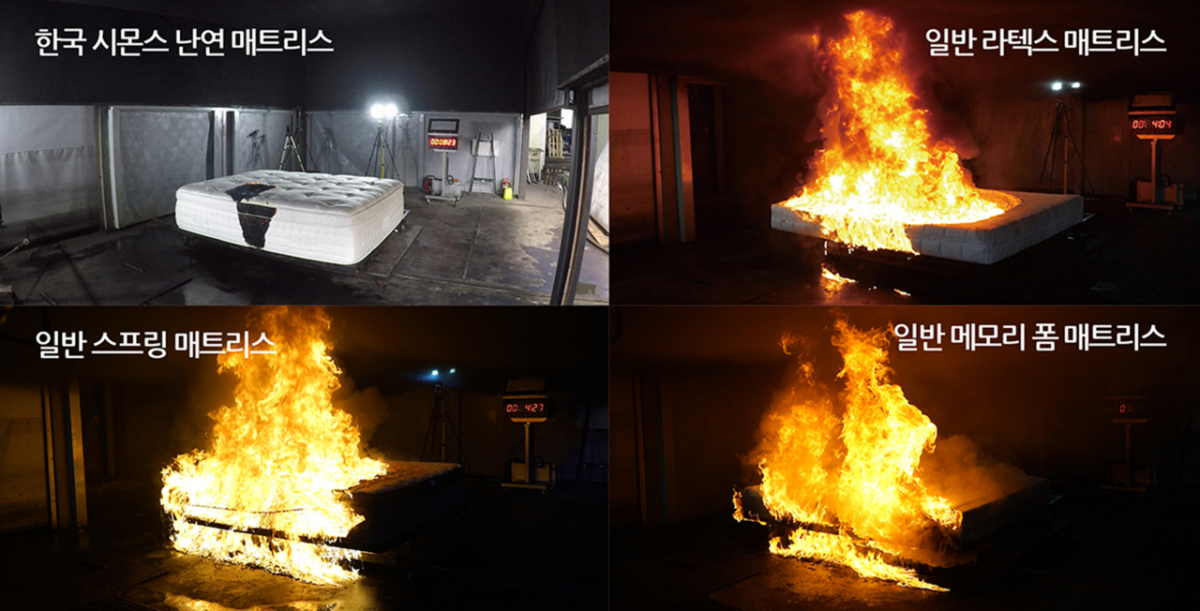
In January 2024, when a severe cold wave swept across the country, numerous residential and apartment fires occurred nationwide, resulting in consecutive casualties. Amidst these tragic reports, Ahn Jung-ho, CEO of Simmons Bed, made a groundbreaking decision. He fully disclosed to the market, without any conditions, the patent for the "flame-retardant mattress manufacturing process" that had been acquired after investing substantial research and development (R&D) costs over several years to differentiate from other companies. In traditional manufacturing industries, a 'patent' is one of the most powerful entry barriers and weapons guaranteeing profits. However, Simmons chose "Open Innovation," sharing its core assets with society instead of maintaining a technology monopoly.
According to industry sources on Thursday, Simmons' such patent disclosure is cited as a representative case of social responsibility in the domestic bed market and a move toward ESG (Environmental, Social, and Governance) management.
The background behind Simmons' decision to disclose the patent lies in its awareness of fire safety issues. Mattresses are bulky and contain internal air layers, which can exacerbate casualties through fire spread and toxic gas emission once ignited.
In particular, residential fires can lead to fatal outcomes if evacuation is delayed. The company focused on the social value of the technology, noting that flame-retardant mattresses can help secure evacuation time by slowing down fire spread.
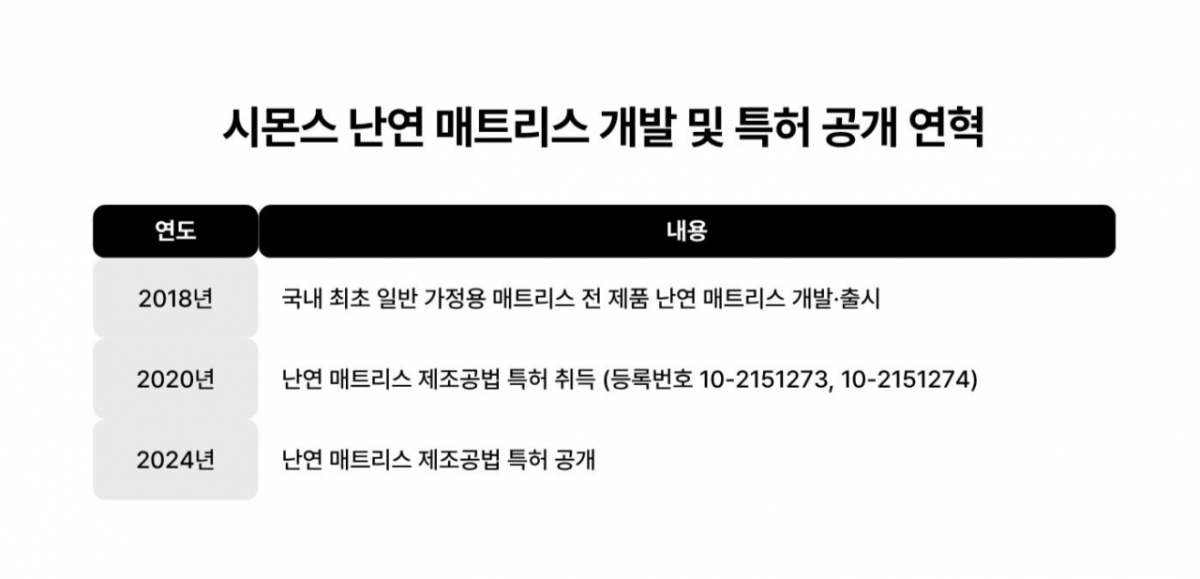
In 2018, Simmons became the first in Korea to convert all its general household mattress products into flame-retardant ones. In 2020, it obtained patents for a flame-retardant mattress manufacturing process applying self-developed new materials such as "Maximum Safety Padding" (Registration No. 10-2151273, 10-2151274). Four years later, the company opened this technology to the market.
Through the patent disclosure, Simmons secured the intangible asset of "social trust." While instilling in consumers the perception of being a safety-focused company, it also achieved the effect of increasing brand loyalty.
Experts assess that Simmons' market dominance has become even more solid. This is because trust was built as a "good company" that shared proprietary technology capable of saving lives with society, making brand loyalty even stronger.
Jung Yeon-seung, a professor in the Department of Business Administration at Dankook University, evaluated it by stating, "Disclosing a proprietary patent that required substantial R&D investment to the market without conditions is not an easy decision without the owner's firm philosophy of public interest," and called it "a case of corporate social responsibility that raises the safety level of the entire industry."

However, there are limits to driving change across the entire bed industry solely through Simmons' patent disclosure. The biggest obstacle is the institutional vacuum.
While major advanced countries such as the United States, the United Kingdom, and Canada apply flame-retardant standards to general household mattresses, Korea does not yet have relevant mandatory standards. Since there is no legal obligation, manufacturers are not strongly motivated to adopt flame-retardant technology while bearing additional costs.
In particular, cost increases and changes in production processes pose a significant burden on small and medium-sized manufacturers. It is not the case that all companies can immediately apply the technology just because the patent has been disclosed.
Additional investment is required from securing flame-retardant materials to improving production equipment, quality control, and performance verification. Although technical accessibility has increased, there are still many hurdles to overcome before it takes root in actual industrial sites.
A bed industry official said, "Mattresses occupy a large area and have air layers, so the speed at which they spread fire is very fast, potentially leading to significant casualties."
He added, "There are many questions about whether it is necessary to invest manpower and costs when safety standards have not been legislated."

 in LIVING


