

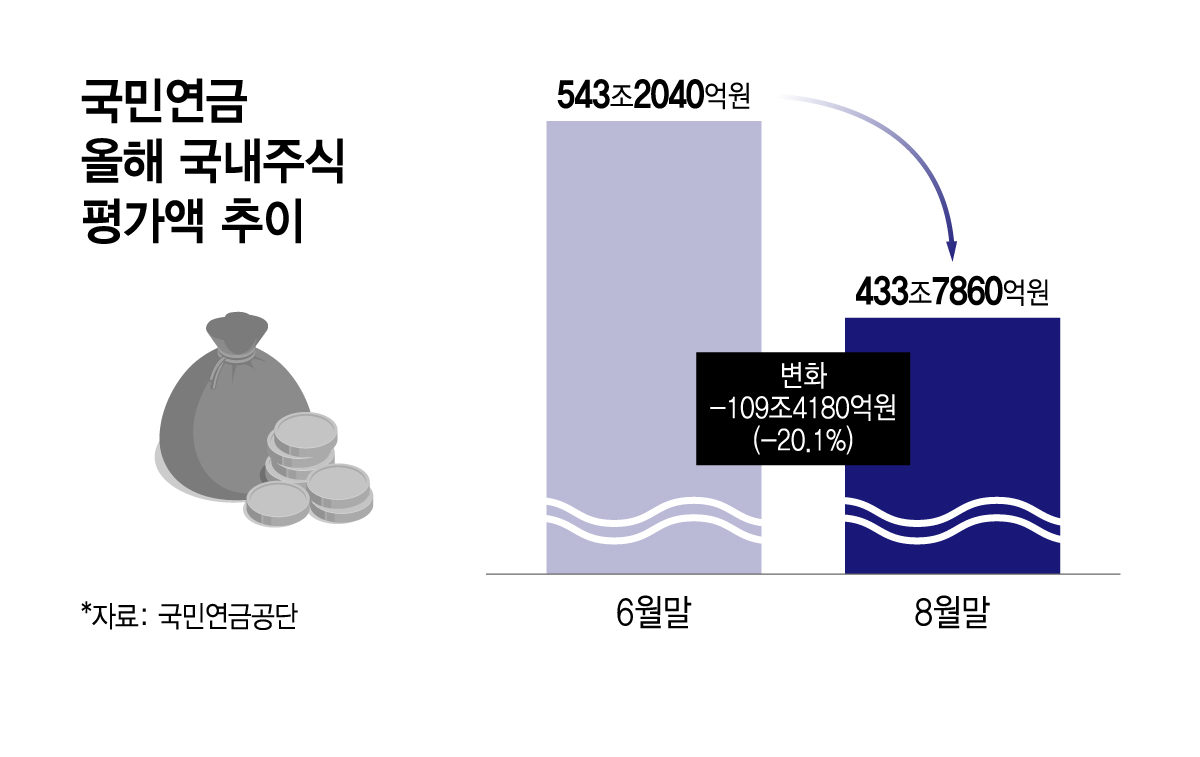
A plunge in AI stocks, comparable to the collapse of the dot-com bubble, has hit the National Pension Service. The NPS's domestic equity valuation dropped by more than 240 trillion won in the second half of this year alone, falling below the 300th trillion won mark. The NPS countered that the first-half suspension of rebalancing ctually reduced losses.
On No. 23, an arithmetic calculation substituting the NPS's latest public disclosure—domestic equity valuation as of the end of August this year (433 trillion 786 billion won)—and the KOSPI closing price at that time (6820.02) into the intraday low of the KOSPI on the 23rd (4656.15) estimated the current domestic equity valuation at 296 trillion 153.5 billion won, falling below 300 trillion won.
Compared with the NPS's disclosed domestic equity valuation at the end of June, this represents a sharp decline of 247 trillion 50.5 billion won.
The NPS uses the KOSPI as a performance benchmark in its internal management guidelines. As of the end of August, the NPS's domestic equity return for this year was 65.86%, while the KOSPI-based return including dividends was 63.54%, indicating that operations have essentially tracked the KOSPI trend directly. Had the NPS maintained its holdings, its domestic equity valuation would likely have absorbed the full impact of the KOSPI decline.
The NPS suspended domestic equity rebalancing in January until the end of June, resuming it on July 1. However, according to NPS disclosures, the change in domestic equity valuation from July to August was at a level similar to the fluctuation in domestic equity returns. It is observed that even after resuming rebalancing in July, the NPS did not significantly reduce its domestic equity holdings through sales.

While stating that it does not disclose real-time domestic equity holdings, an NPS official explained regarding the controversy over the rebalancing suspension: "We understand that a simulation assuming sales without suspending rebalancing would have yielded worse results."
Previously, Kim Seong-ju, head of the National Pension Service, stated during last month's National Assembly audit that had they followed the original rules, they would have had to sell more than 800 billion won worth of stocks daily. At the time, Chairman Kim said, "When the market changes rapidly, it is more beneficial for returns to maintain holdings initially."
The NPS maintains that there were no suitable alternative investment destinations to shift funds from domestic equities. In an SNS video after the audit, Kim noted, "Domestic bonds were down 3%, and overseas equity returns were only about 10%." According to NPS disclosures, the return on alternative investments for this year as of the end of August was also just 0.29%.
James Mackintosh, a columnist for the U.S. Wall Street Journal (WSJ), analyzed in a column titled "Has the AI Bubble Already Burst?" on Nov. 22 (local time) that "history does not repeat itself exactly, but the AI selling sweep that has engulfed stock markets in recent weeks bears a striking resemblance to the dot-com bubble collapse."
In the column, Mackintosh identified the Korean stock market as a typical example of a "mini-bubble," claiming that Korean memory semiconductor stocks surged and plunged by absorbing funds from leveraged retail investors.

 in STOCK

