

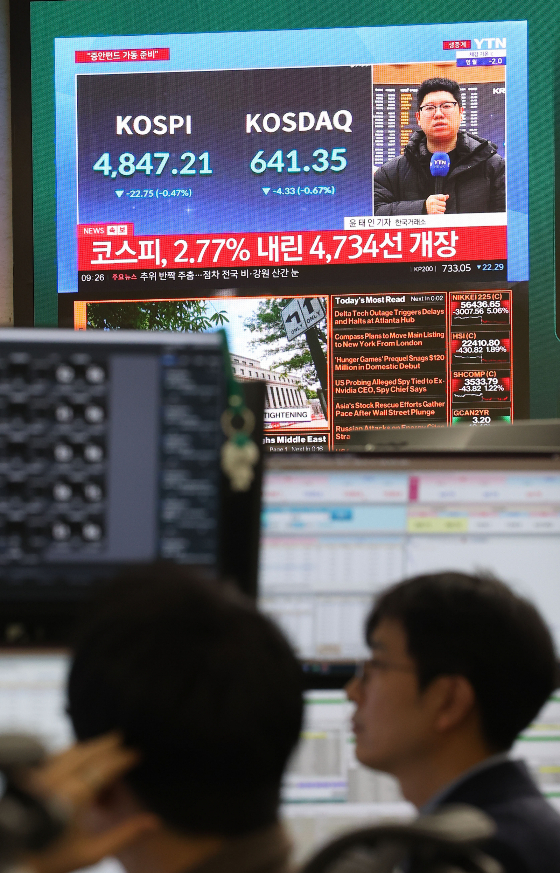
The KOSPI index fell to the 4,600 level during trading, bringing it closer to its year-to-date low of 4,200. This is interpreted as selling pressure intensifying after negative news that shook investor sentiment in AI stocks emerged on Nov. 20 (local time), including U.S. export restrictions on China. A sell-side sidecar was triggered in the KOSPI during the morning session.
According to Korea Exchange data on the 23rd, at 11:21 a.m., the KOSPI index was trading at 4,650.26, down 219.70 points (4.51%) from the previous close. It has consecutively broken below the 4,800 and 4,700 levels. The KOSDAQ index fell to 625.21, setting a new intraday year-to-date low. A sell-side sidecar was also triggered.
On Nov. 20 (local time), on the New York Stock Exchange, the NASDAQ Composite Index fell by 5.28%, the S&P 500 index dropped by 3.70%, and the Dow Jones 30 Industrial Average declined by 1.93%. The Dow Jones Industrial Average and the S&P 500 index have fallen more than 10% from their previous highs, entering a correction phase. The NASDAQ index has given back all of its year-to-date gains. The Philadelphia Semiconductor Index plunged by 10.7%.
Yang Hyeon-gyeong, a research analyst at iM Securities, said, "Suspected violations of export controls surrounding AMD's transactions with sanctioned Chinese companies, concerns over slowing demand for Broadcom due to Google's outlook for reducing shipments of its TPU (Tensor Processing Unit) 8i next year, and reports of an accounting treatment investigation by the U.S. Securities and Exchange Commission (SEC) into NVIDIA impacted the sharp decline in U.S. semiconductor stocks."
There is also an assessment that the KOSPI has fallen relatively less compared to the more than 10% plunge in the U.S. Philadelphia Semiconductor Index. This is due to the aftermath of the KOSPI index dropping by 5% on the previous trading day, last Friday. The market opened lower as supply and demand became skewed due to Anthropic's NASDAQ listing and risks related to AMD's China exports emerged, and sell-side sidecars (futures market circuit breakers) were triggered in both the KOSPI and KOSDAQ markets for the first time in two weeks.
In terms of supply and demand, foreign investors have switched to net selling in the KOSPI market, dumping 125.5 billion won worth of shares. Foreign investors have continued a streak of net selling for seven consecutive trading days since the 13th. However, forecasts suggest that selling pressure may ease starting next month.
Heo Jae-hwan, an executive at Eugene Investment & Securities, explained, "Short-term selling pressure from hedge funds is coming to an end, but pension funds that have not adjusted their high allocation to AI stocks in emerging markets seem likely to sell more. The sharp drop in stock prices occurred after October; it takes two to three months for a hedge fund's position to be fully unwound once triggered, so that process is nearing completion, whereas pension funds sell slowly over a long period, taking more than one quarter."
A common view is that for market conditions to improve, the Federal Open Market Committee (FOMC) of the Federal Reserve System (Fed·Federal Reserve), scheduled to meet next month, must send a message about slowing the pace of rate hikes.
The U.S. Federal Reserve released the minutes of its October FOMC meeting on the 18th (local time). It was revealed that the majority of participants at the meeting judged that additional rate hikes were appropriate. Christopher Waller, a Federal Reserve Board member, also claimed in an interview with CNBC on the same day that a big step (50bp rate hike) (a 0.5 percentage point increase) might be necessary.
As for supply and demand expectations, Anthropic's inclusion in the NASDAQ 100 index next month is highlighted. Executive Heo stated, "Investors are selling other large-cap stocks to buy Anthropic," adding, "Once it is included in the NASDAQ 100 index, portfolio rebalancing will be complete, and selling pressure may disappear."
Attention is also being paid to whether market stabilization policies, including preparations for activating the Securities Market Stabilization Fund announced by the government the previous day, will have an impact on calming investor sentiment.
Han Ji-young, a research analyst at Kiwoom Securities, explained, "While there may be a possibility of actual supply and demand improvement through real capital injection, the signal itself that the market will not leave the sharp decline unchecked can have the effect of calming supply and demand instability."

 in STOCK
