


Domestic and foreign securities firms have been found to have built up large short positions in Korean AI-related component makers, including Isu Petasys, during Nvidia CEO Jensen Huang's absence.
As Nvidia short sellers reportedly suffered mark-to-market losses of more than 1.6 trillion won in a single day following a sharp stock rebound triggered by Huang's dramatic return, attention is turning to whether domestic and foreign institutional investors will rush to buy back shares they borrowed and sold in the Korean market, adding further upward pressure on stock prices.
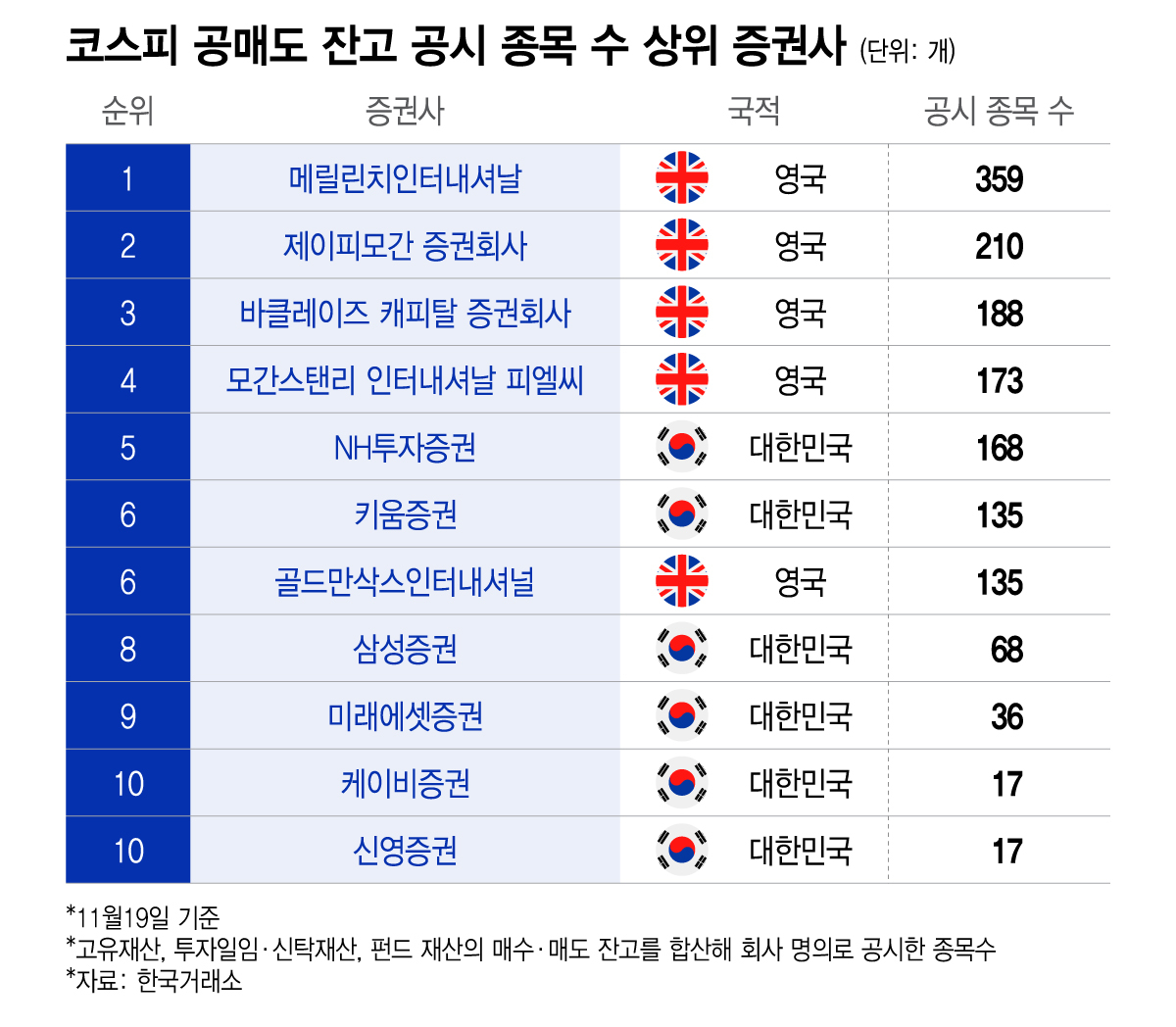
According to the Korea Exchange on Tuesday, there were 1,892 short selling large holding disclosures on the KOSPI as of the 19th. The top firms by number of disclosures were Merrill Lynch International (359 cases), J.P. Morgan (210 cases), Barclays (188 cases), Morgan Stanley (173 cases), NH Investment & Securities (168 cases), Goldman Sachs (135 cases), and Kiwoom Securities (135 cases).
The share of the top 7 firms by number of disclosures accounted for 72.3% of the total. Short selling net holding balance refers to the quantity of stocks borrowed and sold that have not yet been bought back and repaid. Under the Capital Markets Act, if the short selling net holding balance amount is 1 billion won or more, or if the short selling ratio is 0.01% or more of listed shares, it becomes subject to public disclosure (excluding amounts less than 100 million won).
The top 4 firms by number of disclosures were all foreign-affiliated securities firms, accounting for 49.2% (930 cases) of the total short selling balance disclosures. This means that foreign-affiliated securities firms are a major pillar of large-scale short selling positions in the market. For financial institutions such as securities firms, the short selling net holding balance is disclosed under the company's name by aggregating the buying and selling balances of proprietary assets, investment entrustment and trust assets, and fund assets.
LS PetaSys, a manufacturer of MLB (Multi-Layer Board) for network equipment and AI servers, saw all 7 short selling balance disclosure targets list their names between the 12th and the 19th, following CEO Huang's resignation. The dates on which they were listed as disclosure targets were Goldman Sachs (12th), Barclays (13th), Korea Investment & Securities, IM Securities, J.P. Morgan, and Shin Young Securities (17th), and Merrill Lynch International (19th).
SK hynix saw both of its 2 short selling balance disclosure targets list their names this month. They were Merrill Lynch International (11th) and Insight Asset Management (13th).
KB Securities analyzed that global technology stock short selling balances have increased by 46% compared to the beginning of the year since entering the fourth quarter of this year, significantly exceeding the increase rate in buying positions (32%), citing overlapping concerns over AI regulatory uncertainty following the U.S. midterm elections and intensified competition for AI capital raising.
The scale of position liquidation by global hedge funds in the November market was estimated to be approaching its highest level since 2016. This was interpreted as a result of leverage reduction and adjustments to exposure to global risk assets. However, expanded short selling and leverage reduction are cited as factors that build rebound momentum during the process of supply and demand normalization. This is due to expectations for inflows of short covering.
Short selling positions become a factor that amplifies losses in phases where stock prices rebound sharply. According to financial information analysis firm ORTEX, NVIDIA short selling position holders are estimated to have suffered losses of up to approximately $12.2 billion in one day due to CEO Huang's return.
Amid the overnight surge of more than 31% in NVIDIA's stock price, the NASDAQ Composite Index also rebounded sharply by 6.5%. On that day, as the KOSPI Index surged by over 6% in the early trading session, a buying sidecar was triggered.
However, there are also observations that it is uncertain whether the market has enough buying power to support a trend-based rebound. In the domestic stock market, the sharp decline in semiconductor stocks has been analyzed as having dealt a blow to retail investors comparable to the collapse of the 2000 dot-com bubble.

 in STOCK

