

As the government pushes a bill to cap major shareholder stakes in virtual asset exchanges at 20% in principle, all five of the country's top exchanges now stand at a crossroads regarding management restructuring. While major shareholders may be forced to sell large portions of their shares, pathways for transferring equity to private equity funds (PEFs) could be blocked, and securing fair valuations will also prove difficult amid sluggish industry conditions. Concerns are mounting that while overseas exchanges are expanding through mergers and acquisitions (M&A), domestic exchanges risk losing even their competitiveness.
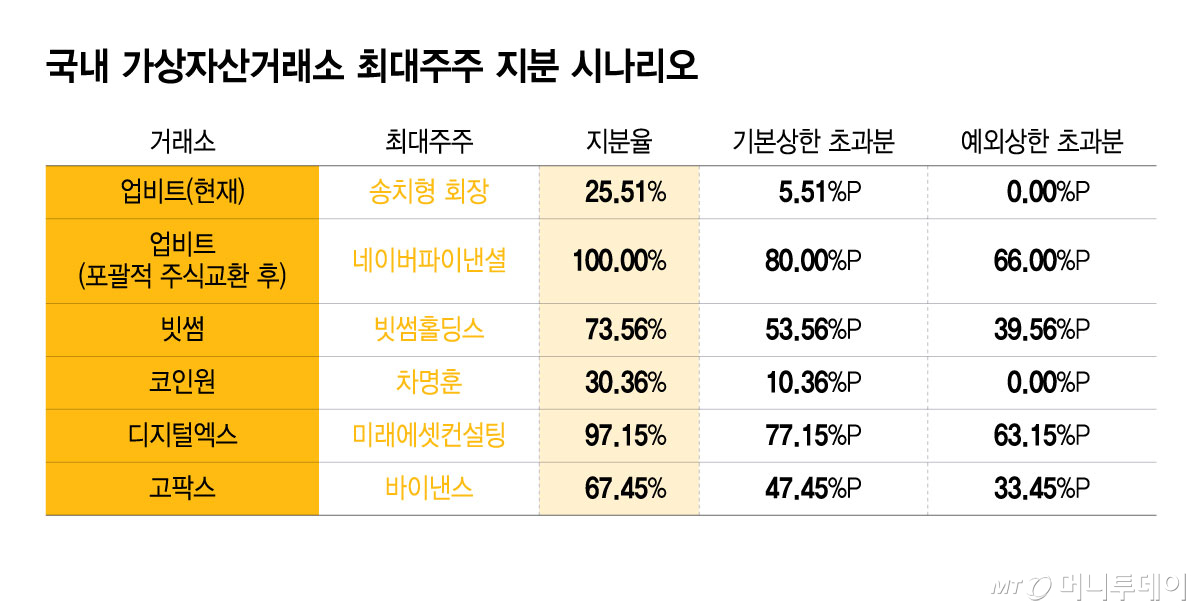
According to financial authorities and the virtual asset industry on the 29th, the government's draft Digital Asset Act limits major shareholder stakes in virtual asset exchanges to 20% in principle, allowing holdings up to 34% with approval from the Financial Services Commission. All five of the country's top exchanges currently have major shareholder ratios exceeding the basic cap, meaning that if the bill passes the National Assembly as is, large-scale share divestiture will be unavoidable even under the exception cap.
Previously, the Financial Services Commission stated a principle of determining regulatory targets based on the shareholder composition of exchange operating entities (subsidiaries). Applying this principle, Dunamu, the operator of Upbit, which plans to execute a comprehensive stock swap with Naver Financial by the end of March next year, will take a direct hit. This is because after the stock swap, when Naver Financial holds 100% of Dunamu's shares and the law takes effect, it would have to dispose of 80% under the basic cap criteria or 66% under the exception cap criteria.
Even considering precedents from financial holding companies and treating the parent company, Naver Financial, as a regulatory target, avoiding shareholding caps remains difficult. After the stock swap, the shareholding ratios for Song Chi-hyung, Chairman of Dunamu (19.5%), Naver (17%), and Kim Hyeong-nyeon, Vice Chairman of Dunamu (10%), each fall below the basic cap. However, Chairman Song and Vice Chairman Kim have agreed to delegate their voting rights to Naver to maintain Naver Financial as a consolidated subsidiary of Naver. The government's draft stipulates that such delegation will also be considered effective ownership.
Even if Naver Financial proceeds with an initial public offering (IPO) as foreshadowed in the stock swap disclosure and attempts to dilute major shareholder stakes through new share issuance, the controversy over duplicate listings remains a stumbling block. This is the backdrop for analyses suggesting that the likelihood of the stock swap between the two companies falling through has increased due to the government's draft.
Bithumb (73.56% held by Bithumb Holdings) would need to dispose of approximately 40 percentage points even if granted the 34th% exception, which could hinder its planned IPO in 2028. For Coinone, both CEO Cha Nam-hoon (30.36%) and Com2uS Holdings (24.54%) exceed the 20th% threshold. If Korea Investment & Securities, which rose to become the third-largest shareholder (approximately 20%) in May last year, is granted the financial institution exception (34%), a reversal in shareholding dominance could even occur.
Digital X (formerly Coinbit) is held by Mirae Asset Consulting, a non-financial affiliate, with a 97.15% stake (rising to 98.13% after additional in-kind contributions in January next year). Even if the shares are transferred to a financial affiliate within the Mirae Asset Group and the exception cap is applied, at least 64 percentage points must be disposed of. For Streamy, the operator of GoPax (67.45% held by Binance), if the major shareholder side sells its stake and relinquishes management control, it could become difficult to repay victims of the GoPay incident.
The government's draft leaves collective investment vehicles (funds) as an exception to shareholding caps but excludes PEFs from this exception, thereby preventing share cleanups through financial investors (FI) or so-called "share parking." Conversely, it opens an exception for asset management institutions entrusted with government-invested assets. If exchange shares are sold in tranches of 10% or more, the buyer must obtain prior approval for a change in major shareholder status, and prior approval from the Financial Services Commission is also required before any merger, division, or stock swap.
The draft provides a grace period of three years (up to six years at the discretion of small and medium-sized firms) from the designation date of Digital Asset Platform Operators (virtual asset exchanges). If excess shares are not resolved within this deadline, voting rights on the excess portion will be restricted, and it may also serve as grounds for business suspension, corrective orders, or license revocation for the exchange. Since criteria for exception approvals and additional grace periods are delegated to presidential decrees, management uncertainty has also increased. Industry officials point out that forced sales at low prices could occur due to pressure from disposal deadlines.
According to a financial authority survey, operating profit for domestic virtual asset businesses in the first half of this year was 81.6 billion won, a sharp decline of approximately 87% (78% compared to the previous half-year) from the same period last year. Furthermore, 99.7% of revenue from won-denominated exchanges was concentrated in trading fees. As of June last year, the number of registered businesses also decreased by 13 firms (approximately 32%) to 28 companies compared to early last year. Coin market exchanges and wallet/custody providers posted losses of 20.2 billion won and 18.6 billion won, respectively, in the first half.
Major exchange Dunamu also recorded its first operating loss since launching in Q3, while Bithumb and Coinone also turned to losses. The cumulative operating profit for Dunamu and Bithumb combined in Q3 was 114.8 billion won, amounting to only about 1% of the combined figure (1,127.11 trillion won) for the country's top five securities firms. With deteriorating profitability and uncertain management stability, not only will the burden of share divestiture increase, but incentives for attracting strategic investors (SI) for business diversification and M&A could also be significantly dampened.
According to estimates by Tiger Research, domestic users paid approximately 480 trillion won in fees to overseas virtual asset exchanges last year, reaching 2.7 times the revenue of the country's top five exchanges. Overseas exchanges are expanding through M&A, with Coinbase acquiring Deribit for $2.9 billion and Kraken acquiring NinjaTrader for $1.5 billion. Meanwhile, it is pointed out that if responsibility management and investment in security and infrastructure are dampened due to dispersed shareholding at domestic exchanges, the domestic market could be eroded.

 in STOCK
