

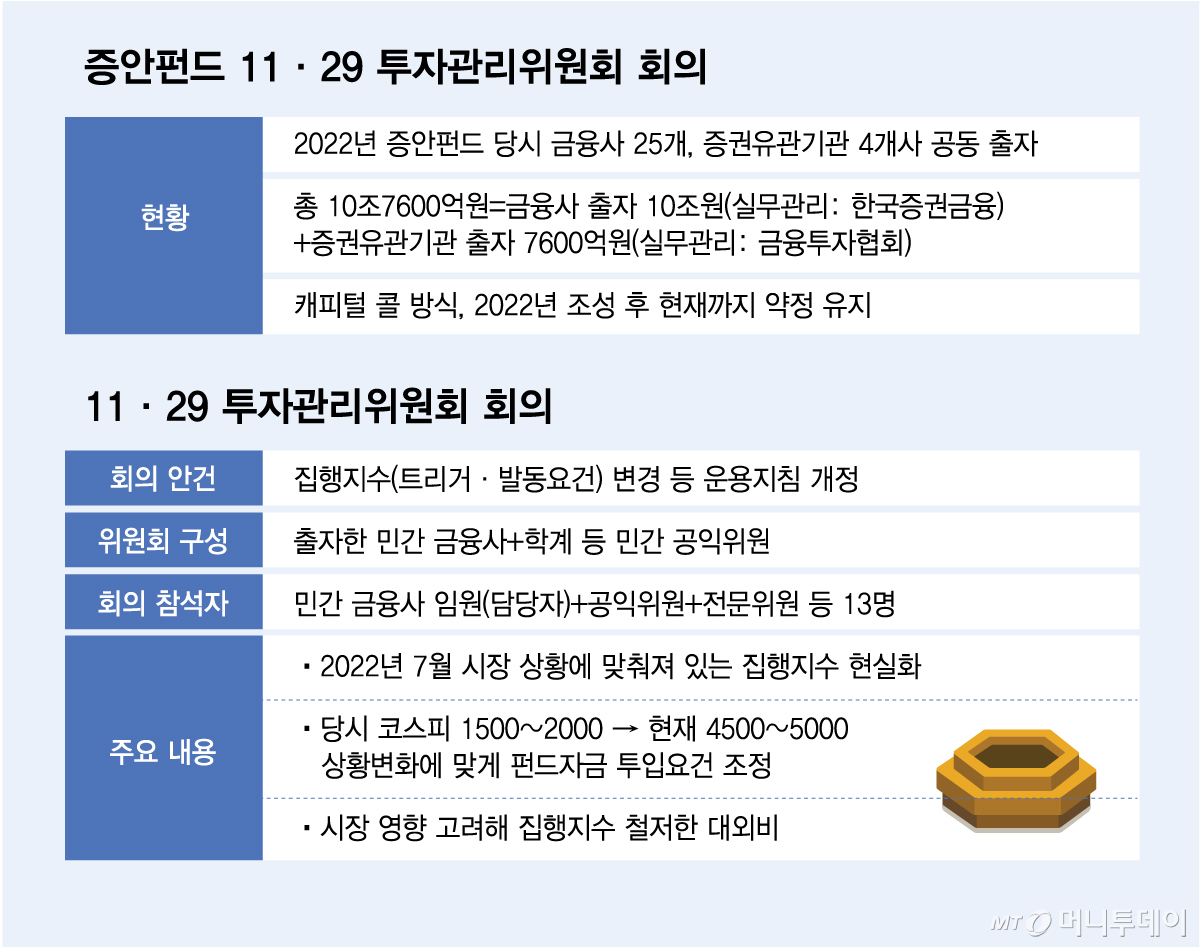
The execution index of the Securities Market Stabilization Fund (SSSF) is expected to be revised for the first time in about four years at the fund's Investment Management Committee meeting on the 29th. This comes just one week after the F4 meeting, which brings together the heads of four key economic and financial authorities, mentioned preparations for the immediate activation of the SSSF. Amid repeated sharp declines and surges in the KOSPI last week, the move effectively loads ammunition worth 10 trillion won. President Lee Jae-myung also commented on the SSSF, saying it "could be helpful psychologically and in the short term."
According to the financial investment industry and banking sector on the day, the SSSF Investment Management Committee will hold a meeting at 5 p.m. to revise its operational guidelines. The SSSF is a 10 trillion won fund established in 2020 primarily with funds from national policy banks and commercial banks, and re-contracted in 2022. It is distinct from the 760 billion won fund established by four related agencies.
Until now, although a 10 trillion won fund existed, its execution index was calibrated to market conditions in the second half of 2022, making actual deployment virtually impossible. Under current operational guidelines, the execution index is set at the KOSPI 1,500–2,000 level. If the execution index is changed through today's revision of the operational guidelines, the conditions will be in place to immediately deploy fund assets when the KOSPI plunges.
According to a synthesis of statements from key officials in the financial investment industry and banking sector, there is a high likelihood that the execution index will be changed at today's meeting. An industry official said, "Because it was the first fund established during the COVID-19 pandemic, the execution index was set according to KOSPI levels at that time," adding, "It appears to be a session aimed at making it realistic in line with current market conditions."
The SSSF's execution index is kept strictly confidential. If the execution index, which serves as the fund's activation condition (trigger clause), becomes known, investors could buy and sell stocks in large volumes based on it, thereby diminishing the policy's effectiveness.
Financial authorities are also reviewing the funding plans of financial institutions that have committed capital to the fund. The SSSF operates on a capital call basis, where financial institutions contribute the amounts they have pledged once specific conditions are met. Accordingly, major banks are considering how to immediately raise and pay 1 trillion to 2 trillion won, while large securities firms are reviewing how to raise several hundred billion won.
The Financial Services Commission will hold an emergency market situation review meeting at the Government Seoul Complex on the morning of the 30th, chaired by Chairman Lee Eo-woon. The heads of the five major financial holding companies (KB, Shinhan, Hana, Woori, and NH), the chairman of the Korea Development Bank, and association presidents from each industry sector are expected to attend to discuss current issues in the financial and securities markets.
The Korea Development Bank sent emails to major banks, securities firms, and insurance companies on the 23rd to assess their ability and scale for additional capital contributions.
During a Q&A session with reporters while climbing Bukaksan near Cheong Wa Dae on the day, President Lee said, "Improving the market's fundamental structure is important," adding, "It is questionable whether it can produce substantive results compared to the overall size of the market." He continued, "Experts will review what level is appropriate," and added, "Volatility is abnormally high, so we must try everything we can."

 in STOCK
