

[For more diverse company information on startups mentioned in this article, visit the Unicorn Factory Big Data Platform 'Data Lab'.]
"The space industry is no longer just about building rockets. It is rapidly evolving into a high-tech materials industry that connects semiconductors, energy, communications, and data centers."
Yang Cheol-min, Head of the Space Composite Materials Research Team at KIST Jeonbuk Branch, made these remarks on the 7th at the 'K-Space Forum 2026 General Assembly' held at Frontone in Mapo-gu, Seoul. Speaking on the theme 'Startup Opportunities Opened by Space Materials,' Yang diagnosed that South Korea's space materials technology remains in its early stages.
While the International Space Exploration Coordination Group (ISECG) is pursuing crewed lunar landing in 2027 and crewed Mars exploration in the 2030s, and the South Korean government aims for lunar landing and resource mining by 2032 and Mars landing by 2045, there are concerns that domestic production of space materials to support these goals is still insufficient. He stated, "Since the first application of domestic composite materials on the Science and Technology Satellite-3 in 2013, there have been almost no cases of actual use in the space environment. Most recently launched satellites also rely on overseas materials and components that have completed space environment verification, making nationalization urgent."
Yang emphasized that the competitiveness of space development ultimately stems from materials technology capable of withstanding extreme environments. He explained that space presents conditions entirely different from Earth—radiation, extreme temperature fluctuations, vacuum, and impact—meaning existing metal materials alone have limits in simultaneously achieving weight reduction and performance enhancement. "Development of ultra-lightweight composite materials will be a key factor determining the future competitiveness of the space industry," he said.
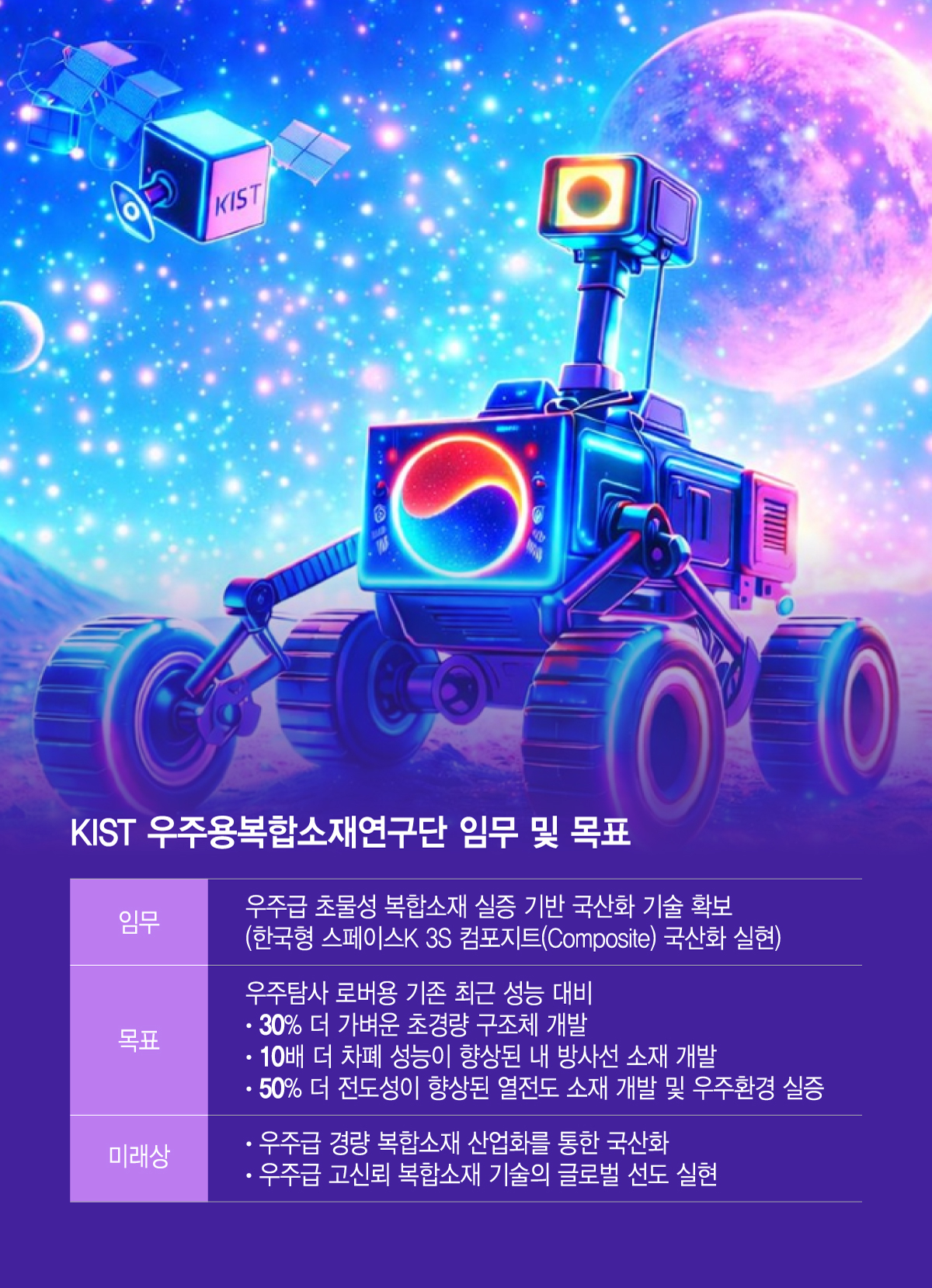
In response, the KIST Space Composite Materials Research Team reorganized its structure in January this year and began developing 'Korean-type Space-K 3S Composites.' The term "3S" refers to: △Special Structure (Structure), △Radiation Shielding (Shielding), and △Thermal/Electrical Conductive Materials (Stabilization). The team aims to achieve an ultra-lightweight structure 30% lighter than existing top-tier exploration rover technology, radiation shielding performance improved by 10 times, and thermal conductivity performance enhanced by 50%.
The developed materials will first be applied to satellite components after ground verification, with long-term plans to expand to lunar and Mars exploration rovers. The team has presented a phased roadmap targeting ground verification in 2028, space environment verification in 2031, and system integration verification in 2035. Additionally, the team plans to conduct radiation, thermal vacuum, and vibration tests in collaboration with the Korea Atomic Energy Research Institute (KAERI), Korea Aerospace Research Institute (KARI), Korea Testing & Research Institute (KTL), and Korea Advanced Institute of Science and Technology (KAIST).
Yang explained that this research also aligns with the government's ongoing Space Data Center (K-Shoot) project. With AI expansion pushing ground-based data centers to their limits in power supply, cooling, and site acquisition, space is gaining attention as a new location for data centers. He elaborated, "Ultra-lightweight composite materials can be used for server racks and heat dissipation structures in space data centers; radiation shielding materials for protecting AI semiconductors; and thermal/electrical conductive materials for thermal management and lightweight power transmission systems in data centers."
The team has set goals through this research: achieving 30% domestic production rate for space materials and components, replacing more than eight key imported items, facilitating over 15 technology transfers and commercializations, nurturing more than ten specialized space companies, and creating 1,000 new jobs. Yang stated, "One innovative materials technology can create a new market, and technologies verified in the space environment become globally competitive. We will work with domestic companies through national projects to build a future space materials market worth trillions of won."
Meanwhile, KIST Jeonbuk Branch will host a small-scale international workshop titled 'KCCI' next month, inviting top Japanese experts in aerospace composite materials. Members of the K-Space Forum will also be invited to participate. The workshop will feature researchers from the Japan Aerospace Exploration Agency (JAXA) and scholars specializing in composite materials. Speakers include Dr. Yuichi Ishida from JAXA's Structural Materials Optimization Team and Dr. Yuki Kubota, a former JAXA researcher now with HI Aerospace.
The event will proceed as an exclusive workshop format, enabling participating companies and researchers to engage in in-depth discussions with Japanese experts to explore joint research and technical cooperation opportunities. Yang noted, "This workshop is being conducted in connection with KIST's Space Composite Materials Research Program (PM). We aim to expand the international cooperation network, traditionally centered on the U.S. and Europe, to include Japan—a leading nation in composite materials—so that domestic companies and researchers can gain practical opportunities for technical exchange and collaboration."
[MoneyToday Startup Media Platform Unicorn Factory]

 in TECH
