

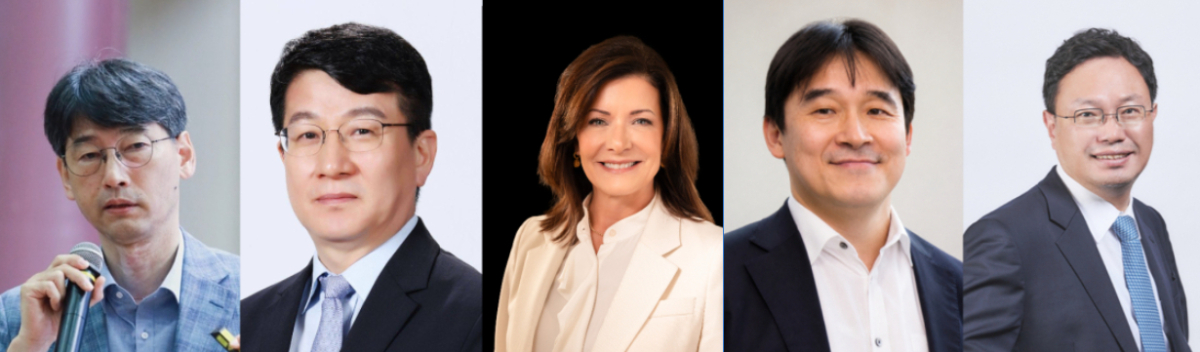
The world is now in the era of AI (artificial intelligence) competition. In particular, it is a "national showdown" where countries must mobilize all their capabilities to enhance competitiveness. Our government and industry also recognize the uniqueness of the AI market and are concentrating national resources. In addition to announcing three mega-projects (semiconductors, AI data centers, physical AI), they are carrying out various state-led projects, large and small, such as developing an "independent foundation AI model" (Dokpamo) and frontier (top-tier) AI development. In the private sector, from major corporations like SK and Samsung to LG, as well as startups leveraging new technologies, investments in AI development and commercialization are being made across the board. At this point, we have gathered opinions from the private sector, public sector, and academia on diagnosing South Korea's AI capabilities and establishing itself as an AI-leading nation.
- How would you assess Korea's AI competitiveness?
▶Head Kim Kyung-man = Our country has risen to the world's top three group, following the United States and China. Our strength lies in being one of the few "full-stack" nations that possess all stages from semiconductors to △power △data centers (DC) △AI models △application services. There are also areas for improvement. The U.S. and China account for 90% of global AI computing resources, creating a significant infrastructure gap. A performance gap remains in top-tier AI models as well.
▶Professor Shin Min-su = Korea is close to the world's leading position in the foundation of AI components, manufacturing, and on-site application, but its ability to convert AI into productivity across the entire economy is still in a transitional stage of upper-middle rank.
▶CEO Yoo Tae-jun = We must distinguish between generative AI and physical AI. In LLMs (large language models), U.S. and Chinese big tech (major IT companies) are ahead with massive capital and computing resources. The field where Korea can become a world-leading nation is precisely physical AI.
- Please evaluate the government's "Three Mega-Projects."
▶Head Lee Young-tak = AI DCs are the foundation of the other two pillars. In that sense, the three mega-projects are not separate businesses but a single strategy where each element interlocks to create synergy. It is significant in terms of securing both the AI ecosystem and future livelihoods together.
▶Professor Shin = Potential growth rate is the ability to produce continuously without inflationary instability, not temporary economic stimulus. If the three mega-projects end as an "equipment expansion project," their effect will be limited. They will only succeed when operated as a "productivity diffusion project."
▶CEO Yoo = The direction of linking semiconductors, AI infrastructure, and physical AI as a national growth strategy is highly desirable. How much on-site productivity is raised and whether companies create new products and revenue will determine success or failure.
- What are the strengths and areas for improvement in our country's infrastructure for leaping to an AI powerhouse?
▶CEO Yoo = Korea's greatest strength is that semiconductors, ICT (information and communication technology), manufacturing, and robotics exist within a single ecosystem. For AI to operate in machines and robots, it requires not only large-scale training computing but also △sensors △real-time communication △AI semiconductors △low-latency control technology. Korea has the industrial foundation to connect this value chain. We must link large-scale AI DCs with regional physical AI data factories and demonstration centers, and utilize common infrastructure by industry.
▶Head Lee = The most important thing is power. In this regard, our country possesses world-class power stability. We expect that the AI DC-specific rate plan, which the government has announced it will introduce within the year, will include reasonable standards reflecting characteristics such as basic charge adjustments.
▶President Shaw = Korea has a highly developed digital infrastructure base and excellent connectivity. Through efforts such as △securing power △site development △communication with local communities, we can capture opportunities in the AI economy.
▶Head Kim = Areas for improvement include securing total electricity supply and "connection." Demand is concentrated in the metropolitan area, while generation is mostly outside it, making the securing of transmission networks urgent. Securing water supply to meet new demand without disruption is also a task.
- As shown by the results of the U.S. midterm elections, there is backlash from local communities regarding AI infrastructure.
▶Head Lee = The fundamental reason why perceptions of AI DCs have worsened in the U.S. is the instability of electricity rates. Unlike the U.S., our country uses central power supply and a single nationwide rate. It is structurally difficult for electricity rates to rise due to DC construction. However, to further increase acceptability, it is desirable to build AI DCs in existing industrial complexes that are non-residential and equipped with power and water infrastructure.
▶Professor Shin = Local backlash is not a simple "NIMBY" (Not In My Back Yard) phenomenon, but a rational reaction to the imbalance where "the region bears costs while profits, taxes, and high-level jobs go to outsiders." Our country should also prioritize contracts with local communities.
▶Head Kim = According to the "AI Data Center Special Act" to be implemented in March next year, the rapid initiation of batch processing for permits, the designation, modification, and revocation of special zones outside the metropolitan area, and support for companies entering special zones will undergo deliberation and resolution by the committee. The committee, as a public-private cooperation platform, will comprehensively incorporate various perspectives.
- Please offer advice on how to prevent local extinction in the AI era.
▶Professor Shin = It is not enough to just place DCs and factories in local areas. △Research △product planning △procurement △data rights △startup capital △universities △residential functions must also move. "Regional AI missions" need to be differentiated, and simultaneous transfer of high value-added functions must occur.
▶Head Lee = AI DCs can increase local tax revenue. The Budget Policy Office estimated that if a 1GW (gigawatt)-class DC is operated, corporate local income tax alone will increase by approximately 80 billion won annually. It can also create opportunities for regions to grow into AI hubs. By providing AI DC computing power to regional industries as low-cost tokens and adding benefits through mutual benefit programs, regions can attract industry and talent.
▶CEO Yoo = The most realistic approach is to increase the productivity of regional industries and create jobs. We must develop physical AI suited to key industries. Specialized data factories and demonstration centers should be built by region.
- If there are ways for AI infrastructure and the three mega-projects to coexist harmoniously with local communities, please share them.
▶CEO Yoo = I do not think "local infrastructure" itself is mutual benefit. Mutual benefit occurs when regional companies gain competitiveness using infrastructure, and revenue and jobs are actually created.
▶Head Lee = Kaohsiung in Taiwan has grown its local ICT ecosystem centered on AI DCs, and the Hamina case in Finland returned DC benefits to residents' daily lives. Google is expected to resolve about 80% of district heating by transferring waste heat from DCs to regional energy companies essentially for free.
▶Head Kim = There are domestic cases as well. Sinan County in South Jeonnam operates a "Sunshine Pension" that shares 30% of solar power generation revenue with residents. If residents participate in renewable energy generation supplying electricity to DCs, AI infrastructure can become regional income.
▶President Shaw = Leading DC companies communicate with local communities from the early stages and continue dialogue with local stakeholders by transparently informing them of expected impacts and benefits. Building trust through communication while clearly demonstrating the economic value, infrastructure investment, and digital capabilities that DCs will bring is an important factor in achieving sustainable growth.
[Production Support: Ministry of Culture, Sports and Tourism Citizen-Centered Communication Activation Project]

 in TECH
