

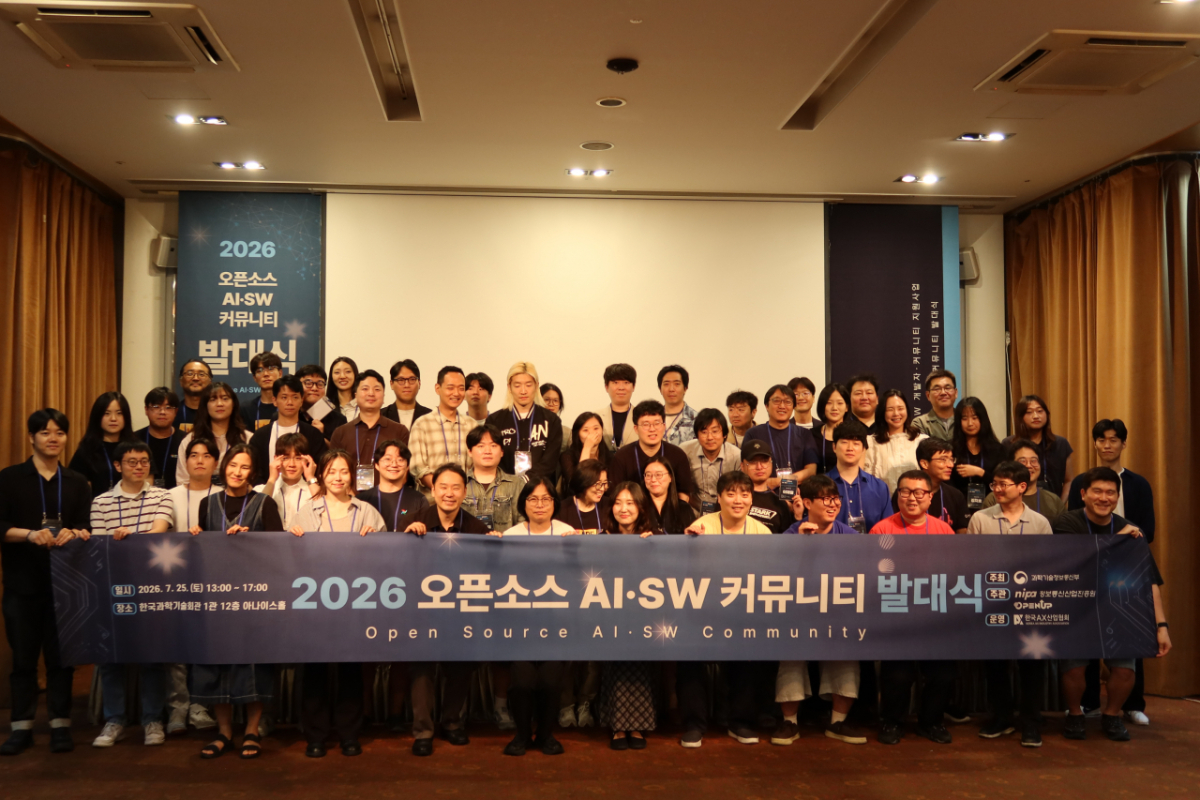
The Korea Institute for Information Technology Advancement (NIPA) announced on the 30th that it has begun full-scale support for 15 communities expected to lead the domestic open-source artificial intelligence and software ecosystem. Prior to this, NIPA held the '2026 Open Source AI·Software Community Launch Ceremony' at Seoul Science & Technology Hall on the 25th.
This project is being launched to support the development activities, technical collaboration, and dissemination of results within Korea's open-source AI and software communities, aiming to create a sustainable open-source ecosystem. In particular, with the rapid advancement of artificial intelligence technology and the growing importance of global open-source projects, various initiatives will be supported to enable domestic developer communities to actively participate in global projects and expand their own ecosystems.
To this end, the Korea Foundation for Advanced Studies (KOFAS) plans to actively promote performance expansion activities by providing selected 15 communities — chosen through a public recruitment in June — with opportunities to participate in domestic and international open-source conferences and seminars, along with support for cloud-based advanced semiconductor (GPU) and server resources, as well as collaboration spaces such as OpenUP Centers. This initiative aims to enable domestic open-source developers to contribute to the global open-source ecosystem.
The communities selected this year are artificial intelligence and machine learning (ML), generative AI, data engineering, cloud infrastructure, open-source databases, and Python.
It covers various technology fields representing the domestic open-source ecosystem, including Python and security.
At the launch ceremony, there was a session to guide community operation directions and support programs, as well as to share development and expansion plans for each community. Additionally, Yoo Tae-hee, a Linux kernel maintainer, delivered a special lecture on "The Role of Communities and Strategies for Contributing to the Ecosystem."
Lee Kyung-rok, head of the Software Convergence Division at the Korea Institute for Advancement of Technology, stated, "At the heart of artificial intelligence and software innovation has always been an open-source community where people can freely communicate and collaborate." He added, "Through this support project, we will enable outstanding domestic communities to stably develop projects and spread technology, helping South Korea grow as a leading force in the global open-source ecosystem."

 in TECH
