

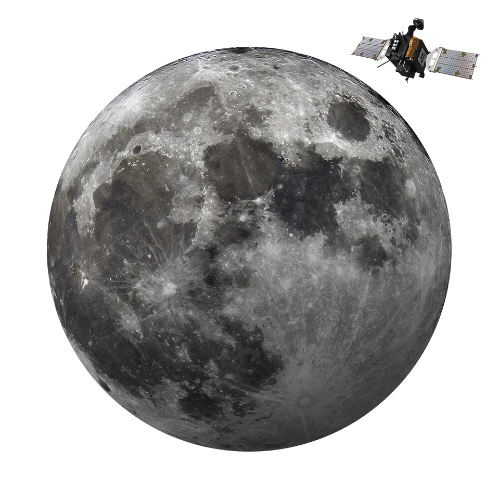
'DaeNuri,' South Korea's lunar orbiter, is expected to capture images of a SpaceX rocket debris colliding with the Moon's western surface.
At 3:34 p.m. on the 5th (Korean time), the second stage of the SpaceX 'Falcon 9' launch vehicle (upper section; 2025-010D), which had been drifting in space, is expected to collide near the western edge of the Moon.
The second stage was part of a Falcon 9 rocket launched on January 15 last year. It was launched from Kennedy Space Center in Florida, USA, carrying Firefly Aerospace's lunar lander 'Blue Ghost' and iSpace's lunar lander 'Resilience.'
The first stage of the launch vehicle was recovered after being dropped into the Atlantic Ocean about eight minutes after launch. The second stage, which carried the payload, entered orbits around the Moon before running out of fuel and remaining in space. For approximately one year and six months, it orbited in an elliptical path between the Moon and Earth, gradually drawing closer to the Moon due to its gravitational pull.
The object is expected to collide directly near Einstein Crater at a speed of about 8,700 km/h—approximately seven times faster than the speed of sound (the speed at which vibrations travel). The rocket weighs about 4.5 tons and measures 12 meters in length. Given that a heavy object will collide at such high speed, a large artificial crater is expected to form on the Moon after impact. According to the astronomy journal 'Astronomy,' the depth of the crater formed by the collision is estimated to be around 20 to 30 meters.
During the collision, lunar dust known as regolith is also expected to be ejected up to several kilometers above the Moon's surface. Regolith is a layer of dust covering the Moon's surface, composed of small rock fragments formed by meteorite impacts.
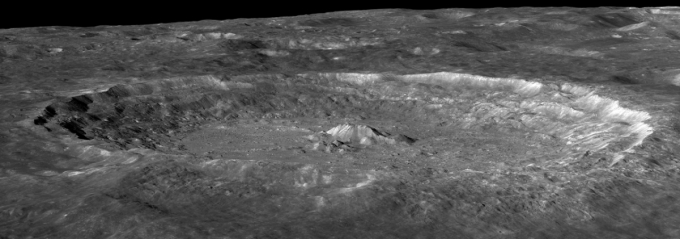
The key question is whether 'DaeNuri' (KPLO), South Korea's lunar orbiter, will be able to capture the moment of impact. Developed by the Korea Aerospace Research Institute and launched in 2022, DaeNuri is South Korea's first lunar exploration probe. It entered a frozen orbit around the Moon last September and is currently conducting observation missions until 2027. A frozen orbit refers to an orbit that can be maintained naturally without artificial adjustments due to lack of fuel.
According to analysis, DaeNuri is expected to approach within several kilometers of the predicted impact site about two minutes before the collision. However, since the exact timing of the collision is based on numerical calculations, experts believe there is a possibility that the time may change as the date approaches. In addition to DaeNuri, NASA's Lunar Reconnaissance Orbiter (LRO) is also expected to observe the scene before and after the collision.

 in TECH

