

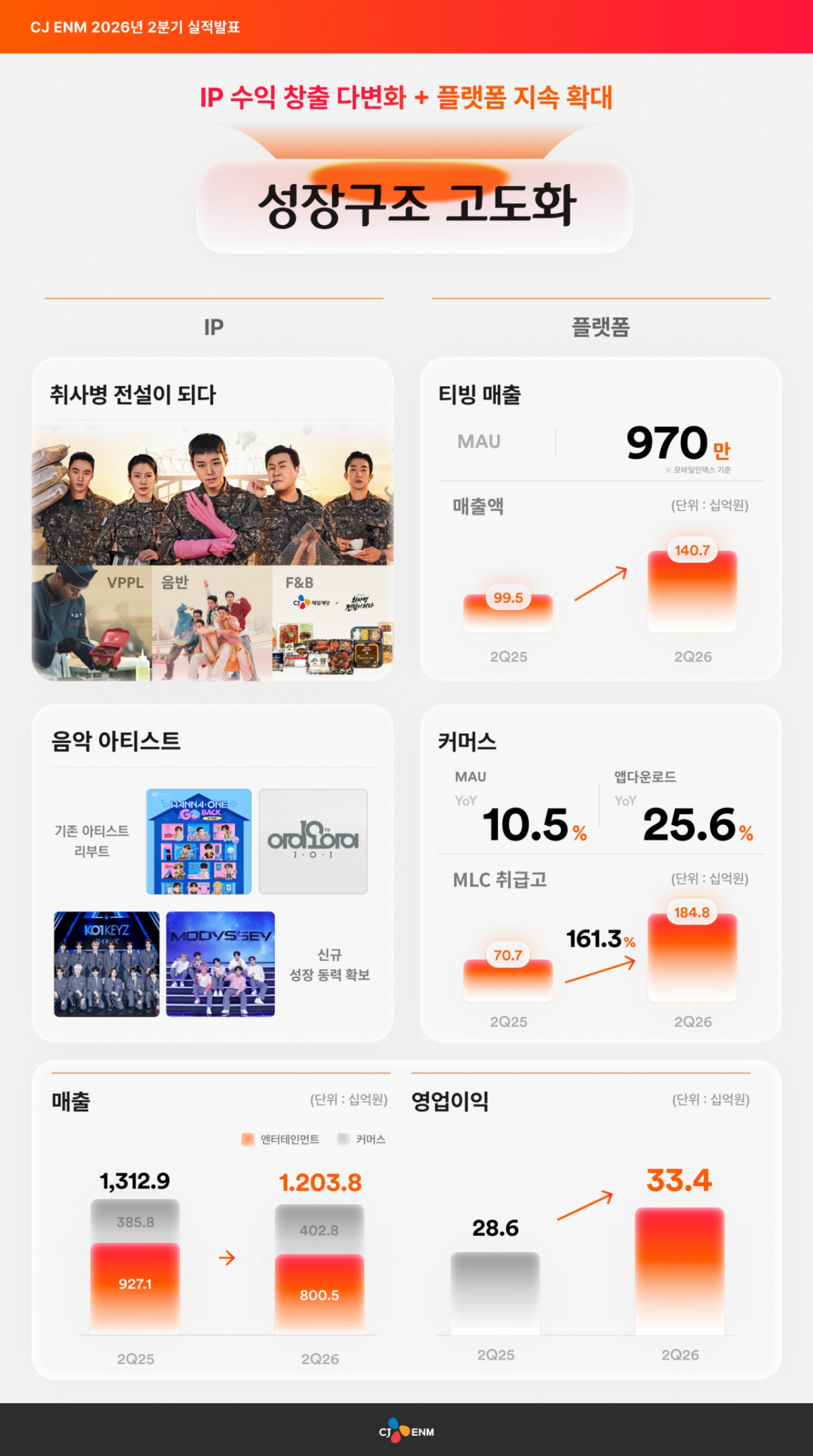
CJ ENM's profitability improved significantly in the second quarter. Thanks to KBO (Korean Professional Baseball) broadcasting rights, TVING subscriptions increased, and existing IPs such as I.O.I and Wanna One regained momentum, leading to an overall improvement in performance. However, the continued weakness of the broadcast advertising market and the possibility that TVING could face fines due to a personal information leak are cited as sources of uncertainty for the second half of the year.
CJ ENM announced on the 6th that it recorded sales of 1.2033 trillion won and an operating profit of 33.4 billion won in the second quarter, representing an 8.3% decrease and a 16.9% increase compared to the same period last year, respectively. The operating profit exceeded the market consensus estimate (31.1 billion won, compiled by F&Guide). Net income attributable to owners of the parent company decreased by 80.6% to 22.248 billion won.
Looking at business segments, Media Platform sales reached 380 billion won with an operating profit of 11 billion won, turning a profit. This was largely due to an increase in platform advertising revenue of 52% year-on-year as TVING subscriptions increased by a net 24.7%, driven by KBO broadcasting rights and an increase in original content. However, TV advertising sales declined by 21% compared to the same period last year.
The Commerce segment recorded sales of 402.8 billion won and an operating profit of 26 billion won, increasing by 4.4% and 21.2%, respectively, for the same period. Short-form content edited from live broadcasts was expanded to external channels such as YouTube, Instagram, and TikTok, and fan-based IP content was integrated into commerce, leading to a significant 161.3% increase in mobile live commerce (MLC) transaction value compared to the previous year.
The Music segment recorded sales of 230.2 billion won and an operating profit of 10.9 billion won, increasing by 16.7% but decreasing by 36.4% compared to the same period last year. The deterioration in performance due to concentrated investment in new IPs and Mnet Plus was offset by diversifying revenue sources through the reboot of past IPs such as 'Wanna One' and 'I.O.I', and global live events like 'KCON Japan 2026'.
The Movie & Drama segment recorded sales of 190.2 billion won and an operating loss of 10.5 billion won, a decrease of 53.7% each, with losses continuing. Although Studio Dragon optimized production costs, CJ ENM's acquired overseas studio 'Fifth Season' did not recognize content supplied to OTT (online video services) as revenue because it was not screened.
CJ ENM plans to significantly shorten the amortization period for content in order to reduce performance volatility. In the first quarter, it recorded an operating profit of 1.5 billion won, suffering a performance shock that fell more than 90% below the market consensus estimate.
Lee Hye-mi, CFO (Chief Financial Officer) of Studio Dragon, a CJ ENM subsidiary, stated, "The burden of amortizing production costs from last year carried over to the first half of this year, creating a vicious cycle that pressured performance." She added, "General dramas will be amortized over 48 months, with 64% accelerated in the first seven months. For OTT pre-sold content, the amortization period will be shortened from the existing six months to four months." Previously, in the first quarter, it recorded an operating profit of 1.5 billion won, suffering a performance shock that fell more than 90% below the market consensus estimate.
CJ ENM forecasted that the trend of increasing advertising revenue driven by net growth in TVING users and steady commerce performance will continue into the second half of the year. However, variables include the continued contraction of the broadcast advertising market and the possibility that the Personal Information Protection Commission (PIPC) may impose fines regarding the TVING personal information leak incident in the second half of the year.
A CJ ENM official added, "The scale of fines and penalties due to the TVING personal information leak issue will be known only after the Personal Information Protection Commission investigation is completed," and noted that "compensation plans for the personal information leak are scheduled to be released in September and October."

 in TECH
