

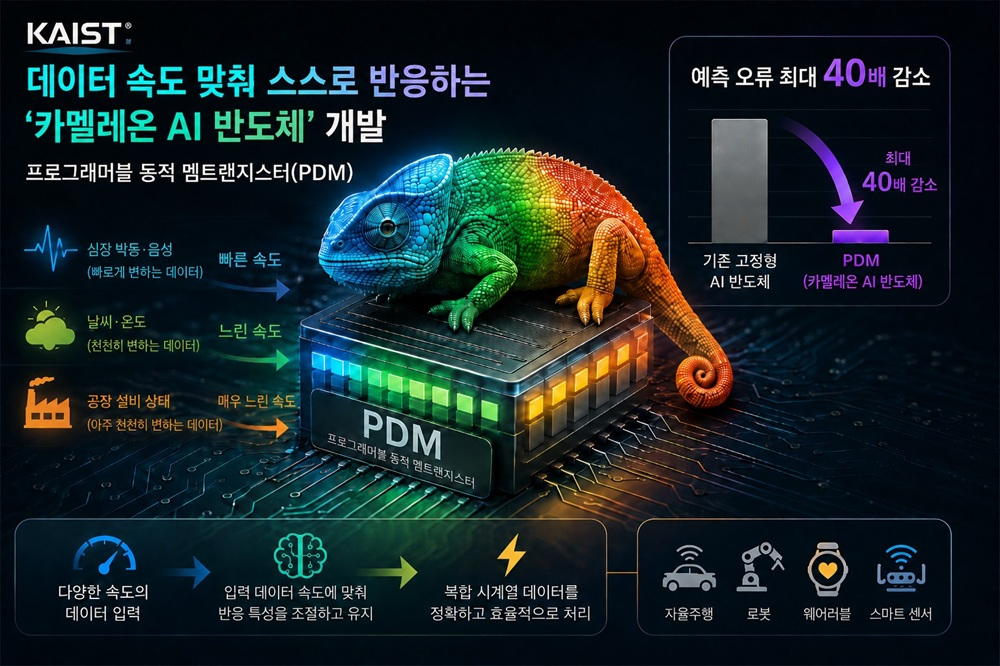
A 'data-customized' AI semiconductor technology has emerged that automatically adjusts its response speed to match input data.
KAIST announced on the 7th that a research team led by Professor Lee Sun-hyun of the Department of Electrical and Electronic Engineering and Graduate School of Semiconductor Science developed an AI semiconductor device called 'programmable dynamic memtransistor' (PDM) that reacts according to the speed of input data changes. The research results were published last month in the international academic journal 'Nature Communications'.
A memtransistor is a semiconductor device that combines 'memory', which stores information, and 'transistor', which performs calculations, into one unit. Its characteristic is that it performs calculation and storage simultaneously.
Existing AI semiconductors are designed to maintain the same response speed and duration of response state regardless of what data is input. Consequently, when data with different characteristics enters, overload can occur. For example, if data that changes constantly, such as heartbeats, and data that changes relatively little, such as factory equipment status, are input into a single AI semiconductor, the semiconductor finds it difficult to process both types of information simultaneously. This becomes a cause of reduced semiconductor efficiency.
To solve this problem, the research team developed a memtransistor that combines a layer (charge storage layer) for storing electrical information and a layer (electron trapping layer) for storing electrons to control the semiconductor's reaction within a single transistor. When external data enters, the charge storage layer processes the information. The electron trapping layer adjusts the speed so that the semiconductor can quickly return to its original state after processing the information.
Actual experimental results confirmed that the research team could adjust the time it takes for the semiconductor to return to its original state after reacting to an input signal within a five-fold range. In addition, the ability to process rapidly repeating signals (frequency characteristics) could be adjusted over a range of more than ten times.
In data prediction experiments containing both rapidly changing and slowly changing information, prediction errors were reduced to one-fortieth compared to existing fixed-type semiconductors.
As a result of experiments using an 'array' created by connecting multiple memtransistors, the system operated with significantly less energy while maintaining accuracy similar to existing software-based AI systems. The technology was confirmed to be compatible with commercial semiconductor processes (CMOS).
Professor Lee Sun-hyun stated, "We have implemented an AI semiconductor that allows the semiconductor to react in the most suitable way on its own according to the speed of data changes," and added, "This will become a technology to improve the performance of various AI devices such as autonomous vehicles, robots, and wearable devices."

 in TECH
