

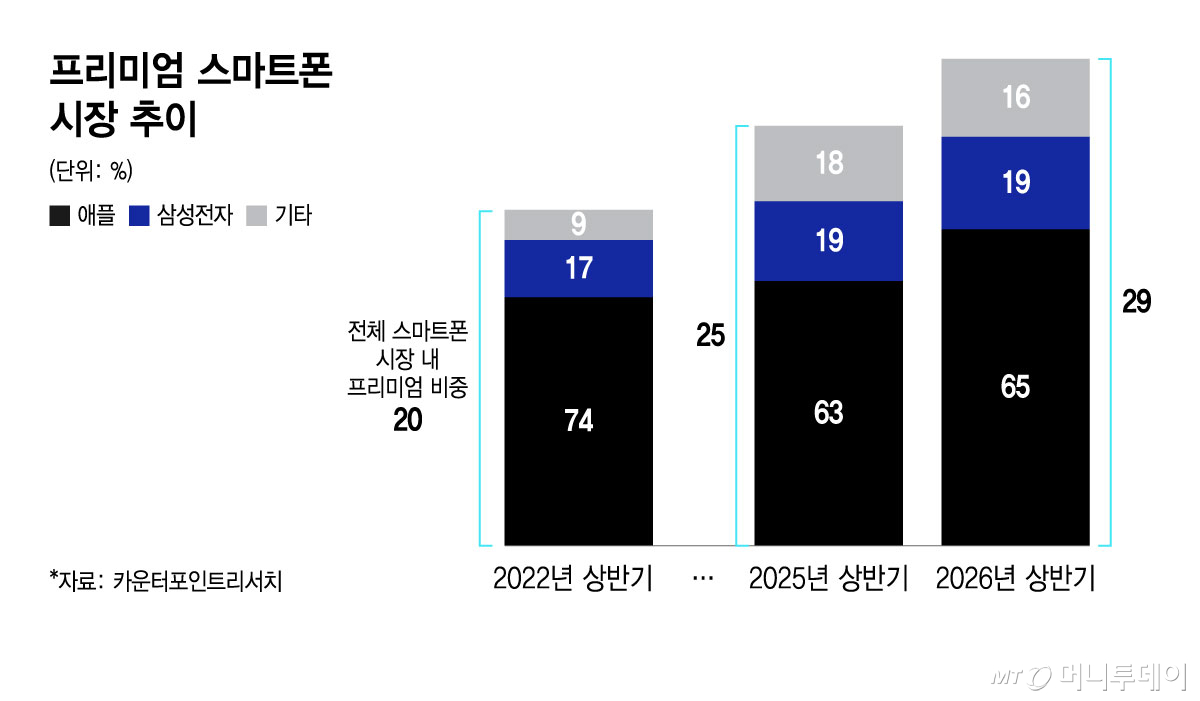
As rising memory prices accelerate the shift toward premium devices in the global smartphone market, the share of premium smartphone sales reached a record 29% in the first half of this year. This was driven by price increases in mid-range and low-end smartphones, which face relatively higher cost burdens, narrowing the price gap with flagship models.
According to Counterpoint Research, a market research firm, global sales of premium smartphones priced at $600 (approximately 850,000 won) or more rose 5% year-on-year in the first half of this year. Their share of total smartphone sales increased by 4 percentage points from 25% in the first half of last year to 29% this year. Compared to 20% in the first half of 2022, this marks a 9-percentage-point expansion over four years.
Mid-range and low-end products, which typically have lower profit margins, are more significantly affected by rising component prices, including memory chips. In contrast, premium manufacturers have greater capacity to absorb cost pressures through higher margins and reduced promotional spending.
Notably, as mid-tier Android smartphone prices rise, the price gap between these devices and older or discounted flagships is narrowing. For consumers, this creates a stronger incentive to pay slightly more for flagship models instead of the now-more-expensive mid-range options. Manufacturers are also expanding installment plans, trade-in programs, and buyback schemes to reduce the financial burden of purchasing high-end devices.
By company, Apple saw its premium phone sales rise 9% year-on-year in the first half, boosted by strong demand for the iPhone 17 series. The base model iPhone 17 was particularly instrumental in driving growth. While Apple maintained its leading position with a 65% share of the premium market, this represents a 9-percentage-point decline from 74% in the first half of 2022. This shift is attributed to local manufacturers such as Huawei, Xiaomi, OPPO, and Vivo strengthening their flagship product lines in China, the world's largest premium smartphone market.
Samsung Electronics recorded a 3% year-on-year increase in premium phone sales during the first half, capturing a 19% market share. In the Galaxy S26 series, the Ultra model accounted for more than half of total series sales and led overall performance. Combined, Apple and Samsung Electronics held an 84% share of the global premium smartphone market.
Chinese manufacturers also showed growth in the premium segment. OPPO reported a 69% year-on-year increase in sales, driven by its Find X9 series, marking the highest growth rate among major players. Vivo also achieved 20% growth, fueled by strong sales of its X300 series.
Market restructuring centered on high-end products is expected to continue. As market focus shifts from expanding shipment volumes to securing revenue and profitability, manufacturers are increasingly prioritizing higher-margin product lines. Additionally, the trend among consumers with extended smartphone replacement cycles to opt for premium devices designed for long-term use is also cited as a factor driving market expansion.
Khan Chauhan, Senior Research Analyst at Counterpoint Research, stated, "Premiumization will become a core strategy for the smartphone industry." He added, "Apple and Samsung are expected to maintain their leadership in the premium market, leveraging their strong positions, ecosystems, and brand value in developed markets."

 in TECH
