

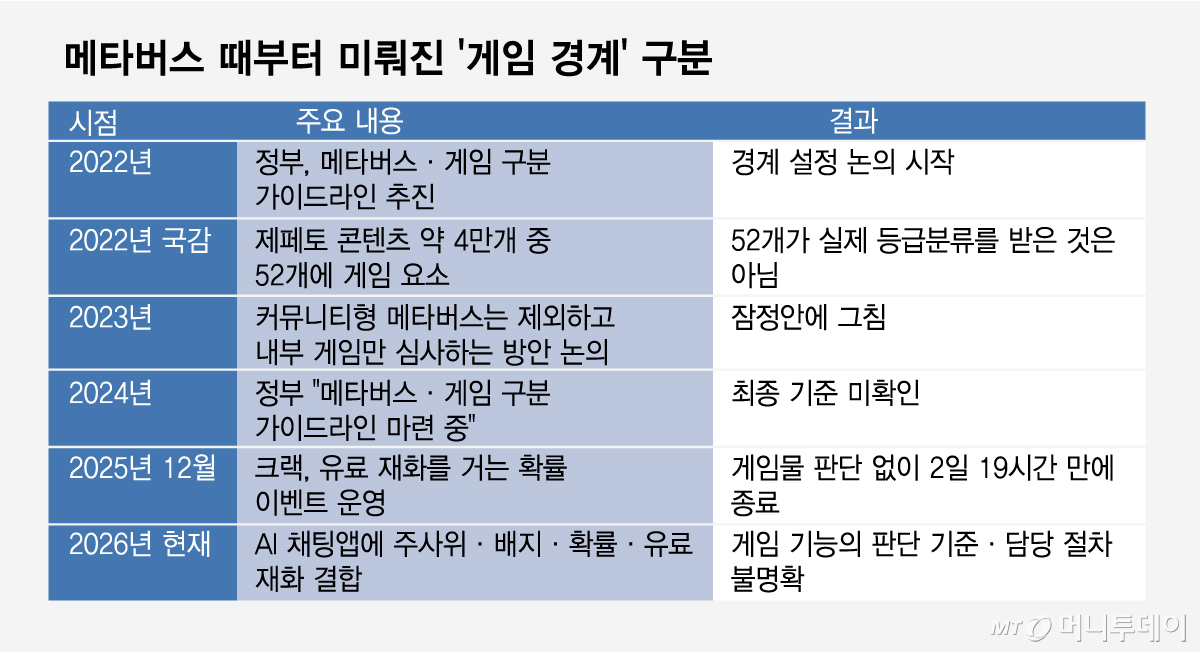
#In 2022, when a metaverse craze swept the country, the government stepped forward to define the boundary between metaverse services and games. A debate emerged over whether all metaverse services should be classified as games or only the game content within them should undergo separate review. Although the government promised to create guidelines, it failed to reach a clear conclusion.
At the center of the controversy was Naver Z's "Zepeto," a service where users meet others in virtual spaces and create avatars and content. Inside, beyond simple gathering spaces, there were game contents such as shooting games and role-playing games. During the 2022 national audit, Naver Z revealed that among approximately 40,000 registered contents on Zepeto, only 52 contained game elements. These 52 items did not actually receive age ratings.
The government discussed a plan to exclude entire "community-type metaverses" like Zepeto from game rating targets, while separately rating any game content created by game companies within them. However, disagreements between ministries and industry backlash continued. The government explained in 2024 that it was still preparing guidelines to distinguish between metaverse and games. To date, final criteria remain unconfirmed.
Problems unresolved in the metaverse have resurfaced with AI chat apps. The function of conversing with AI characters resembles the "otome romance simulation" (otome game) genre, where users interact with virtual characters such as young girls and develop relationships through nurturing and bonding. Especially when dice roll judgments, rankings, badges, paid currencies, and success or failure based on probability are added, the boundary with games becomes even blurrier.
A representative example is the "Cracker Baking" event held in December last year by the AI chat app "Crack." Users wagered crackers, a paid currency, to win 2 to 100 times their stake or lose everything based on probability. A probability-based event involving wagers of paid currency alongside general AI conversations was operated within a single app.
The Game Rating and Administration Committee stated that the function of conversing with AI alone is difficult to classify as a game. However, it explained that if paid currencies are used and results along with acquisition or loss of currencies are determined by probability, there is a possibility it qualifies as a game. It added that if financial gains or losses occur, it must be separately examined whether it constitutes a gambling-type game.
There is a gap between the operator's classification and the judgment of national institutional investors. If an operator launches a service as a non-game "entertainment" app, it does not apply for game rating. The Game Rating and Administration Committee can only verify actual service content after discovering content suspected to be games or receiving reports and complaints. Until someone raises an issue, there is no opportunity to determine whether it qualifies as a game.
Critics argue that instead of classifying all AI chat apps as games, criteria are needed to selectively judge only the parts within services that function like games. Criteria could include whether there are specific goals and rules, whether success or failure is determined by probability, whether users can gain or lose paid currencies, and whether rankings and rewards encourage repeated participation.
It must also be decided who makes the initial judgment. One possible approach is for the Game Rating and Administration Committee to make a primary judgment on functions suspected of having game elements, followed by the Korea Communications Commission and the Korea Communications Standards Commission examining issues related to youth protection and decency.
An industry official said, "Another alternative would be to require operators to submit rules, probabilities, and currency flows for game modes and events and maintain operational records." They added, "There is a need for criteria to judge whether actual functions operate like games and for designated institutional investors."

 in TECH
