

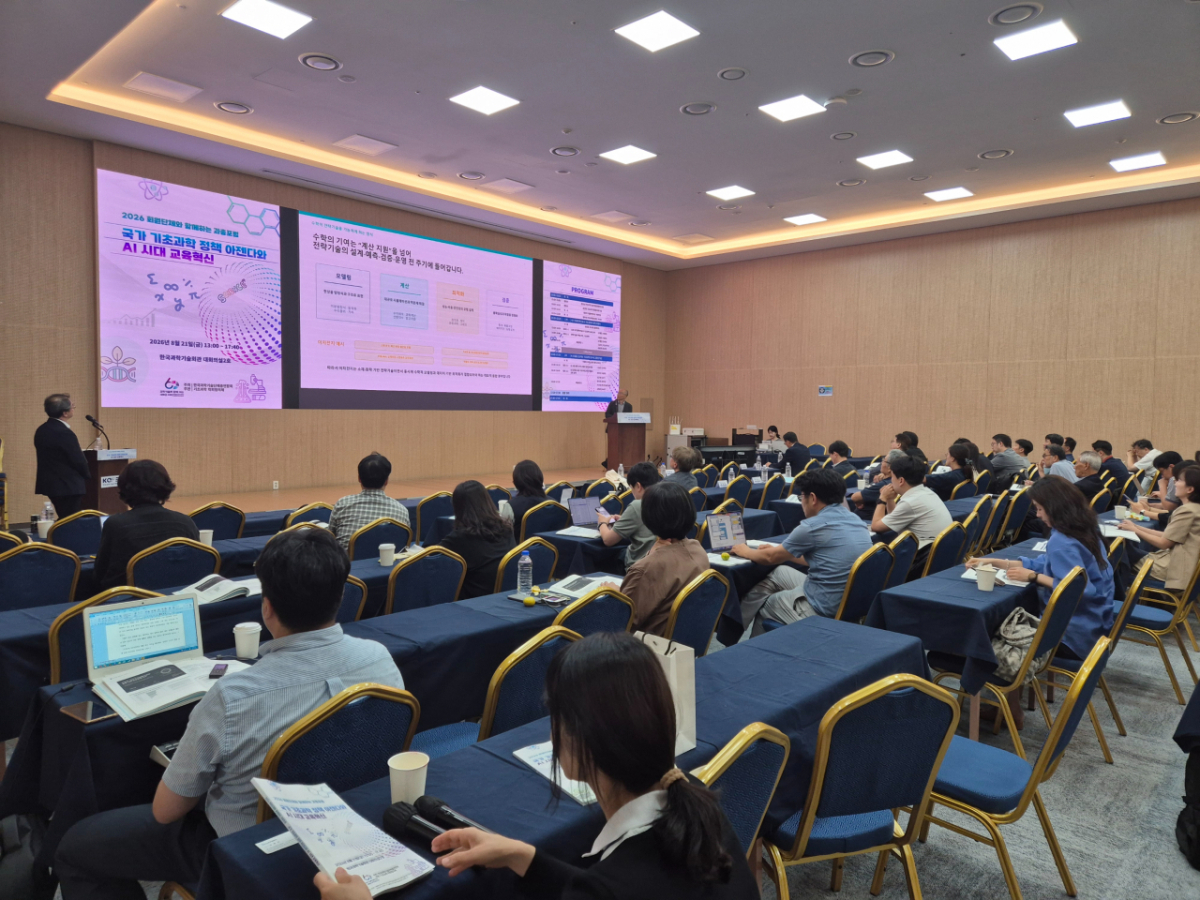
"Every time Japan wins a Nobel Prize, I get asked, 'Why does South Korea have zero (Nobel Prizes in Science)?' It's only natural. No one has ever raised a flag to set the direction of basic science."
At the forum held on the 21st at the Korea Science & Technology Center in Yeoksam-dong, Seoul, titled "National Basic Science Policy Agenda and Education Innovation in the AI Era," a representative from a domestic basic science society voiced this sentiment. The event was hosted by the Korean Federation of Science and Technology Societies (KOFST) and organized by the Consortium of Basic Science Societies. Attendees included key figures from major domestic basic science societies such as the Mathematical Society of Korea, the Physical Society of Korea, and the Daehanwha Society, along with Democratic Party of Korea lawmaker Hwang Jeong-a and Lee (President) of the Korea Foundation for Advanced Studies.
With this year's government R&D (Research and Development) budget reaching 35.5 trillion won and next year's budget expected to set a new record high, "National Strategic Technologies" lie at the center. National Strategic Technologies refer to technologies critical to national security and diplomacy—such as semiconductors, AI, and biotechnology—that are essential for driving the national economy and creating future industries. The Ministry of Science and ICT's "NEXT Project" is a representative initiative and policy focused on nurturing these strategic technologies.
However, the societies pointed out that there is no clear policy direction regarding basic science, which forms the foundation of strategic technologies. Basic science encompasses academic fields such as mathematics, physics, chemistry, and earth sciences that serve as the foundation for all applied sciences and engineering.
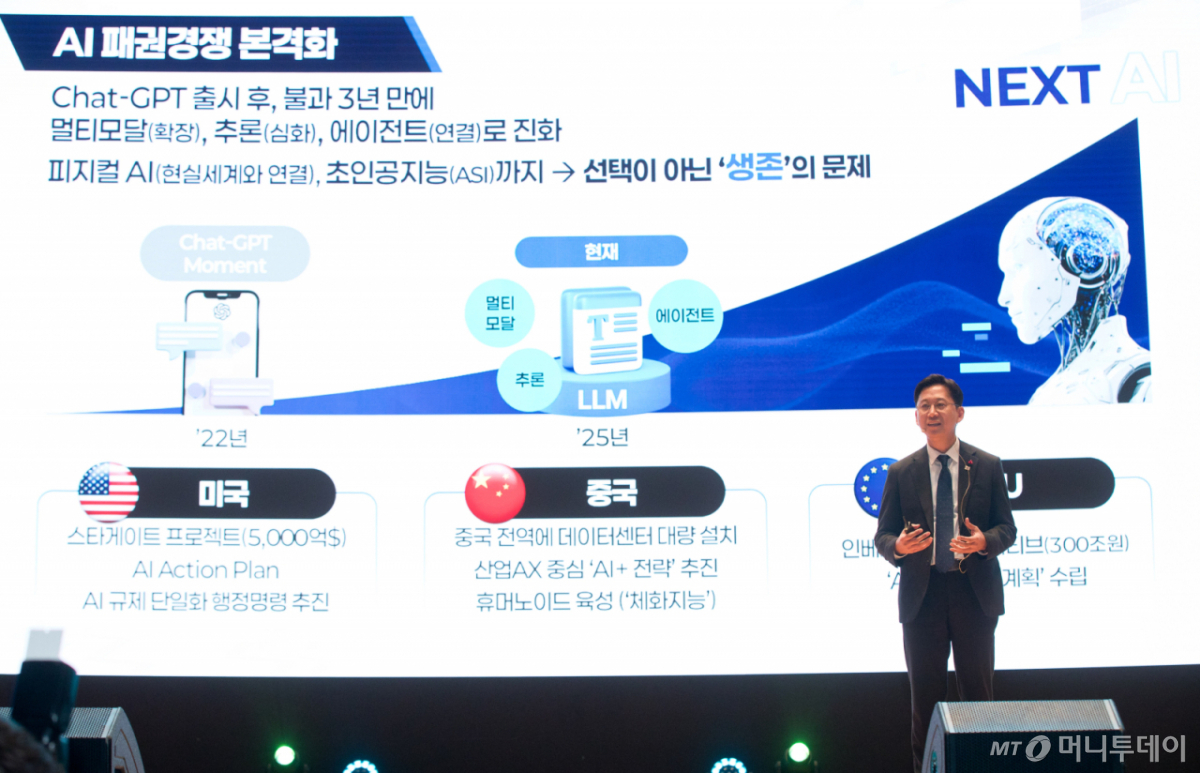
Yoo Jae-jun, former dean of the College of Natural Sciences at Seoul National University and a physics Cheon Mun-hak-bu (Prof.) at Seoul National University, stated, "What we commonly call strategic technologies are generally things that other countries have already developed." He added, "It is time to identify how to secure knowledge and possibilities that have not yet been named 'strategic technologies.'" Professor Yoo further remarked, "South Korea must develop its own strengths to increase value-added output; focusing solely on strategic technologies means only picking up crumbs from technologies others excel at." He also noted, "Although the government has declared it will pursue excellence based on diversity, it remains unclear how this has been reflected in actual policies."
As an alternative, Professor Yoo proposed organizing basic science into "10 key fields." This approach would consolidate scattered academic departments and majors in basic science around thematic areas such as computing and data science, quantum science, and astrophysics along with the fundamental laws of the universe. Each theme would then be linked to national strategic technologies and the national R&D support system to explore pathways for revitalizing basic science. He concluded, "The state should define missions, but researchers must be allowed to formulate their own questions."
Meanwhile, this year's budget for basic research projects increased by approximately 17% compared to last year, with projections indicating that next year's budget will either maintain or increase at a similar level. Additionally, a bill under consideration in the National Assembly mandates that at least 10% of the national R&D budget be allocated specifically to basic research projects. However, critics note that basic research projects support not only basic science but also multiple disciplines such as medicine and engineering across various levels; thus, an increase in funding for these projects does not necessarily equate to expanded support for basic science alone.
Hwang (Rep.), who sponsored the bill, stated at the forum today, "We recognize that growth is only possible when basic science is robust," adding, "We will work to ensure balance so that R&D investments do not become overly concentrated on AI."

 in TECH

