

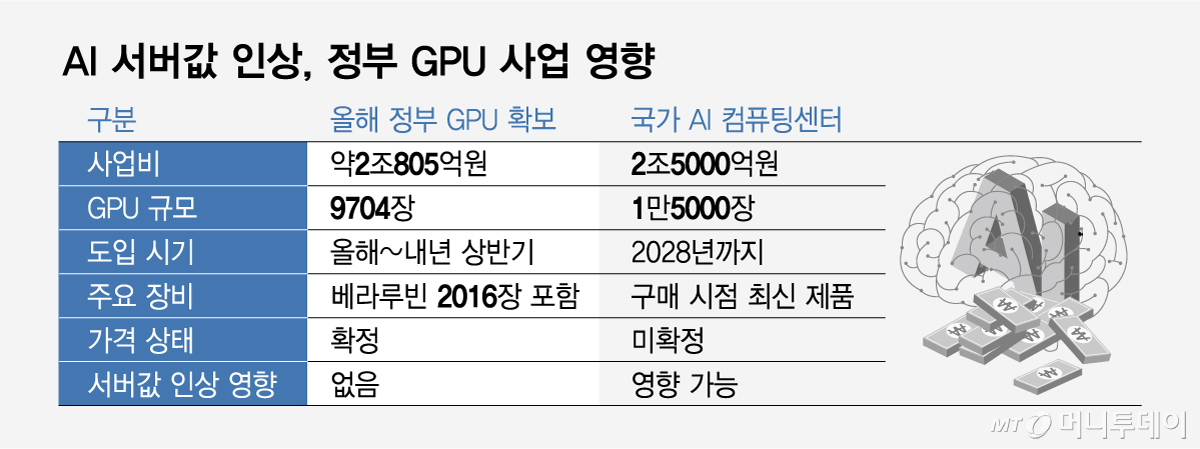
Although forecasts suggest AI server prices could rise by more than 15% starting with shipments in early next year, it has been confirmed that the 9,704 GPUs (graphics processing units) secured by the government this year at a cost of approximately 2 trillion won are outside the scope of any price increases. This is because prices are fixed at the time of ordering. However, among domestic cloud companies, some have already received verbal notifications about potential price hikes.
Foreign media outlets such as Bloomberg recently reported that major customers of NVIDIA have been notified of price increases for the latest Vera Rubin and Grace Blackwell series servers. The increase does not apply to GPU chip prices alone but to the entire server system combining GPUs, memory, and networking equipment. The cause is rising costs for HBM (high-bandwidth memory) and DDR5 DRAM installed alongside the GPUs. To operate, GPUs require memory capable of rapidly supplying data; as AI models grow larger, the required capacity also increases. Industry experts project that the share of memory in component costs will rise by 3 to 5 times compared to current levels (5–10% for Grace Blackwell rack configurations) to 25–30% when Vera Rubin racks are deployed.
This issue connects to government projects due to the purchasing unit. Neither the government nor cloud companies purchase GPU chips individually. Prices are determined at the level of integrated systems bundling GPUs, CPUs, memory, and networking equipment; thus, if memory prices rise, the cost of securing GPUs also increases accordingly.
The Ministry of Science and ICT is currently securing 9,704 GPUs for domestic companies' AI model development and national AI projects at a total cost of approximately 2 trillion won 85 billion won this year. The scale of equipment is expressed in terms of the number of GPUs. Among these, 2,016 Vera Rubin units are scheduled for introduction in the first half of next year, overlapping with the timing of potential price increases.
However, the Ministry of Science and ICT has clarified that price increases will not apply to already-ordered quantities. A ministry official stated, "Prices are determined at the time of ordering; they are not finalized afterward," adding, "The 2,016 Vera Rubin units' prices are unaffected, and there will be no changes to already-fixed quantities and models."
Naver Cloud, an institutional investor, confirmed it received verbal notice regarding the price increase announcement but noted that the final rate remains undecided as formal notification has not yet been issued. The company verified that shipments scheduled for early next year under existing orders are not subject to the price hike. Another corporate official involved in government projects also remarked, "When recently inquired about, some parties expected prices to rise," but added, "Since orders have already been placed, there will be no impact on government project funds."
While existing contracts remain secure, this does not guarantee that future prices will remain unchanged. AI server pricing is not based on fixed consumer prices but is determined by component costs, system configurations, and contract terms at the time of ordering. Consequently, even identical products may have different prices depending on when they were ordered.
The government plans to construct a national AI computing center in Haenam, South Jeolla Province by 2028, investing 2.5 trillion won to secure 15,000 advanced AI semiconductors. Since equipment will be selected based on the latest models available at the time of purchase, continued rises in memory prices could alter either the quantity or configuration achievable within the same budget.
Calculating the impact separately is also challenging. A Ministry of Science and ICT official explained, "Since unit costs are calculated per integrated system, it is difficult to isolate and discuss only memory price differences." Fluctuations in memory prices are expected to become evident in quotations at the time new equipment orders are placed.

 in TECH
