

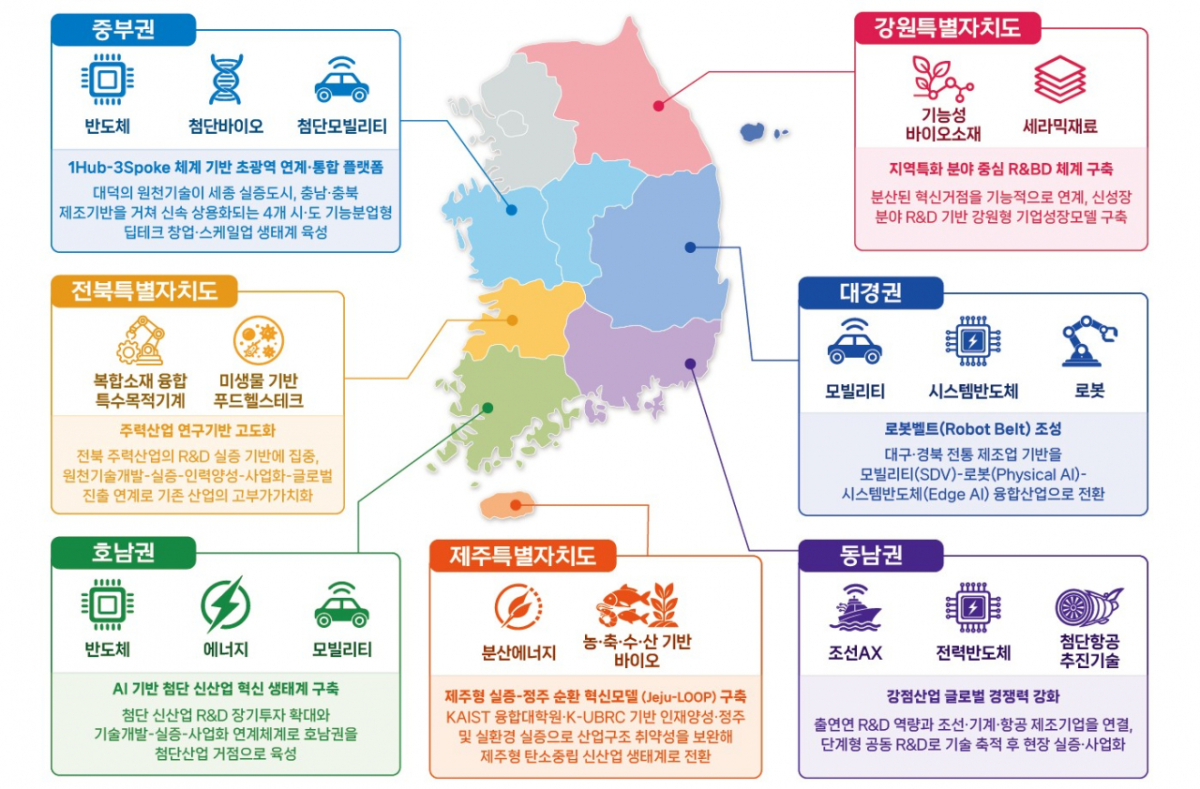
For the first time, local governments are directly planning and executing specialized regional R&D (research and development) projects under the new "4 Polarities and 3 Specialties Regional Autonomous R&D Project," with a total budget of 78.9 billion won.
The Ministry of Science and ICT announced on the 10th that it held a launch ceremony for the project at KAIST in Yuseong-gu, Daejeon. The event was attended by First Vice Minister Gu Hyeok-chae of the Ministry of Science and ICT, representatives from 13 local governments across the 4th Polarities and 3 Specialties regions, heads of seven regional project teams, research support units, companies, and over 100 young researchers.
The "4 Polarities" refer to: △Central Region (Daejeon, Sejong, North Chungcheong, South Chungcheong), △Honam Region (Gwangju, South Jeolla), △Daegu-Gyeongbuk Region (Daegu, North Gyeongsang), and △Southeast Region (Busan, Ulsan, South Gyeongsang). The "3 Specialties" include: △Gangwon Special Self-Governing Province, △Jeonbuk Special Self-Governing Province, and Jeju Special Self-Governing Province.
The distinctive feature of this autonomous R&D project is that local governments are responsible for selecting projects and planning initiatives independently. While previous regional R&D efforts were centered on individual projects planned by the central government, the autonomous model allows each region to proactively propose growth strategies and key technology areas, with the central government providing necessary R&D support.
Accordingly, the 4th Polarities have each selected three key technology areas, while the 3rd Specialties have each selected two, totaling 18 priority fields.
The Central Region will invest a total of 13.1 billion won: 4.2 billion won in semiconductors, 3.9 billion won in advanced biotech, and 4 billion won in advanced mobility. The plan aims to connect Daejeon's foundational R&D capabilities with Sejong's policy and demonstration strengths, as well as South Chungcheong and North Chungcheong's manufacturing and industrialization expertise.
The Honam Region will invest a total of 13.1 billion won: 4.6 billion won in semiconductors, 4 billion won in energy, and 3.7 billion won in mobility. The goal is to combine Gwangju's AI and semiconductor design capabilities with South Jeolla's renewable energy and material foundations, creating a seamless path from technology development to commercialization.
The Daegu-Gyeongbuk Region will build a "robot belt" by connecting mobility, robotics, and system semiconductors. Investments include 4.3 billion won in mobility, 3.7 billion won in robotics, and 3.75 billion won in system semiconductors, totaling 13.1 billion won.
The Southeast Region will invest a total of 13.1 billion won: 4.33 billion won in shipbuilding AI transformation (AX), 4 billion won in power semiconductors, and 4 billion won in advanced aerospace propulsion technologies. The objective is to link research capabilities of government-funded institutes with the shipbuilding, machinery, and aerospace manufacturing bases of Busan, Ulsan, and South Gyeongsang, establishing a manufacturing-site-centered R&D system that spans from technology development to on-site demonstration and commercialization.
Additionally, Gangwon Special Self-Governing Province will invest a total of 8.8 billion won: 5.089 billion won in functional bio-materials and 2.331 billion won in ceramic materials. Jeonbuk Special Self-Governing Province will invest a total of 8.8 billion won: 4.39 billion won in composite material-integrated special-purpose machinery and 3 billion won in Misaeng water-based food and health tech sectors. Jeju Special Self-Governing Province will invest a total of 8.8 billion won: 5.183 billion won in distributed energy and 3.617 billion won in bio-based agriculture, livestock, and fisheries sectors. A joint graduate school between KAIST and Jeju National University will also be established.
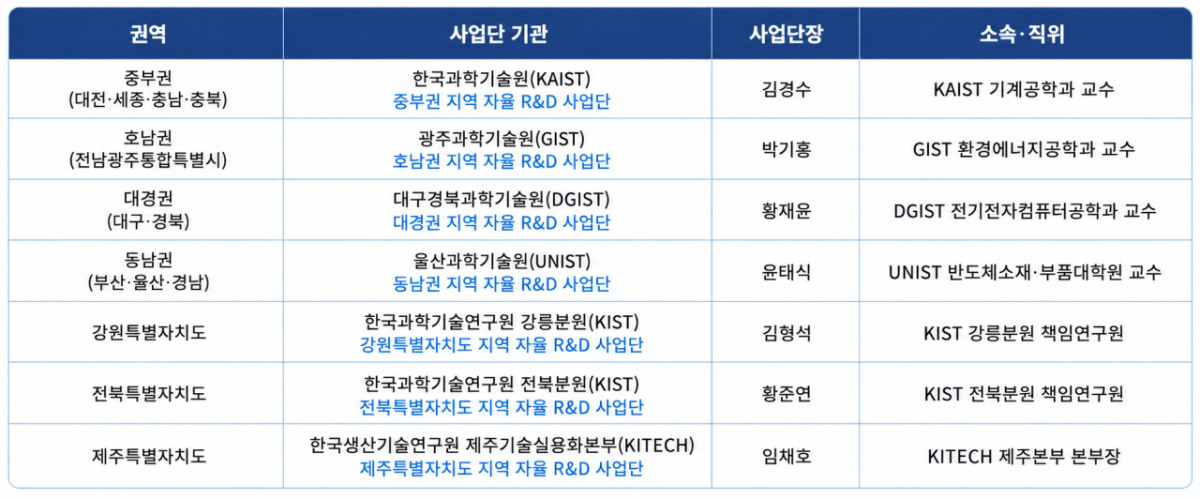
The project teams will be led by KAIST for the Central Region, GIST (Gwangju Institute of Science and Technology) for the Honam Region, DGIST (Daegu Gyeongbuk Institute of Science and Technology) for the Daegu-Gyeongbuk Region, and UNIST (Ulsan National Institute of Science and Technology) for the Southeast Region. For the 3rd Specialties, KIST (Korea Institute of Science and Technology) Gangneung and Jeonbuk branches will lead the Gangwon and Jeonbuk projects, respectively, while the Korea Institute of Industrial Technology's Jeju Technology Commercialization Center will manage the Jeju project. The project teams will oversee project planning, task management, and outcome dissemination.
First Vice Minister Gu Hyeok-chae of the Ministry of Science and ICT stated, "This project marks the first regional autonomous R&D initiative driven by individual regions." He added, "We will actively support efforts to ensure that research outcomes lead to corporate growth and quality jobs, fostering a virtuous cycle where new talent and investment further stimulate R&D within each region."

 in TECH

