

Amid expectations of a major overhaul of government-funded research institutions in the science and technology sector, suggestions were made that the voices of researchers on the front lines must be reflected in the government's first-ever 'Five-Year Plan for Affiliated Research Institutes.'
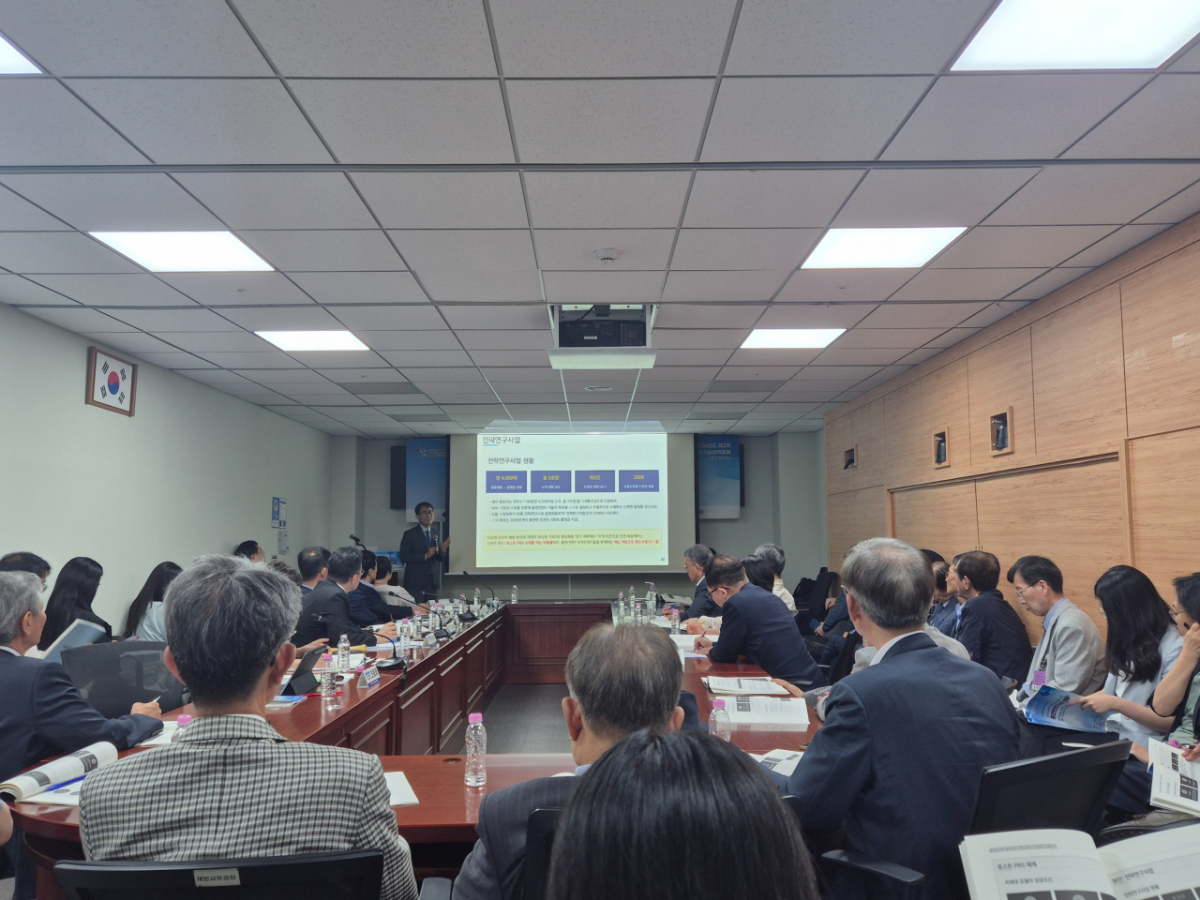
Experts voiced these opinions at the 'Next-Generation Model for Affiliated Research Institutes to Fulfill National Science and Technology Missions' Science and Technology Policy Forum held at the National Assembly Conference Hall in Yeouido, Seoul, on the 10th.
Following the implementation of a partial revision to the 'Act on the Establishment and Operation of Government-Funded Research Institutions in the Science and Technology Sector' on the 11th, the Ministry of Science and ICT is now legally required to establish medium- and long-term development plans and funding acquisition plans for NST (National Research Council of Science and Technology) and its 23 affiliated research institutes. This is commonly referred to as the 'Five-Year Plan for Affiliated Research Institutes.'
The revision came in response to criticisms that policies for affiliated research institutes have frequently changed with shifts in administration or ministry directions, creating obstacles to foundational technology R&D (research and development) requiring long-term investment and deep focus. The core of the plan is to establish a five-year roadmap and pursue consistent policies for at least this duration.
However, the fact that the 'government' is the entity responsible for establishing the plan has become problematic. Concerns have been raised that the autonomy of affiliated research institutes, which were released from public institution status in 2024, could be infringed upon during this process.
Kwon Sung-hoon, a legislative researcher at the National Assembly, stated, "While it is advantageous for the Ministry of Science and ICT to lead in ensuring alignment with higher-level plans and strengthening links with national finances," he also pointed out that "there is a risk that top-down policy demands from the government could overwhelm research needs essential for fulfilling the unique missions of affiliated research institutes and accumulating their capabilities." Although affiliated research institutes are legally designated as 'special corporations,' they could degenerate into mere institutions simply executing government demands in line with the five-year plan.
An exception is IBS (Institute for Basic Science). Under the 'Special Act on the Establishment and Support of International Science Business Belt,' IBS independently establishes its own medium- and long-term development plans, while the government plays a supportive role to enable IBS to implement these self-formulated plans. Legislative researcher Kwon added, "The case of IBS could serve as a reference for affiliated research institutes as well."
Furthermore, although procedures exist to gather NST's opinions when establishing the five-year basic plan, no explicit procedure is specified for collecting input from researchers on the front lines at affiliated research institutes. Legislative researcher Kwon emphasized, "The people who know affiliated research institutes best are their own staff," and stressed that "measures must be taken to allow them to participate as substantive co-designers."
Kim Sung-soo, special professor at Yonsei University (former scienceGi Sul-hyeok-sin (Head)), who delivered the keynote address today, also stated that the state's obligation regarding science and technology is undervalued in the Constitution. Article 10 of the Constitution stipulates: "The State shall strive to promote national economic development through innovation in science and technology and the development of information and human resources."
Professor Kim remarked, "Science and technology have been defined merely as a 'means' for economic development," and argued that "during constitutional revision discussions, science and technology should be explicitly codified as an independent value." He also noted that in the current legal framework, definitions of affiliated research institutes, NST, national R&D projects, etc., are either unclear or partially omitted. Professor Kim emphasized, "To guarantee research autonomy, institutional mechanisms and legal frameworks must accompany each other."
Meanwhile, the Ministry of Science and ICT plans to announce a medium- and long-term roadmap in November that will comprehensively restructure the operational framework and compensation systems of affiliated research institutes. The ministry intends to define the core missions of each affiliated research institute and accordingly revise their project portfolios.

 in TECH

