


To supplement the existing TV viewership survey relying on approximately 4,000 households, 'TV Index,' which utilizes data from about 18 million set-top boxes across three IPTV providers, was proposed as an alternative. This method measures not only viewership ratings but also actual reach and total viewing time.
The Korea IPTV Broadcasting Association held a press study session on the 15th titled 'Changes in Domestic Media Usage Patterns and Directions for Utilizing the TV Index,' introducing the role of the TV Index and its industrial application strategies.
Lee Seo-yong, team leader at IGA Works, who delivered the presentation, stated, "The TV Index analyzes comprehensive data from approximately 18 million household set-top boxes across three IPTV providers." He added, "While the existing viewership survey targeted about 4,000 households, this method measures a target population approximately 4,000 to 5,000 times larger in terms of sample size."
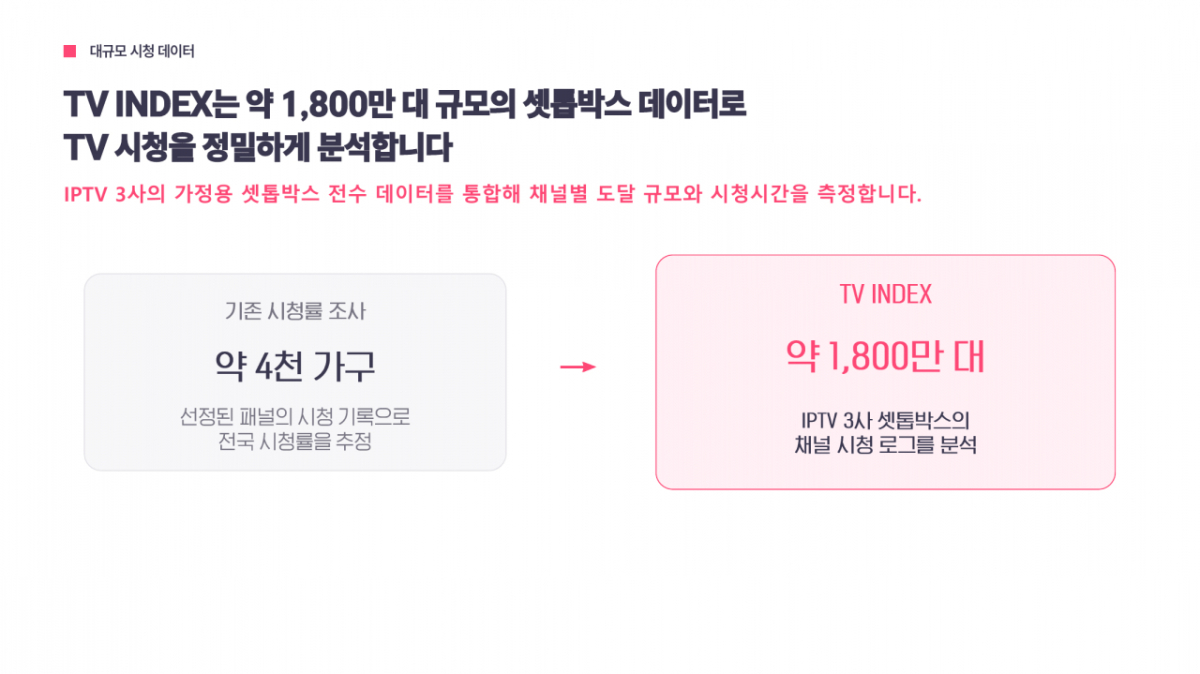
The TV Index uses large-scale viewership data to reveal specific numbers for channels that were difficult to capture in traditional sample surveys. According to data released at a Korean Broadcasting Studies Association seminar last May, among 306 channels distributed by three IPTV providers, 85 channels (27.7%) recorded a viewership rating of 0% in the existing survey. This does not necessarily mean no viewers existed; rather, it suggests that these channels may have gone undetected within the approximately 4,000-household sample.
In reality, the TV Index reveals viewing scale previously obscured by ratings. In August, CNTV's monthly viewership rating was 0.0902%, yet 11.52 million TVs had watched the channel at least once, with total viewing time reaching 20.04 million hours. KBS2 recorded a viewership rating of 1.0292%, but its reach extended to 22.46 million TVs, with total viewing time amounting to 234.99 million hours.
Team leader Lee explained, "To more concretely demonstrate the value of broadcasting, it is necessary to examine not only viewership ratings but also actual reach and viewing time." He further noted, "Such data can be utilized across various fields, including content and scheduling strategies for broadcasters and PP providers."
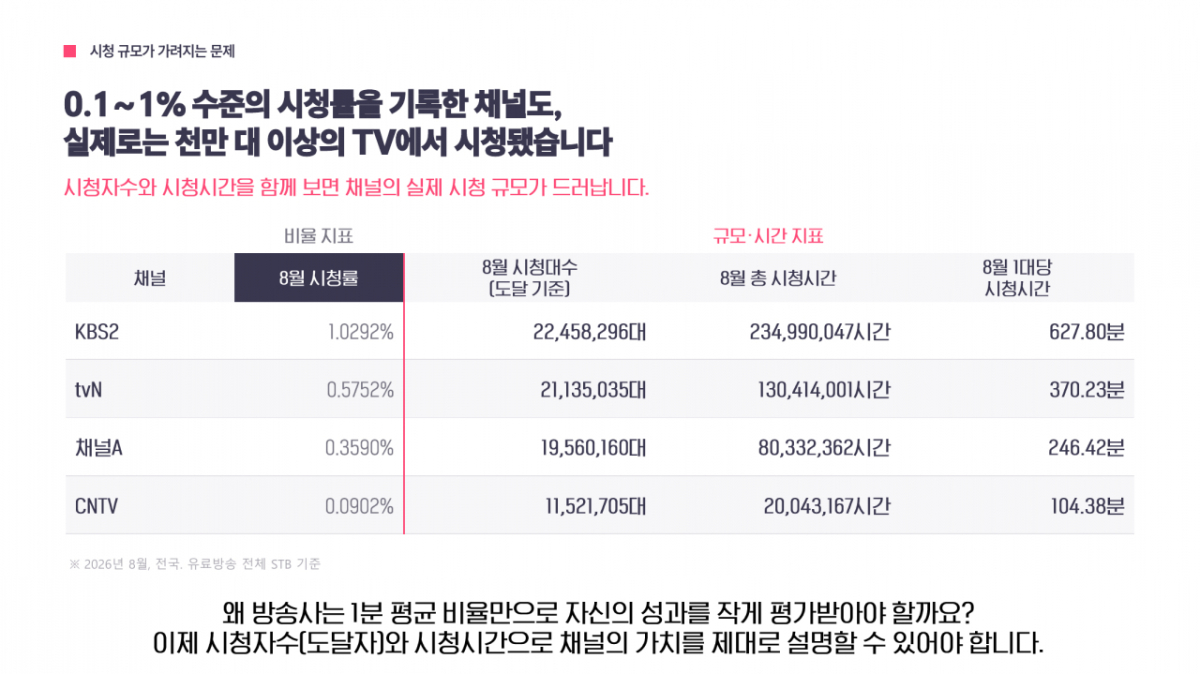
Traditional viewership ratings represent the 'average one-minute viewing ratio' during broadcast time, not the proportion of people who watched a program at least once. In contrast, the TV Index provides absolute values such as reach and viewing time, offering a more concrete picture of actual viewership scale.
Yoo Yong-hwa of Korea IPTVBang Song-hyeop (Chairman) stated, "As media usage patterns become increasingly diverse, the importance of data that can measure and utilize broadcasting value from various perspectives is growing." He added, "Based on the large-scale viewership data held by IPTV providers, we will expand data utilization across the entire media industry, including broadcasters and PP providers."

 in TECH


