

[For more diverse corporate information on the startup featured in this article, please visit the Unicorn Factory big data platform "Data Lab."]
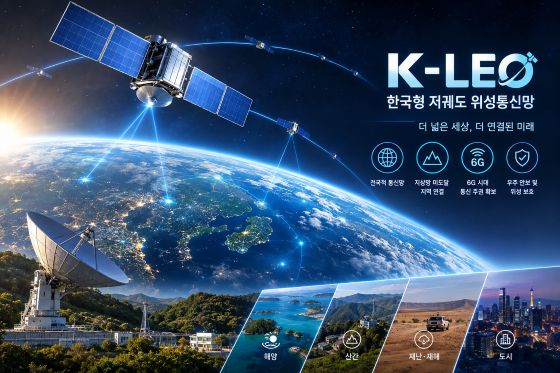
The government has formalized the construction of a Korean low Earth orbit satellite communication network, commonly known as "K-LEO." The plan aims to establish national infrastructure that connects even areas difficult to reach with terrestrial communication networks by deploying multiple communication satellites in low Earth orbit by 2035. The K-Space Forum, opening on Oct. 28, is expected to focus on the government's policy direction and public-private cooperation plans for building K-LEO.
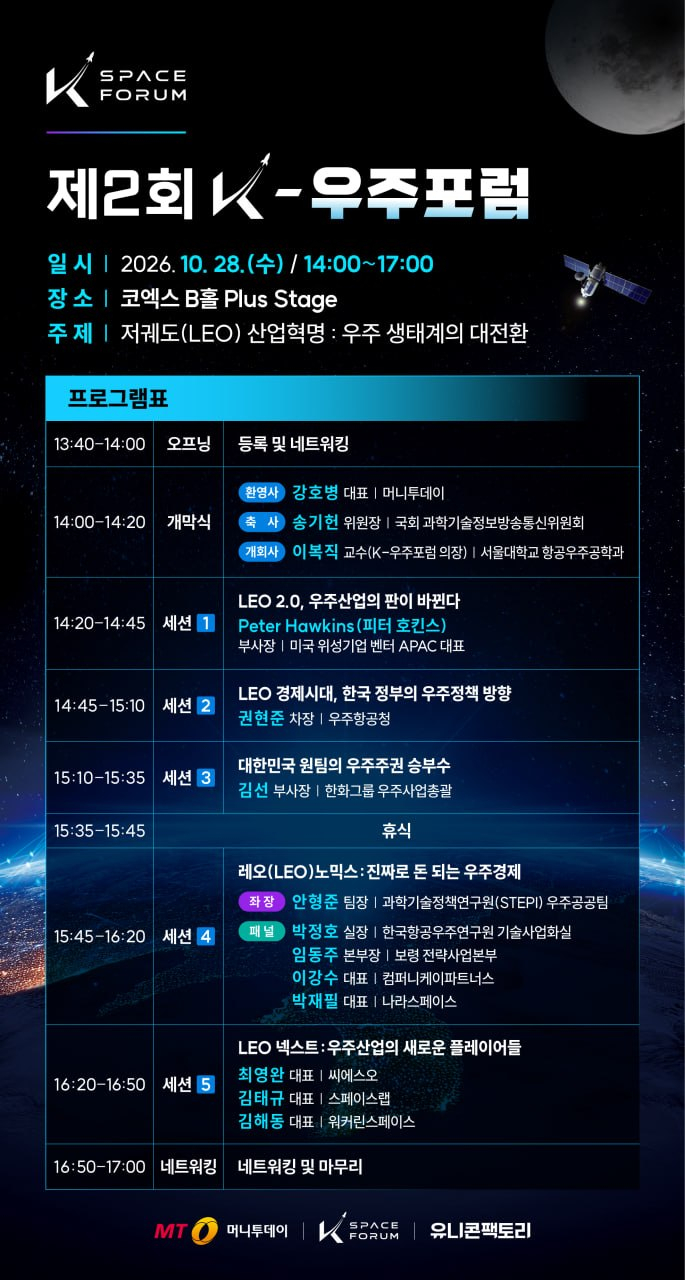
MoneyToday's startup media platform "Unicorn Factory" will host the "2nd K-Space Forum" (Registration: https://url.kr/2hgl5j) from 2 p.m. to 5 p.m. at the Plus Stage in Hall B of COEX in Samsung-dong, Seoul, under the theme of "The LEO Industrial Revolution: A Major Shift in the Space Ecosystem"
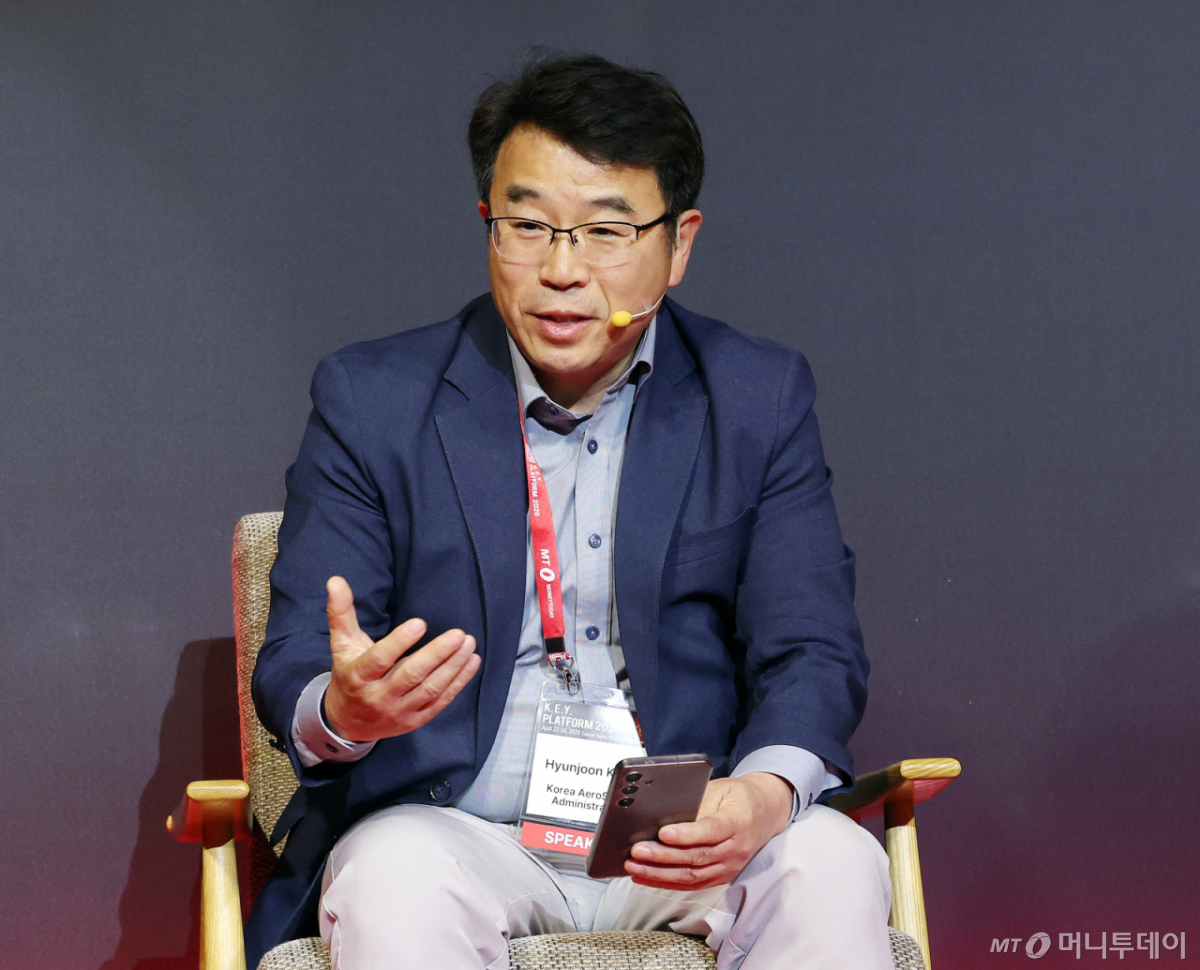
In particular, Deputy Director-General Gwon Hyeon-jun of the Korea Aerospace Administration will take the stage as a speaker in the second session to present space policy directions for the LEO economic era. As K-LEO is closely linked to the business models (BM) of domestic and international space startups, industry attention is focused on specific construction directions and the role of domestic companies.
The government recently announced through the National Space Committee that it will build a Korean low Earth orbit satellite communication network by 2035. Specifically, the phased roadmap involves creating a technology and industrial ecosystem capable of satellite Yangsan and launches by 2030, verifying communication satellite operations in space by 2032, and completing the construction of the satellite communication network by 2035.
The scale of construction is being considered up to a maximum of 512 units. This plan aims to grow the domestic low Earth orbit satellite communication industry into a single national infrastructure, going beyond the existing level of "developing and demonstrating two satellites."
Previously, the Ministry of Science and ICT and the Korea Aerospace Administration are promoting a project to develop a system consisting of two communication satellites and ground stations and terminal stations by 2030 in order to secure core technologies for low Earth orbit satellite communication based on 6G international standards.
The goal is to secure core technologies required for the 6G era, including not only communication between satellites and the ground but also △inter-satellite communication △satellite tracking △handover (switching of communication connections) △and signal error compensation.
Low Earth orbit satellite communication is drawing attention due to its very wide range of applications. It can connect not only maritime, aviation, island, and mountainous areas that are difficult for terrestrial base stations to reach, but also various mobile entities such as autonomous vehicles and urban air mobility (UAM).
It is evaluated as having a high potential to develop into core infrastructure that complements the limitations of existing terrestrial communication networks while commercializing national advanced strategic technologies.
The key issue is who will build K-LEO and in what manner. The government launched the "Korea Low Earth Orbit Satellite Communication Industry Council" in February last, centered on the Defense Acquisition Program Administration, with 86 domestic companies participating.
Companies in four fields — satellite bodies, ground systems, terminals, and communication services — are participating in the council. In addition, it is planned to support the global business participation of domestic companies based on civil-military-government cooperation.
Movements in the industrial sector are also accelerating. Korea Aerospace Industries (KAI) recently signed a memorandum of understanding (MOU) for strategic cooperation with Belgian satellite specialist company Aerospace Lab (ASL). The two companies agreed to promote cooperation on the K-LEO project and joint development of next-generation commercial communication satellites.
However, there are no few challenges that must be resolved for K-LEO to proceed as planned. This is because competition between nations to secure orbits and frequencies required for satellite operations is becoming increasingly fierce as the number of low Earth orbit satellites surges globally. Since satellite networks operate for long periods once built, it is analyzed that how quickly orbits and frequencies are secured can determine the future competitiveness of the space and communication industries.
For this reason, voices of concern are emerging in the industry over whether the 2035 target date presented by the government is sufficient to respond to global competition. At the 6G Satellite Communication Conference held last July, arguments were also raised that the timing for building K-LEO should be moved up.
Choe Kyung-il, CEO of KT SAT, stated at the time, "It is a structure where countries that preemptively secure orbits effectively secure the space domain," and suggested, "The 2035 target must be moved up."
This forum is expected to be an opportunity to concretize the K-LEO construction plan while gauging the scope and role of domestic company participation and challenges for securing a leading position in the global market. It is anticipated that core agenda items will go beyond the declaration of building a Korean satellite communication network, focusing on when and at what scale the network will be built, and through what technologies and companies it will be implemented.
Meanwhile, this K-Space Forum will proceed with five sessions covering the entire space industry, from global market trends to government policy, industrial strategy, and commercialization. In the first session, U.S. satellite company Vantor (formerly Maxar) will review the latest trends in the global low Earth orbit market.
Following this, Kim Sun Hanwha Group Space Business Head (Vice President) will unveil a "Low Earth Orbit Full Value Chain" strategy encompassing launch vehicles, satellites, and data solutions.
In the fourth session, Ahn Hyeong-jun, Team Leader at the Science and Technology Policy Institute (STEPI), will serve as moderator for a discussion on commercialization and revenue generation strategies for the space economy with Park Jeong-ho, Director of the Technology Commercialization Office at the Korea Aerospace Research Institute, Im Dong-ju of Borin Jeon Ryak-sa-eop (Head), Lee Kang-su, CEO of Company K Partners, and Park Jae-pil, CEO of Nara Space. In the final session, CEOs of space startups such as CSO, Walkerin Space, and Space Lab will directly introduce their business models and technological competitiveness, examining the current state and growth potential of the private space industry.
Lee Bok-jik, a professor of aerospace engineering at Seoul National University and chair of the K-Space Forum, said, "This forum will be an opportunity to identify key strategies for South Korea to become a leading space power amid the rapidly changing global low Earth orbit market."
<2nd K-Space Forum: Low Earth Orbit Industrial Revolution - The Daejeon of the Space Ecosystem>
• Date and Time: October 28, 2026 (Wed) 14:00 ~ 17:00
• Location: Seoul COEX Hall B Plus Stage
• Target Audience: VCoCVC reviewers and those interested in space industry investment
• Key Content: Global low Earth orbit market trends, anchor company (Hanwha) space business strategy presentation, space startup IR
• Registration: https://url.kr/2hgl5j
[MoneyToday startup media platform "Unicorn Factory"]

 in TECH


