

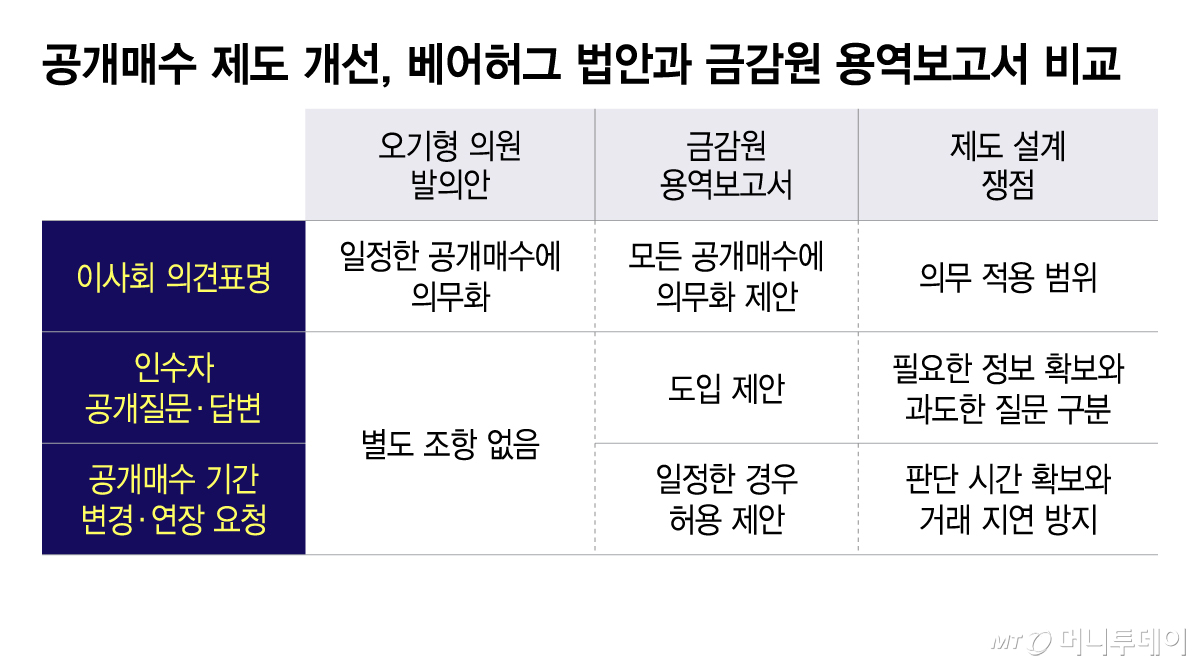
In the legislative process for a "Korean-style bear hug system," a key point of contention has emerged over how far to allow target companies' rights to request public questions and extensions of the tender offer period. The Financial Supervisory Service's commissioned report proposed these measures to assist shareholders in making informed decisions, but warnings have been raised from overseas jurisdictions such as Japan that information requests could be distorted into a means of blocking acquisitions.
Differing Views on the Duty to Explain and the Right to Stall…Question and Extension Requirements at Issue
A commissioned report by the Financial Supervisory Service titled "Improvement Measures for Recent Control Disputes," obtained on the 14th through the office of Democratic Party of Korea lawmaker Park Hong-bae, a member of the National Assembly's Committee on Finance, stated that the purpose of improving tender offer systems is to promote shareholders' "informed decision-making." The goal is to disclose the board of directors' position and the basis for its judgment, thereby helping shareholders independently decide whether to accept a tender offer.
The mandatory requirement for boards of directors to express their opinions, which is central to the Korean-style bear hug legislation, aligns with this direction. However, the issue of holding boards accountable for explaining matters to shareholders should be distinguished from allowing them to request information from acquirers or extend deal timelines. The report's proposals for public question-and-answer sessions and requests to modify or extend the tender offer period under certain circumstances go one step further than simply strengthening the duty to explain.
The commissioned report did not view the mandatory expression of opinions itself as an obstacle to mergers and acquisitions (M&A). It noted that in friendly M&A, a board's opinion can help persuade shareholders and facilitate the transaction. In hostile M&A, it assessed that the chilling effect on desirable deals due to directors' liability for providing incorrect information or unreasonable opinions would be limited.
Public questions and period extensions also hold significance in that they secure necessary information for shareholders and provide time for review. However, there are concerns that if questions can be repeated or procedures extended solely on the grounds that additional information is needed, it could increase acquirers' costs and deal uncertainty. This is why the possibility that procedures intended to assist shareholder judgment could be used as a means to protect incumbent management's position must also be examined.
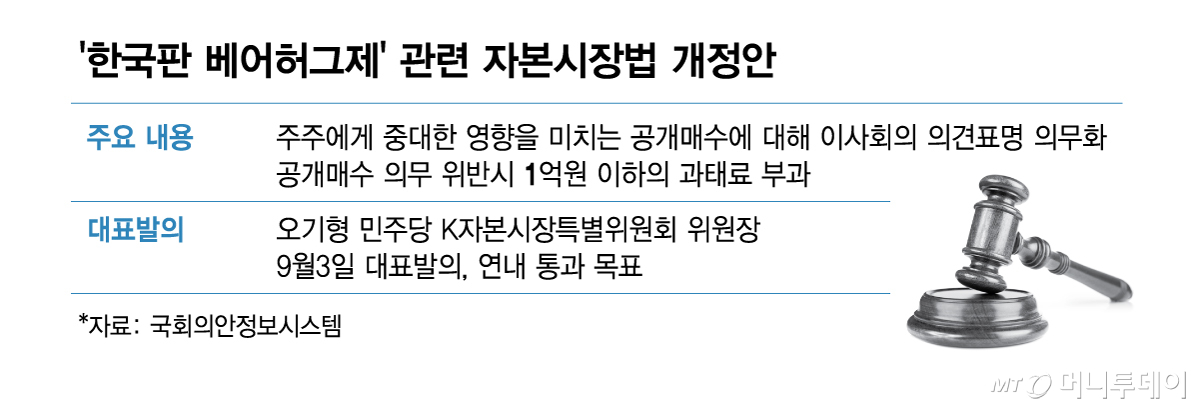
The "Partial Amendment Act of the Capital Markets and Financial Investment Business Act," introduced by Oh Ki-hyung, Democratic Party of Korea chairman of the Special Committee on the K-shaped Capital Market, does not include provisions for public question-and-answer sessions or requests to extend the period. The core issue is whether such information and additional time are essential for shareholder choice. Distinguishing between questions aimed at clarifying ambiguous acquisition terms and those that repeatedly request already answered content, as well as requiring explanations of reasons when extending periods, are cited as review tasks in the upcoming legislative process.
Japan's Guidelines: "Acquisitions Must Not Be Blocked by Excessive Questions"
In 2023, Japan's Ministry of Economy, Trade and Industry explicitly stated in its "Code of Conduct for Corporate Acquisitions" that target companies must not use excessively detailed questions as a de facto means to block changes in control. It also instructed outside directors to appropriately supervise this matter. This established criteria for guarding against the abuse of information requests, separate from legal obligations.
At the time, UK asset management firm Asset Value Investors (AVI) argued in an opinion submitted to the Ministry's research council that acquisitions should not be chilled or unfairly delayed by endless information demands. Simultaneously, it demanded that management rejecting acquisition proposals must publicly disclose objective reasons for rejection and why existing management can create higher value.
In actual M&A negotiations as well, information provision and review periods have become sources of conflict. Canadian convenience store company Alimentation Couche-Tard withdrew its acquisition proposal to Japan's Seven & i Holdings in July last year, citing insufficient information provision and negotiation delays. Seven & i countered that it had negotiated in good faith and had explained the high barriers and potential for lengthy antitrust review processes. Although this is a separate negotiation case from the public question-and-answer system, the boundary between shareholder-oriented review and stalling tactics has also been an issue in real-world negotiations.

 in STOCK

