

Domestic game companies are giving their end-of-life "retired PCs" a "new life" outside the company through recycled PC donation programs. This allows the companies to reduce waste, improve corporate image, and gain advantages in global expansion, delivering a "triple win" effect.
According to Seongdong District in Seoul on the 17th, the Dokseom Scholarship Society of Seongsu 2-ga, Jeong 1-dong, submitted an application for the "Krafton High-Performance Recycled PC Support Project" to the Seoul Metropolitan Council of Social Welfare Associations last month. The project involves refurbishing Krafton's aging PCs and providing them to help bridge the educational gap among vulnerable children in densely populated redevelopment areas.
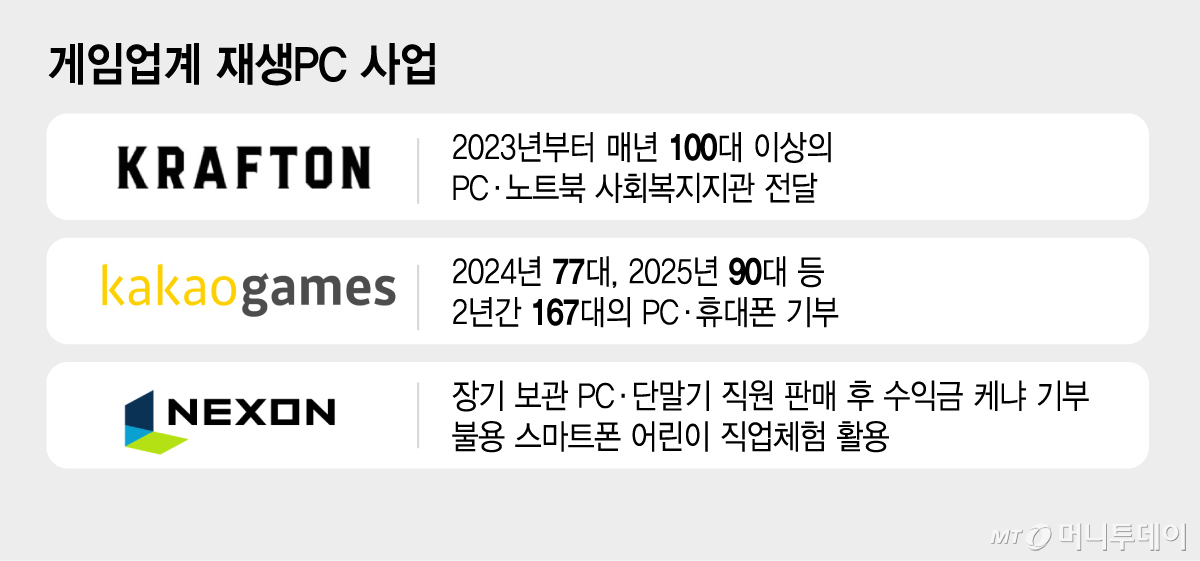
Since 2023, Krafton has collaborated with the Korea IT Welfare Promotion Institute, the Seoul Metropolitan Council of Social Welfare Associations, and the Yongin City Council of Social Welfare Associations, among others, to meticulously repair more than 100 PCs and laptops annually and deliver them to social welfare institutions across the country, including Seoul, Gyeonggi Province, Daejeon, and Busan.
The initiative was inspired by the observation that high-performance PCs used for development, operations, and testing, even when too outdated for their original workloads, still deliver excellent performance for educational and office tasks such as watching online lectures, creating documents, and editing videos.
A Krafton official stated, "We plan to continue refurbishing IT equipment slated for replacement and delivering it to information-disadvantaged and vulnerable groups in local communities." The official added, "We will consistently contribute to promoting resource reuse, improving access to information, and creating social value."
Kakao Games launched its "Donation of Unused PCs and Test Mobile Phones" program in 2024, donating a total of 167 IT devices—77 units in the first year and 90 last year. The company first repurposes these devices as auxiliary equipment internally to maximize their lifespan. Once deemed unusable for internal purposes, they are donated through "E-Circular Governance." E-Circular Governance is a non-profit public interest corporation that disassembles, crushes, and separates collected electronic waste to use it as recycled raw materials.
In 2018, Nexon sold PCs and terminals that had been stored internally for long periods to its employees and donated the proceeds to the NGO (non-governmental organization) "Team & Team International." Nexon also added a separate donation to fund the construction of wells providing clean drinking water to remote villages in Kenya. The company has also utilized unused smartphones for children's vocational experience programs.
Game companies are enjoying the triple-win effect. This is particularly relevant as game companies, facing slowing growth in the domestic market, are betting their survival on global expansion and require ESG (Environmental, Social, and Governance) management; this type of business is well-suited to that need. According to the "2025 Korea Game White Paper" published by the Korea Creative Content Agency last May, the size of the domestic game market in 2024 was 2,385.15 billion won, representing a year-on-year growth of just 3.9%. The annual growth rate, which reached 21.3% in 2020, has declined to 11.2% in 2021, 5.8% in 2022, and 3.4% in 2023.
Major overseas institutional investors, such as BlackRock and the Government Pension Fund Global (Norway's sovereign wealth fund), are factoring ESG-related risks into their investment decisions, meaning these initiatives can positively contribute to securing the trust of foreign investors. A gaming industry official stated, "ESG projects can enhance corporate credibility in global markets and help attract overseas investment or establish a foundation for sustainable business." The official added that this is an element increasingly considered important when attempting global expansion recently.

 in TECH
