

[For more diverse corporate information on startups, you can view it on the Unicorn Factory big data platform 'Data Lab'.]
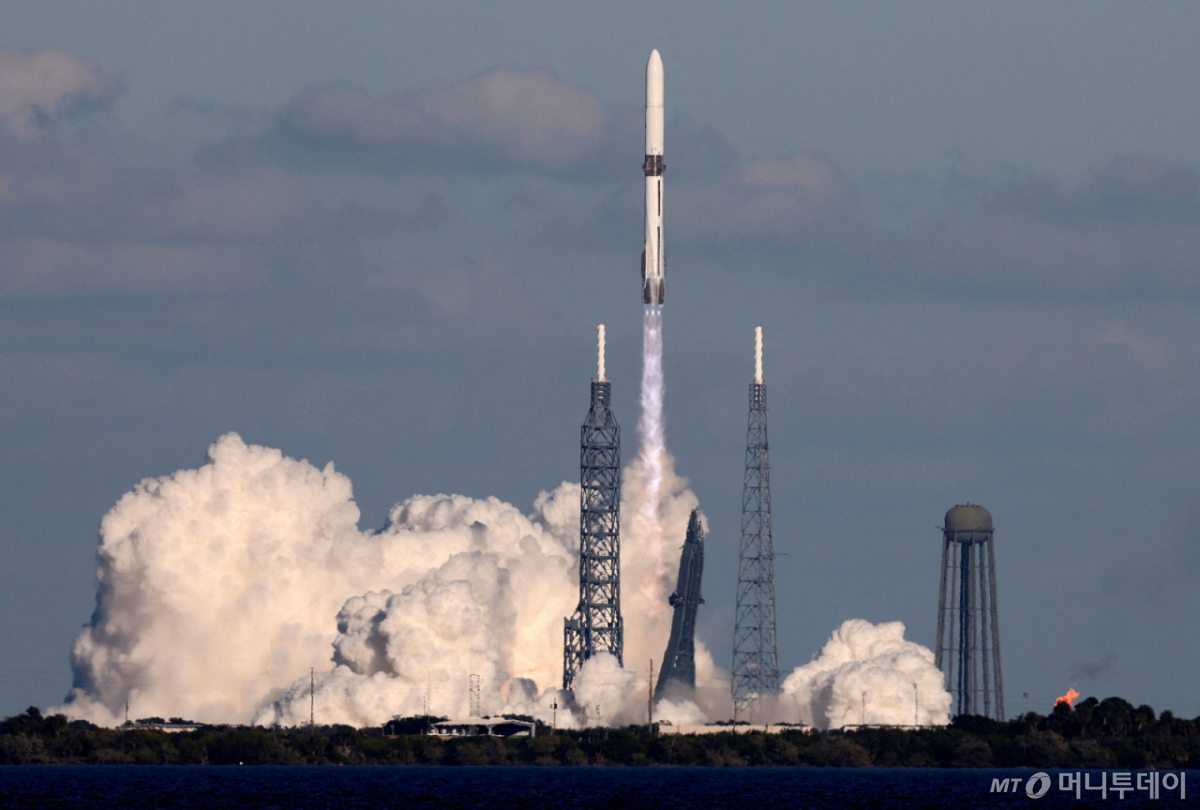
![[Cape Canaveral=AP/NEWSIS] A Falcon 9 rocket carrying the Dragon spacecraft for NASA's SpaceX 'Crew-13' mission is launched toward the International Space Station (ISS) from the U.S. Space Force Base at Cape Canaveral, Florida, on the 1st (local time). October 2, 2026.](https://thumb.mt.co.kr/cdn-cgi/image/f=avif/21/2026/10/2026101618173920569_1.jpg)
Investments in global space startups in the third quarter of this year recorded an all-time high for a single quarter. Analysts say that space-related investments triggered around the listing of SpaceX are spreading across the entire infrastructure sector, including launch vehicles and satellite manufacturing. There is also an interpretation that investor interest is shifting beyond simple expectations of listings to actual commercial and public demand.
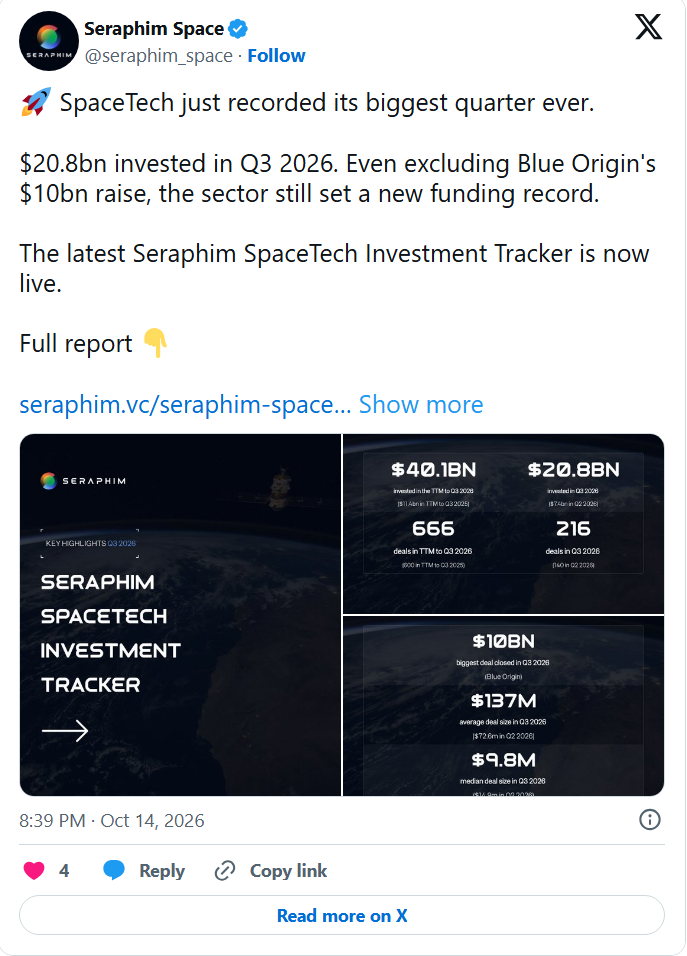
Reuters reported on the 14th (local time), citing a latest report from global space investment firm 'Seraphim Space,' that global space startup investments in the third quarter totaled $20.8 billion (approximately 28 trillion won). This figure is nearly three times higher than the second quarter ($7.4 billion) and represents the largest scale for a single quarter on record. The number of deals also reached 216, the highest for any quarter.
Exceeds $10 billion even excluding 'Blue Origin'… Investment boom without illusion
This third-quarter tally includes $10 billion raised by 'Blue Origin,' the space company founded by Amazon founder Jeff Bezos. Even excluding Blue Origin's fundraising amount to eliminate the illusion effect of a single large investment, third-quarter space startup investments stood at $10.8 billion, which also aligns with an all-time high.
By sector, $16.4 billion (120 deals), accounting for 80% of total funds, was concentrated in the launch vehicle and manufacturing infrastructure sector, which secures launch vehicles and enhances space accessibility. Approximately $4 billion was invested in service sectors such as satellite communications, Earth observation, and data analysis.
In addition to Blue Origin, large-scale investment cases followed one after another. Intelligent space and defense parts manufacturing startup 'Hadrian' raised $1.37 billion, while reusable rocket developer 'Stoke Space' secured $1 billion, and large satellite bus platform developer 'K2 Space' secured $5 million won each.
By region, North America led the global space venture ecosystem, accounting for approximately 70% of total funds on a year-to-date basis this year. China's growth was also notable. In the third quarter of this year, 49 investments were made, and $3.3 billion, an all-time high for a single quarter, was poured into the space sector. It is interpreted that the success of 'LandSpace' (란젠항톈) Zhuque-3 reusable rocket and government-led large-scale low-orbit satellite projects such as 'Guowang' and 'Qianfan' served as catalysts absorbing funds into private space startups.
Experts view this investment not as the lingering effect of expectations for initial public offerings (IPOs) by space startups such as SpaceX, but as a result demonstrating actual market demand. Analysts note that despite many listed space companies being in the red and attention to small and medium-sized listed companies being dispersed due to SpaceX's market monopoly, private venture funds are converging on space companies with definite 'infrastructure and defense demand.'
Lucas Bishop, Vice President of Seraphim Space, stated, "Capital in the current space market is following evidence of actual demand from commercial and institutional investors, not the lingering effect of IPOs," adding, "Government demand in various countries is increasingly underpinning investments in launch, manufacturing, and orbital infrastructure." He further predicted, "The explosive investment growth in the third quarter of this year may slow down somewhat in the short term," but "as more companies enter full-scale growth and scale-up stages, an investment flow significantly exceeding past average levels will continue."
"We judge accurately"… Boom for decision-making AI 'Zeb'
TypeSafe AI, the developer of the AI model 'Zeb,' which shook Silicon Valley in the U.S. within weeks of its release, has secured a large-scale investment, instantly rising to become a major startup. Unlike AI models that fluently write long texts, Zeb presents only choices such as 'yes' or 'no' in 0.1 seconds, captivating corporate executives and developers, while investors lined up to provide funds.
According to Bloomberg News, TypeSafe AI, headquartered in San Francisco, U.S., recently secured approximately $870 million (approximately 1.2 trillion won) in investment in a funding round led by Andreessen Horowitz (a16z). In addition to a16z, major global venture capital firms such as Sequoia Capital and early investor DCVC, along with key angel investors, participated heavily. The company's valuation was recognized at $7.5 billion (approximately 10 trillion won).
TypeSafe AI is a company established in San Francisco in 2024 by researchers from big tech companies such as OpenAI, Meta, and Google. Their first AI model, 'Zeb,' is not a conversational generative AI that exchanges text or writes code like ChatGPT or Claude.
Instead, Zeb is specialized in making precise 'decisions' by connecting directly to internal systems of enterprise software. Because it departs from the existing large language model (LLM) method of sequentially generating sentences word (token) by word, it enables much cheaper and faster computation compared to existing models.
Diogo Almeida, CEO of TypeSafe AI, pointed out, "Existing LLM models show Einstein-like intelligence with 95% probability, but in the remaining 5%, they produce absurd wrong answers like Mr. Bean," adding, "This instability of intelligence can never be used in automation systems where precision is life." The company explained that it has achieved both high reliability and cost-effectiveness by extremely reducing this error margin.
Immediately after Zeb's demonstration video was released, explosive reactions emerged in the market. Within days of its release, it surpassed 1 million users, and currently, about one-third of Fortune 500 companies have adopted this model to utilize in their business processes. The amount of tokens processed per day reaches trillions.
TypeSafe AI announced that with a small elite team of just over 20 people, it is already generating substantial operating profit after deducting expenses. The company plans to focus the large-scale funds secured this time on expanding software distribution, hiring additional talent, and securing computing resources to meet surging demand.
Martin Casado, Partner at a16z, evaluated, "There was already a 'gap in the form of Zeb' in the industry," adding, "TypeSafe AI has perfectly filled the area that all developers have wanted but could not properly implement until now."
$5 million won lump sum to nuclear power startup 'Atlas Atomic'
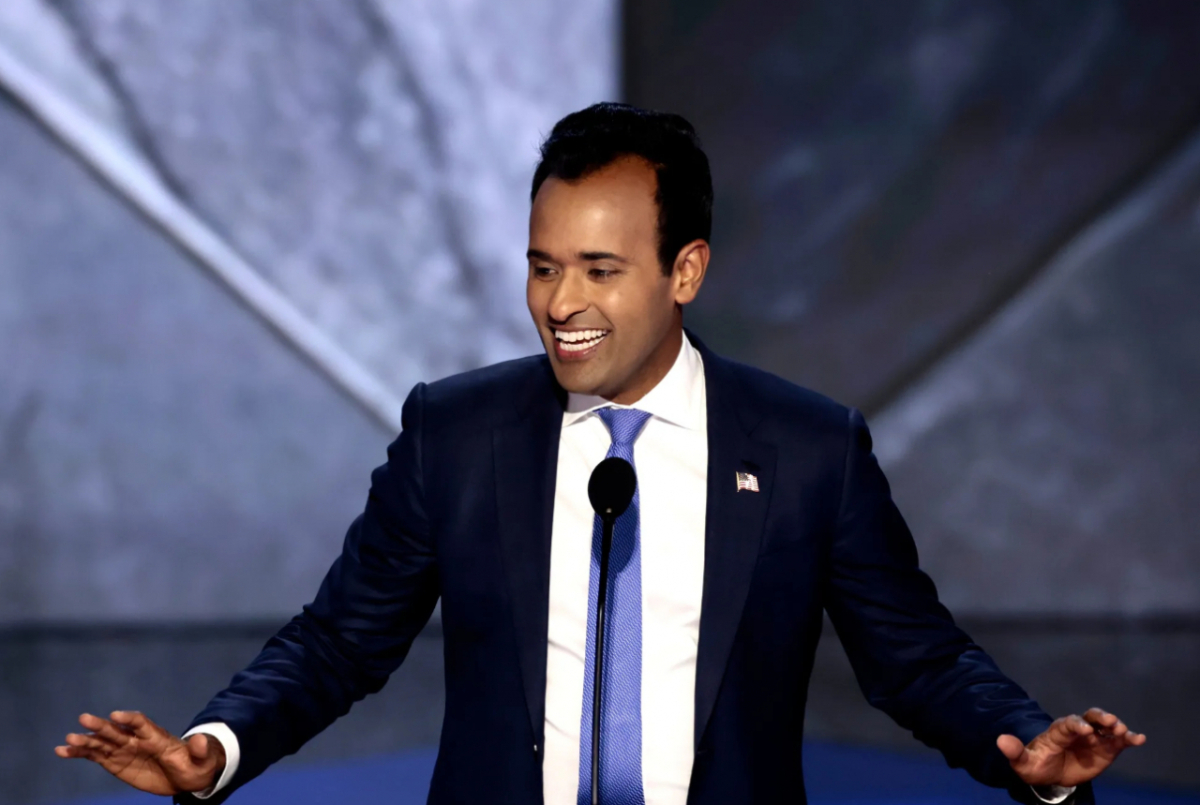
As interest in nuclear companies rises due to the explosive power demand of artificial intelligence (AI) data centers, a next-generation nuclear power startup co-founded by U.S. politician and entrepreneur Vivek Ramaswamy has successfully secured large-scale funding, joining the ranks of unicorns.
Bloomberg News reported, citing sources familiar with the matter, that U.S. nuclear startup 'Atlas Atomic' completed Series A fundraising totaling $400 million (approximately 540 billion won) while receiving a corporate valuation of $1.9 billion (approximately 2.5 trillion won). This investment round was led by General Catalyst, with participation from Andreessen Horowitz (a16z).
Atlas Atomic, which is operating in stealth mode (a stage where external exposure is minimized and development and fundraising are focused on secretly until products or technologies are disclosed), is known to be developing improved heavy water reactor technology that does not rely on enriched uranium. The core is to drastically reduce nuclear power plant construction and operation costs by using easily processed fuel instead of expensive highly enriched uranium.
The company is led by Kevin Gann, CEO, known as an energy investment expert, and Valendra Sutarshan, Chief Nuclear Officer (CNO), who was the Chief Operating Officer (COO) of Oak Ridge National Laboratory (ORNL). Attention is also drawn to the fact that the company was co-founded by Vivek Ramaswamy, who ran as a Republican Party candidate in the U.S. Ohio gubernatorial election.
Ramaswamy, who majored in biology at Harvard University, has serially founded biotech companies and became a billionaire in his 30s. He was known as a close aide during Donald Trump's re-election campaign, and after winning, he served as co-head of the Department of Government Efficiency with Elon Musk to reform practices in the civil service or budgets. Due to this connection, he also received 0.5 billion won in political funds from Musk in the second quarter of this year.
Market experts evaluated, "Big tech and large VCs are executing extraordinary funding for nuclear power startups at the technology verification stage," adding, "The power infrastructure bottleneck triggered by AI data centers has led to the result of an increase in nuclear unicorns." Meanwhile, as of October this year, venture funds flowing into U.S. nuclear power startups have reached $4.6 billion (approximately 6.2 trillion won).
[MoneyToday startup media platform 'Unicorn Factory']

 in FUTURE


