

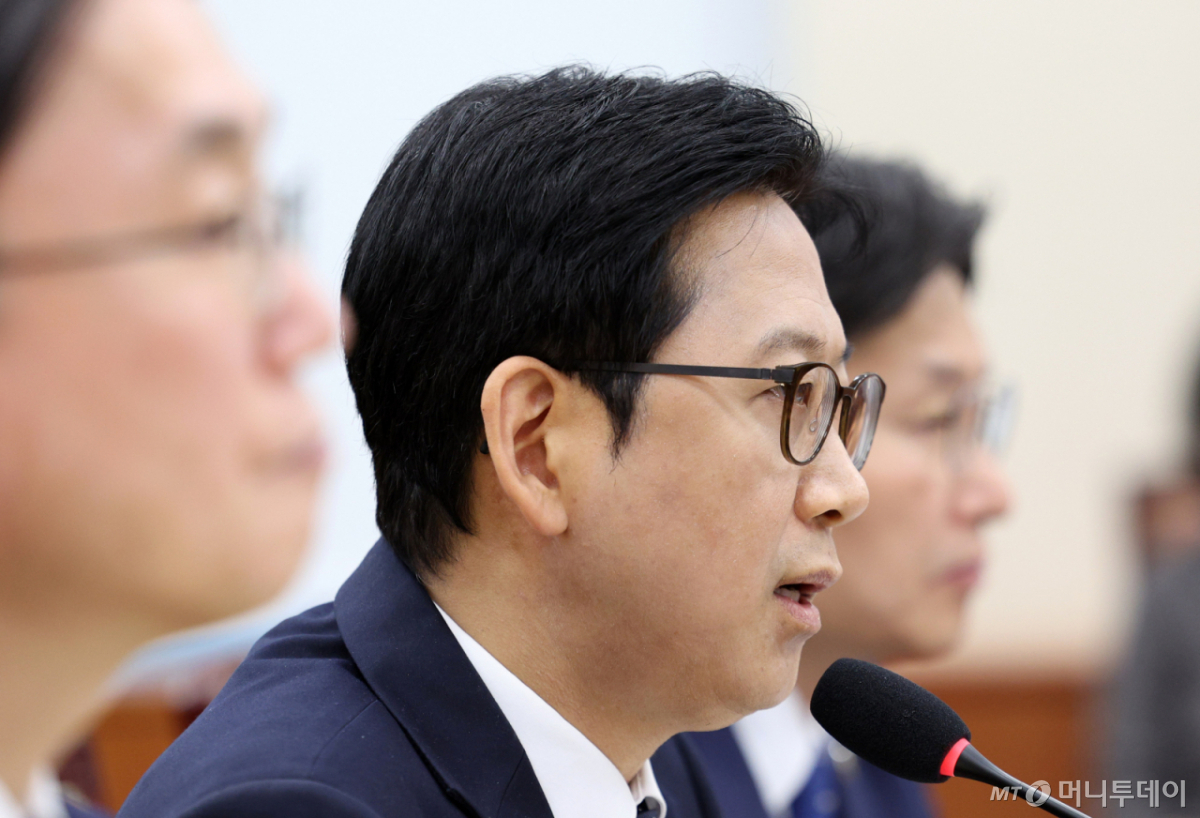
Deputy Prime Minister and Minister of Science and ICT Bae Kyung-hoon emphasized the need to accelerate the development of low-Earth-orbit communication satellites, referred to as a "Korean version of Starlink."
At the State Council meeting chaired by President Lee Jae-myung on the 20th, Deputy Prime Minister Bae stated, "While it is important to complete launch vehicle development within a short period, we must also accelerate the development of communication satellites." This remark was made during a report by the Korea Aerospace Administration on the results of the fifth Nuri rocket launch and future plans.
Deputy Prime Minister Bae said, "Currently, about 67 South Korean satellites are in space, most of which are observation satellites." He added, "Communication satellites are currently under development, with a goal to begin launching between 2030 and 2035, aiming for a minimum of 128 and a maximum of 512 units."
The National Space Committee approved an aerospace industry promotion strategy in July that includes plans to build a Korean low-Earth-orbit satellite communication network. It is currently reviewing three scenarios: launching 128 satellites at an altitude of 1,280 kilometers above Earth by 2035; launching 256 satellites at an altitude of 888 kilometers; and launching 512 satellites at an altitude of 1,280 kilometers.
Prior to this, one set of the 6G low-Earth-orbit communication satellite system is scheduled to be launched on a domestically produced launch vehicle in 2030. This is a verification system consisting of two communication satellites, a ground station, and a terminal station.
Deputy Prime Minister Bae noted, "However, while the microsatellite constellation launched on this Nuri rocket weighs 100 kilograms, each communication satellite weighs 500 kilograms." He added, "It is expected that next-generation launch vehicles will be able to carry up to 2.2 tons, but discussions are also underway regarding plans to increase the payload weight by approximately three times to reach 7 tons."
He further emphasized, "While it is important to complete launch vehicle development quickly within the designated period, we must also rapidly develop communication satellite technology simultaneously."
He also stated, "Arithmetically, it is not possible to launch 128 communication satellites at once, so there are limitations to relying solely on domestic launch vehicles," adding, "Cooperation with other countries is also necessary in this situation."
In response, President Lee Jae-myung said, "As seen in the war in Ukraine, the importance of satellite communication networks has grown. Accordingly, demand will increase significantly." He pointed out, "We need hundreds of satellites domestically, but are we only going to put 3 or 4 into space by 2030?"
Minister of National Defense Kang Shin-cheol replied, "In coordination with the Aerospace Administration, we plan to launch four microsatellite systems in 2031. Since the military is also developing solid-propellant launch vehicles, the launch cycle will become much shorter."
President Lee said, "South Korea's aerospace sector actually has far greater capabilities than what we currently perceive." He added, "Let us comprehensively gather opinions from each ministry, academia, and industry to greatly expand investment in this direction."

 in TECH
