

[For more diverse corporate information on the startups mentioned in this article, please visit the Unicorn Factory big data platform 'Data Lab'.]
"Pittsburgh, USA, which had been in decline due to the downturn of the steel industry, transformed into a high-tech industrial city through two pillars: robotics and artificial intelligence (AI) research at Carnegie Mellon University and the medical center of the University of Pittsburgh (UPMC). Autonomous driving companies established research institutes in Pittsburgh following university research teams, and many innovative companies, including language learning platform Duolingo, were also born from the universities."
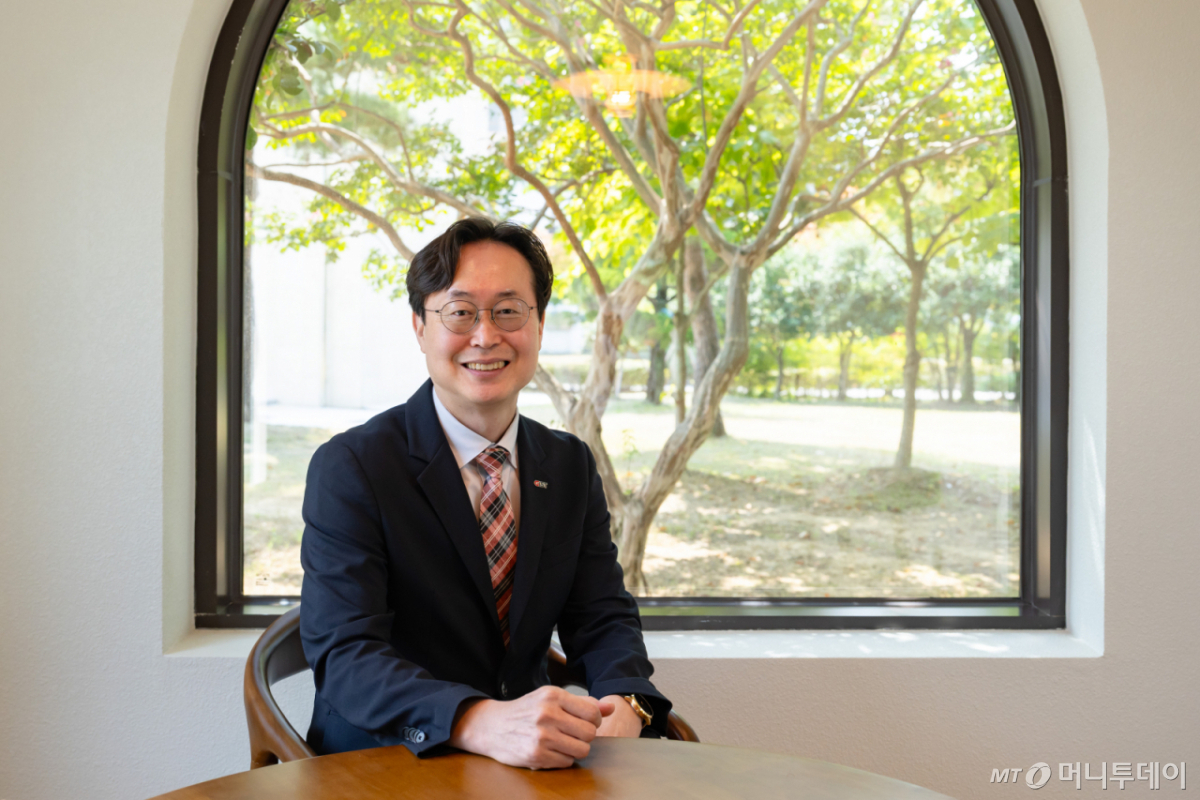
Kim Jae-gwan, the newly appointed director of the GIST Startup Innovation Promotion Institute, answered this way when asked to name the model he most wants to emulate. His judgment is that Gwangju already possesses sufficient elements and foundations necessary for deep tech startups, such as advanced research infrastructure at universities, excellent scientists, and university hospitals. Director Kim stated, "The 'MedTech Bridge' involving GIST and Chonnam National University Hospital was created with this kind of structure in mind," and explained his future blueprint in detail.
Director Kim is himself an entrepreneur. While researching biomedical engineering, he founded the sleep healthcare company "TeddyMedi" in 2021. Having experienced the field as both a researcher and an entrepreneur, he said he felt that research and entrepreneurship can develop each other. He noted, "Running a company actually made my research questions sharper," adding, "because I came to understand what patients and the market need." He further emphasized, "Entrepreneurship is not about stepping away from research, but rather a pathway for research to reach society."
The GIST Startup Innovation Promotion Institute was established by upgrading the Science and Technology Innovation Business Unit (GTI), which originated from the Startup Technology Support Center in 2000, into an institute. It consolidated the Technology Commercialization Center, Startup Promotion Center, and Startup Innovation Strategy Center under a single command structure. Director Kim explained, "It is important that the technology transfer organization and the startup organization are within the same framework," adding, "The goals of patent management and technology transfer no longer remain limited to recovering technology fees; they now look in the same direction as the growth of startup companies."
How will the division of roles work with GIST Holdings, the technology holding company launched earlier in 2024? Director Kim compared the relationship between the two organizations to a "base camp and climbing partner." The Promotion Institute discovers technologies and teams from laboratories and supports them through market validation, prototype production, and corporate establishment, while GIST Holdings continues with seed investment, follow-on investment, and scaling up.
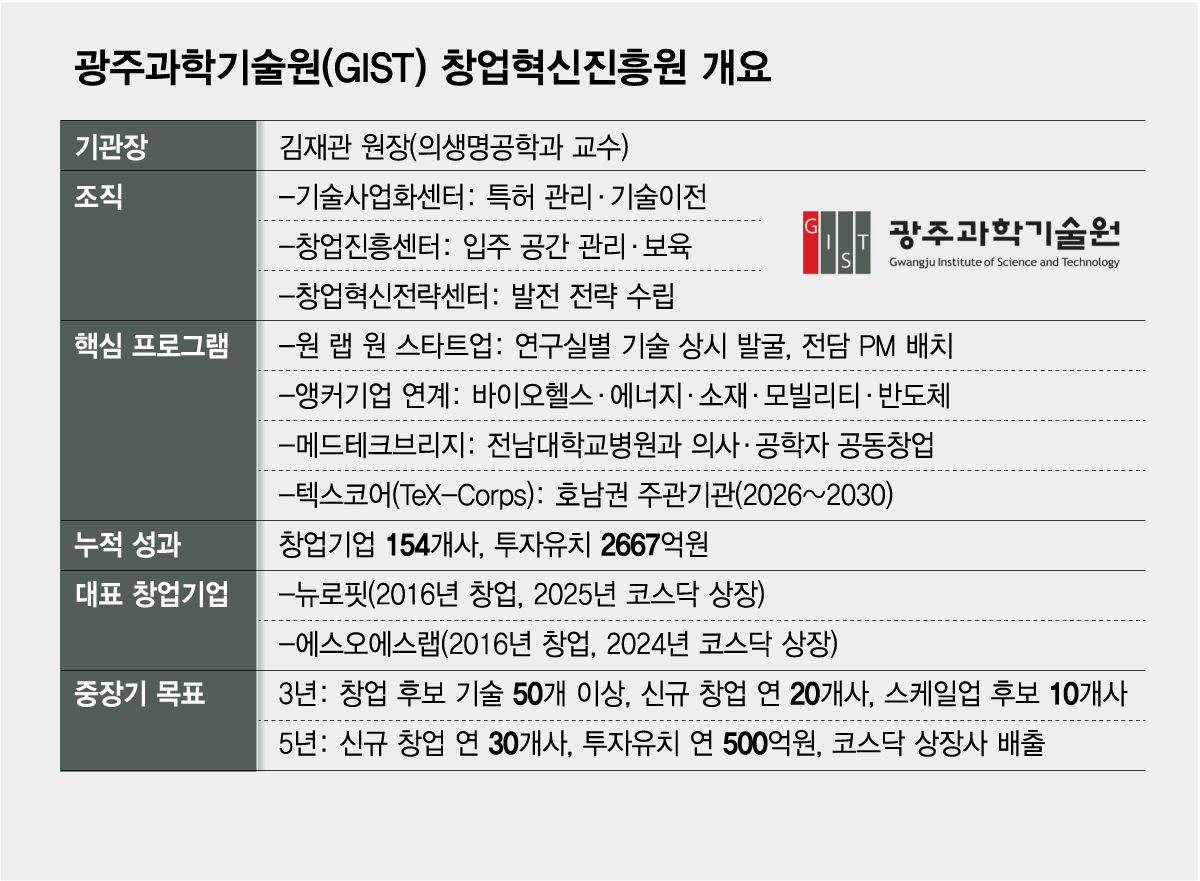
The Promotion Institute will pursue three strategies going forward. The first is "One Lab One Startup." It plans to continuously discover technologies with commercialization potential in each laboratory, assign dedicated PMs (Project Managers), and support them to lead to actual startups. Director Kim said, "This will be a method where related experts are fully deployed to connect laboratories and the market, moving away from the existing form where individual researchers judge commercialization potential and handle startup procedures alone."
The second is linkage with regional anchor companies. With AI as a common foundation, it will discover technology demand from large and public enterprises in the regions in the fields of biohealth, energy and materials, mobility, and semiconductors, connect laboratory technologies that match this demand, and promote validation. The third is the "MedTech Bridge" with Chonnam National University Hospital. It attempts a model where doctors and engineers collaborate to develop technology and co-found companies, starting from unmet medical needs in clinical settings.
GIST already has several cases demonstrating the potential of laboratory-based startups. Notably, NeuroPit, an AI company for brain diseases founded by current students in 2016, was listed on KOSDAQ last July. SOS Lab, a LiDAR company established by a doctoral program graduate in the same year, also entered KOSDAQ in 2024. GIST has cumulatively 154 startup companies, with total investment raised reaching 266.7 billion won.
However, the number of companies that have successfully listed remains few. Director Kim judges that it is difficult to achieve sustained results relying solely on the capabilities of some outstanding entrepreneurs. He stated, "With a structure where success only happens when an outstanding individual emerges, we cannot reach our goal of 30 unicorns."
Therefore, what the Promotion Institute aims to change includes not only the support method but also the criteria for evaluating performance. It plans to place more weight on indicators directly linked to corporate growth, such as the number of actual corporate conversions and private investment raised, rather than the number of recruited startup teams or the frequency of events.
In particular, Director Kim is emphasizing the scaling-up stage after startup. Even if laboratory startups lead to corporate establishment, it is difficult to achieve sustained growth if they fail in follow-on investment and securing initial customers. Director Kim noted, "The period where regional deep tech companies most often collapse is around Series A investment," adding, "We will support follow-on investment and the acquisition of first customers, and also connect validation and purchases with anchor companies." To this end, GIST signed a six-party memorandum of understanding last month with POSCO Holdings, KEPCO, Korea Energy Engineering University, and Jeonnam Startup Technology Holdings to discover and invest in promising companies in the secondary battery and energy sectors.
Along with this, the Promotion Institute and GIST Holdings plan to build a management talent pool centered on regional experienced professionals from large and public enterprises, connecting co-founders or professional managers to researcher startup teams. In particular, for the bio and medical device fields, where licensing/permits and insurance reimbursement strategies determine the success or failure of a business, they decided to prepare a separate specialized talent pool for support.
In its third year of operation, the Promotion Institute plans to secure more than 50 candidate technologies for laboratory-based startups, achieve 20 new startups per year, and reach 10 scaling-up companies as listing candidates. By its fifth year, it aims to increase new startups to 30 per year, with goals of 50 billion won in annual investment raised by startup companies and the production of a new KOSDAQ listed company. Director Kim stated, "We will create a structure where startup companies' technologies are first used in existing regional manufacturing sites, and graduates from regional universities work at those companies," adding, "We will definitely achieve a transition to a system that grows together with the region."
[Money Today Startup Media Platform Unicorn Factory]

 in TECH

